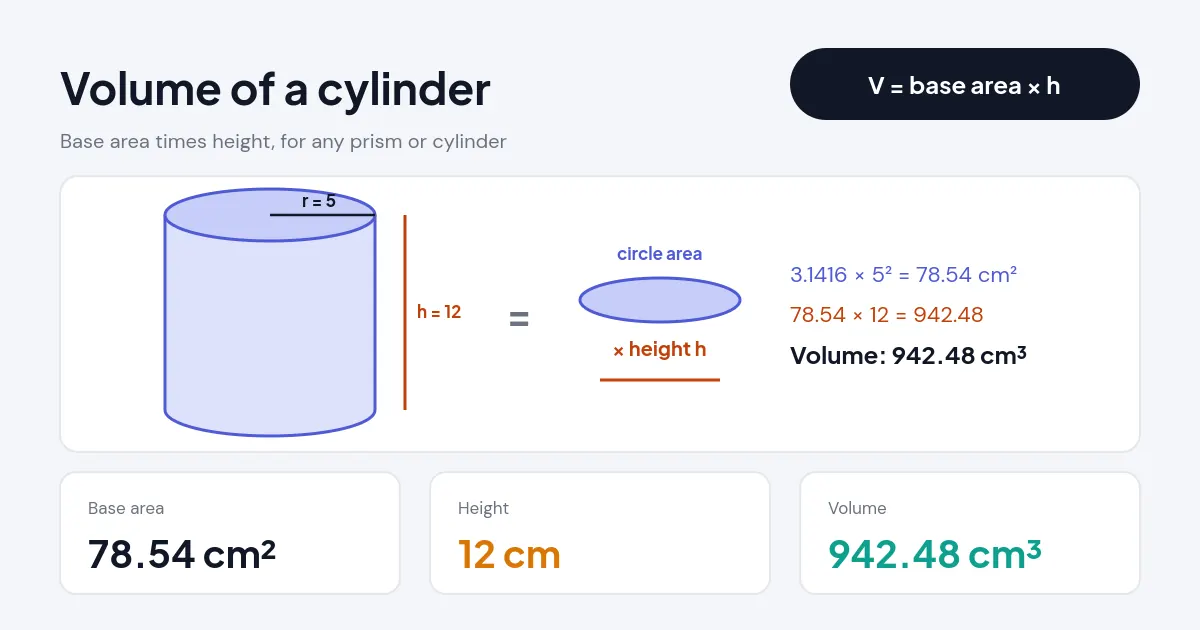
Quick answer: Volume is the space a 3D shape takes up, measured in cubic units. A volume calculator applies the right formula for the shape: a cylinder with radius 5 cm and height 12 cm holds V = πr²h = π × 25 × 12 ≈ 942.48 cm³, which is 0.94 litres. This tool covers 9 shapes and converts to litres and gallons.
What Does a Volume Calculator Work Out?
A volume calculator works out how much space a solid fills, or how much a container holds, from a few measurements. Choose a shape, type in its lengths, and the answer appears in cubic units of the length you used, together with litres, cubic metres, UK gallons and US gallons. The formula is printed underneath with your own numbers in it, so you can follow every step or copy the working into your exercise book.
It covers the 9 shapes that appear most often in GCSE questions and practical jobs: cube, cuboid, cylinder, cone, sphere, hemisphere, square-based pyramid, triangular prism and frustum. For a shipping box with dimensional weight, the box volume calculator goes further, and if you need to paint, wrap or line a shape rather than fill it, use the surface area calculator.
How Do You Use the Volume Calculator?

- Choose the shape, for example cylinder, cone or triangular prism.
- Choose the unit your measurements are in: millimetres, centimetres, metres, inches or feet.
- Enter the measurements asked for. Cones, pyramids and frustums need the vertical height, not the sloping edge.
- Set the number of decimal places you want.
- Read the volume in cubic units, then the litres, cubic metres and gallons underneath. Press Copy to keep the answer.
Keep every measurement in the same unit. If a tank is 1.2 m long but only 45 cm wide, convert one of them first, otherwise the answer will be out by a factor of 100.
What Are the Volume Formulas for Each Shape?
Every volume formula is built from one idea: a prism is the area of its cross-section multiplied by its length, and a shape that comes to a point holds one third of the matching prism.
Cylinder: V = πr²h Cone: V = ⅓πr²h
Sphere: V = ⁴⁄₃πr³ Hemisphere: V = ⅔πr³
Square-based pyramid: V = ⅓a²h Triangular prism: V = ½bh × L
Frustum: V = ⅓πh(R² + Rr + r²)
Worked example (sphere): a football has a radius of 11 cm. V = ⁴⁄₃ × π × 11³ = ⁴⁄₃ × π × 1,331 ≈ 5,575.28 cm³, or about 5.58 litres of air. Be careful to cube the radius, not the diameter; using 22 cm would give an answer 8 times too big.
Worked example (frustum): a plant pot is 10 cm tall with a bottom radius of 8 cm and a top radius of 5 cm (measure the narrow end as r and the wide end as R; the formula is the same either way up). V = ⅓ × π × 10 × (64 + 40 + 25) = ⅓ × π × 10 × 129 ≈ 1,350.88 cm³, so it takes about 1.35 litres of compost.
Worked example (triangular prism): a tent-shaped door wedge has a triangular end with base 8 cm and height 6 cm and is 20 cm long. The triangle is ½ × 8 × 6 = 24 cm², so V = 24 × 20 = 480 cm³.
How Much of a Box Does Each Shape Fill?
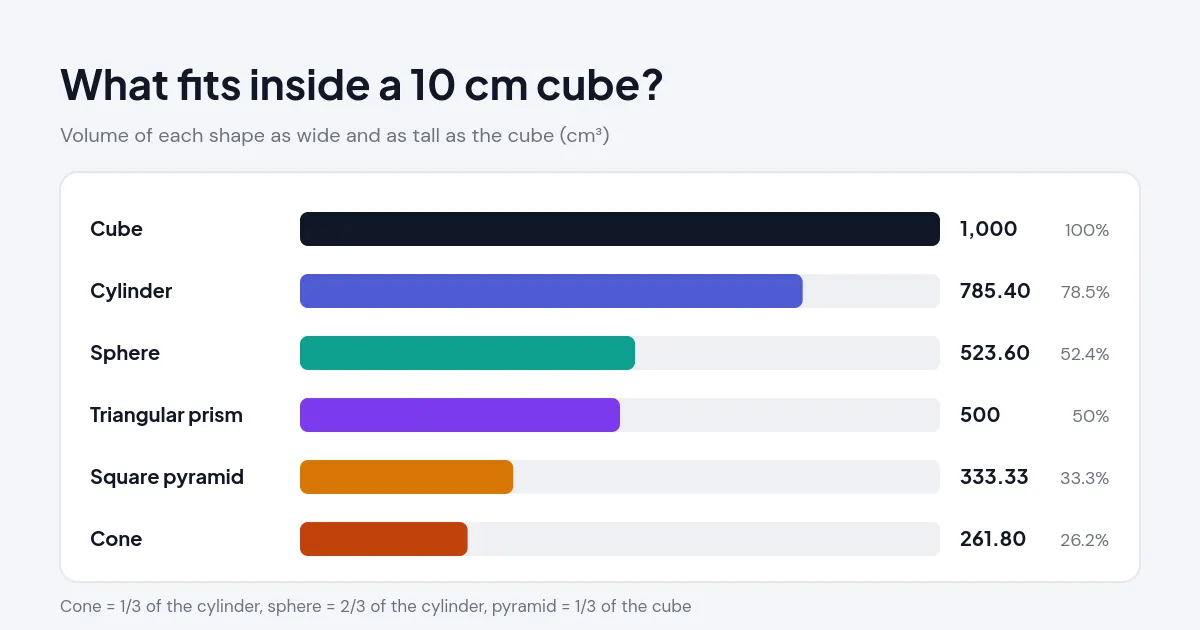
Fit each shape snugly inside a 10 cm cube and compare how much room it takes. The cube holds exactly 1 litre, and the other shapes fill a fixed fraction of it, which is a quick way to sense-check an answer.
| Shape (fits a 10 cm cube) | Formula with numbers | Volume | Share of the cube |
|---|---|---|---|
| Cube, a = 10 | 10³ | 1,000 cm³ (1 L) | 100% |
| Cylinder, r = 5, h = 10 | π × 5² × 10 | 785.40 cm³ | 78.5% (π/4) |
| Sphere, r = 5 | ⁴⁄₃ × π × 5³ | 523.60 cm³ | 52.4% (π/6) |
| Square-based pyramid, a = 10, h = 10 | ⅓ × 10² × 10 | 333.33 cm³ | 33.3% (⅓) |
| Cone, r = 5, h = 10 | ⅓ × π × 5² × 10 | 261.80 cm³ | 26.2% (π/12) |
| Triangular prism, b = 10, h = 10, L = 10 | ½ × 10 × 10 × 10 | 500 cm³ | 50% |
Two patterns stand out. A cone is exactly one third of the cylinder around it (261.80 × 3 = 785.40), and a sphere is exactly two thirds of that same cylinder (523.60 ÷ 785.40 = ⅔), the result Archimedes was proudest of. If your cone comes out larger than the cylinder it sits in, a radius has been squared incorrectly somewhere.
How Do You Convert Volume to Litres and Gallons?
To convert a volume to litres, use the fact that 1 litre is exactly 1,000 cm³ and 1 m³ is 1,000 litres. So 942.48 cm³ is 0.94 litres, and a water butt measuring 0.21 m³ holds 210 litres. Converting between cubic units means cubing the length factor: 1 m = 100 cm, so 1 m³ = 100³ = 1,000,000 cm³, not 100.
The UK gallon is defined in the Weights and Measures Act 1985 as exactly 4.54609 litres, while the US gallon is 3.785411784 litres, so the same tank shows about 20% more US gallons than UK gallons. The calculator gives both, which helps with American product listings and recipes. For quick swaps between the two systems, the litre to gallon converter and the cubic feet calculator handle single values.
Volume of cuboids, prisms, cylinders, pyramids, cones and spheres is listed in the Department for Education GCSE mathematics subject content, and exam papers usually give the formulas for the cone and the sphere on the question itself. Learning the prism rule (cross-section × length) means you only have to remember two ideas instead of nine formulas.
Related Tools
- Box Volume Calculator
- Cone Volume Calculator
- Surface Area Calculator
- Circumference Calculator
- Density Calculator
- Pool Volume Calculator
Want the formulas written out? Our guide covers volume formulas for cubes, cylinders, cones and spheres, each with a worked example.
Frequently asked questions
How do you calculate volume?
Multiply the area of the cross-section by the length for any prism or cylinder. For a cone or pyramid, take one third of that. A cuboid 30 cm by 20 cm by 15 cm has a volume of 9,000 cm³.
What units is volume measured in?
Cubic units such as mm³, cm³ or m³, because three lengths are multiplied together. Liquid capacity is often given in millilitres and litres, where 1 ml = 1 cm³.
How many litres are in a cubic metre?
There are exactly 1,000 litres in 1 m³. A cube 1 m on each side would hold a tonne of water.
What is the volume of a cylinder?
V = πr²h. A cylinder with radius 5 cm and height 12 cm holds π × 25 × 12 ≈ 942.48 cm³, just under a litre.
Do I use the slant height for a cone or pyramid?
No. Volume uses the vertical height, measured straight up from the centre of the base to the tip. The slant height is only needed for surface area.
How do I find the volume of an irregular object?
Lower it into a measuring jug of water and read how far the level rises. The rise in millilitres equals the object's volume in cm³.