How to use the limit calculator
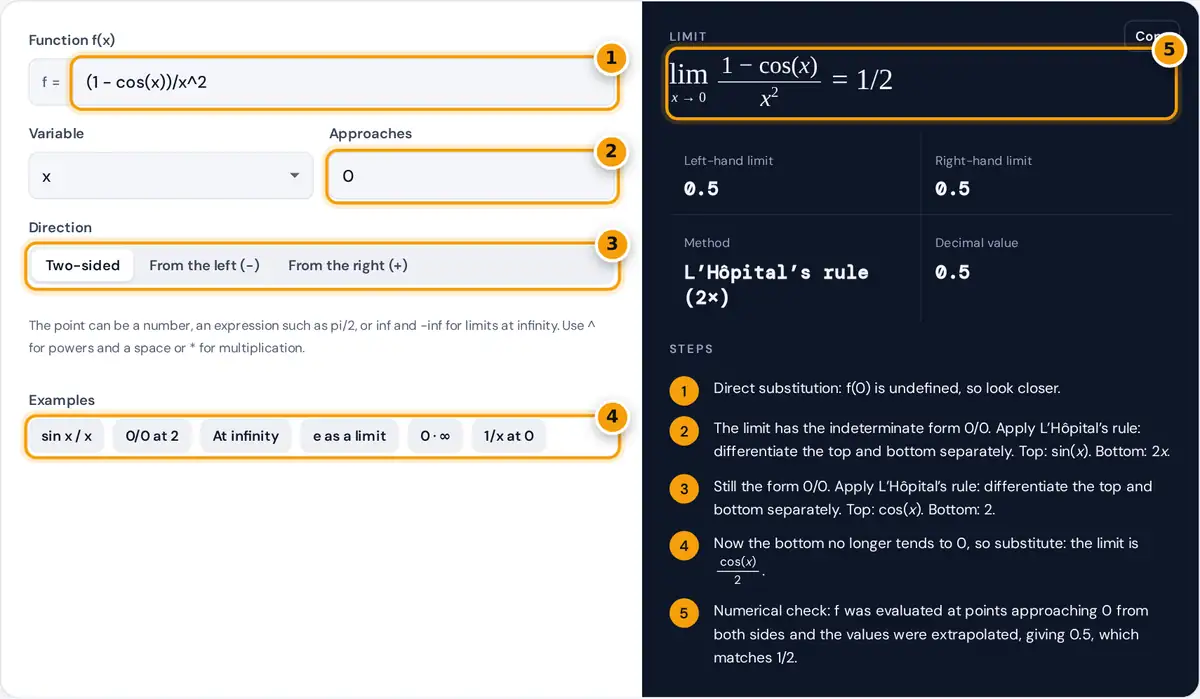
- Type your function, for example (1 - cos(x))/x^2 or sin(x)/x.
- Enter the value x approaches: a number, pi/2, inf or -inf.
- Choose a two-sided limit or a left or right one-sided limit.
- Or tap an example to see how indeterminate forms are solved.
- Read the exact limit, then follow the steps and the numeric check.
Type the function, choose the variable and enter the value it approaches. The point can be a number, an expression such as pi/2, or inf and -inf for limits at infinity. Choose two-sided, left-hand or right-hand. The result panel shows the limit, both one-sided limits and the method used, and the steps explain how the answer was found.
The calculator first tries direct substitution. If that gives an indeterminate form such as 0/0 or ∞/∞, it applies L'Hôpital's rule using symbolic derivatives from the open-source nerdamer library. Every answer is then checked numerically: the function is evaluated at points closer and closer to the target from each side, and the values are extrapolated to the limit. If the symbolic and numerical answers do not agree, the exact form is not shown.
What a limit is
The limit of f(x) as x approaches a is the value f(x) gets arbitrarily close to when x gets close to a, without needing x to equal a. The two-sided limit exists only when the left-hand limit (x → a−) and the right-hand limit (x → a+) exist and are equal.
L'Hôpital's rule: if f/g gives 0/0 or ∞/∞, then lim f/g = lim f′/g′
Worked examples
A 0/0 form needing L'Hôpital's rule twice
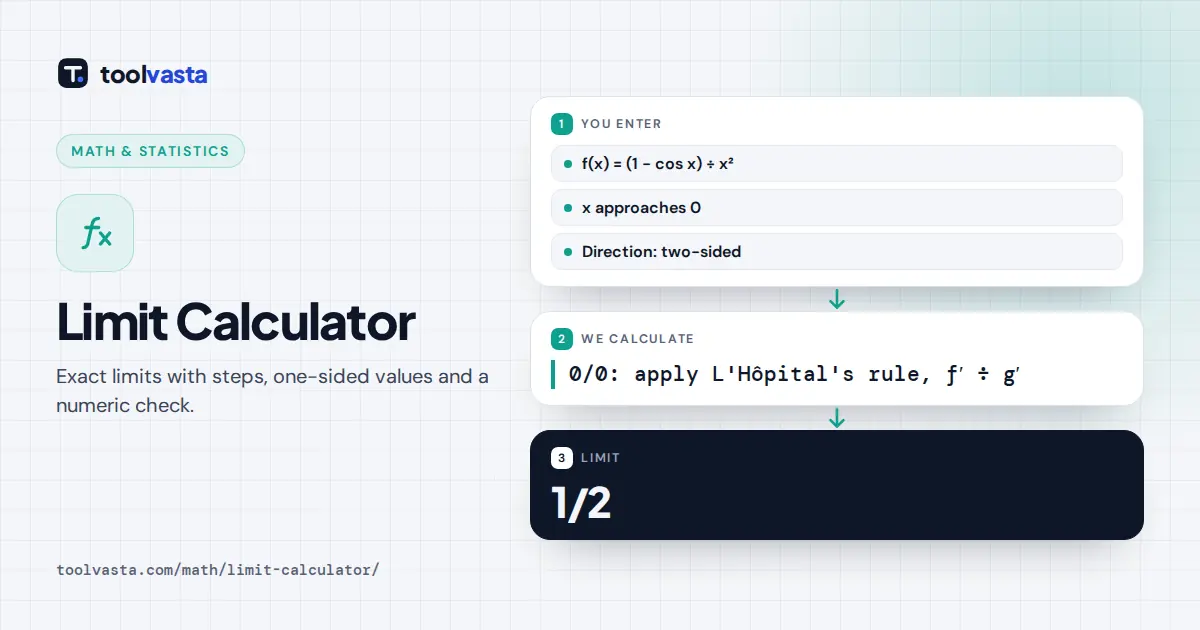
Find the limit of (1 − cos x)/x² as x → 0. Substituting gives 0/0. Differentiating the top and bottom gives sin x / 2x, which is still 0/0. Differentiating again gives cos x / 2, and substituting x = 0 gives 1/2. Numerically, at x = 0.001 the function equals 0.49999996, which agrees.
A limit at infinity
For (3x² + 2)/(5x² − x) as x → ∞, both top and bottom grow without bound. Dividing every term by x², or applying L'Hôpital's rule twice, gives 6/10 = 3/5 = 0.6.
A limit that does not exist
For 1/x as x → 0, the right-hand limit is +∞ and the left-hand limit is −∞. Because they differ, the two-sided limit does not exist.
Indeterminate forms
| Form | Example | Typical approach |
|---|---|---|
| 0/0 | sin x / x at 0 | L'Hôpital's rule, factoring, or a known limit |
| ∞/∞ | (3x² + 2)/(5x² − x) at ∞ | Divide by the highest power or L'Hôpital |
| 0 · ∞ | x ln x at 0+ | Rewrite as a quotient, then L'Hôpital |
| 1∞ | (1 + 1/x)x at ∞ | Take logarithms; the answer here is e |
| ∞ − ∞ | √(x² + x) − x at ∞ | Combine into one fraction or rationalize |
Notes and limits
Limits of the forms 1∞, ∞ − ∞ and 00 are found numerically, and when the value matches a simple number such as 1/4, π/2 or e to about 11 digits, that exact form is shown. Functions that approach their limit very slowly, such as 1/ln x, give fewer reliable digits, and the steps say so. Piecewise functions and limits of sequences defined by recursion are not supported. ln(x) and log(x) both mean the natural logarithm.
Frequently asked questions
How do you find a limit?
Start by substituting the value. If you get a real number and the function is continuous there, that is the limit. If you get 0/0 or ∞/∞, simplify the expression or use L'Hôpital's rule, then substitute again.
What is L'Hôpital's rule?
If f(x)/g(x) gives 0/0 or ∞/∞ at the point, the limit equals the limit of f′(x)/g′(x), provided that limit exists. You may need to apply it more than once.
When does a limit not exist?
A two-sided limit does not exist when the left-hand and right-hand limits differ, when the function oscillates without settling, as sin(1/x) does near 0, or when it is unbounded with different signs on each side.
What is the limit of sin(x)/x as x approaches 0?
It is 1. This is one of the most important limits in calculus and is used to prove that the derivative of sin x is cos x.
Can the limit be infinity?
Yes. If f(x) grows without bound as x approaches the point, the limit is written as ∞ or −∞. Strictly, this means the limit does not exist as a real number, but it describes how the function behaves.