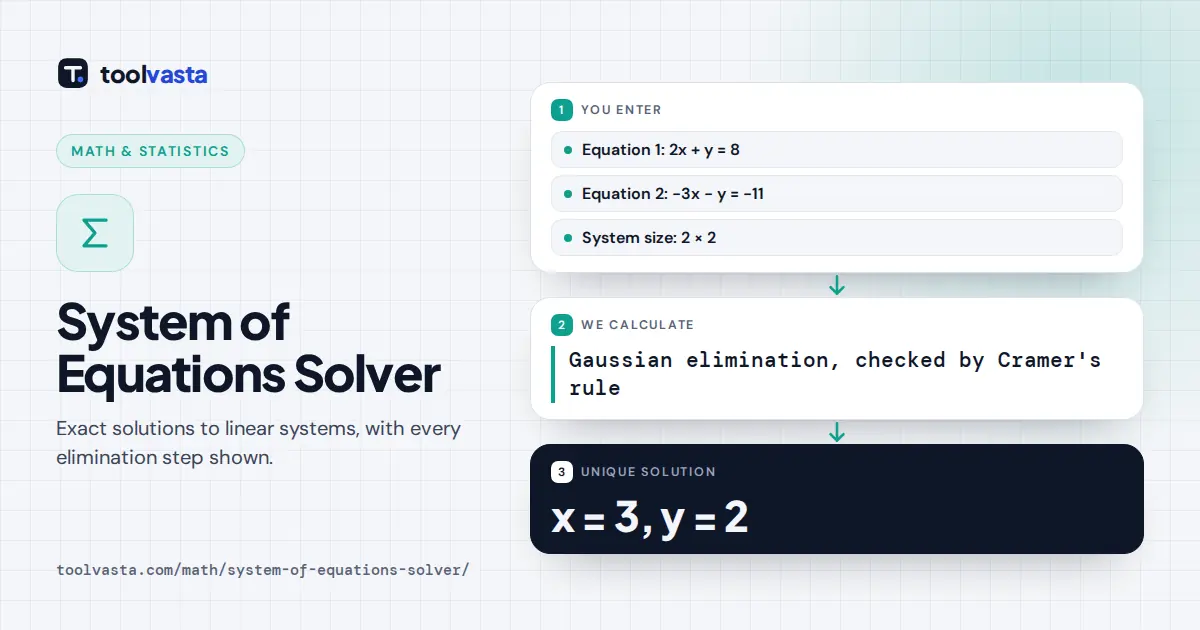
How to Use the System of Equations Solver
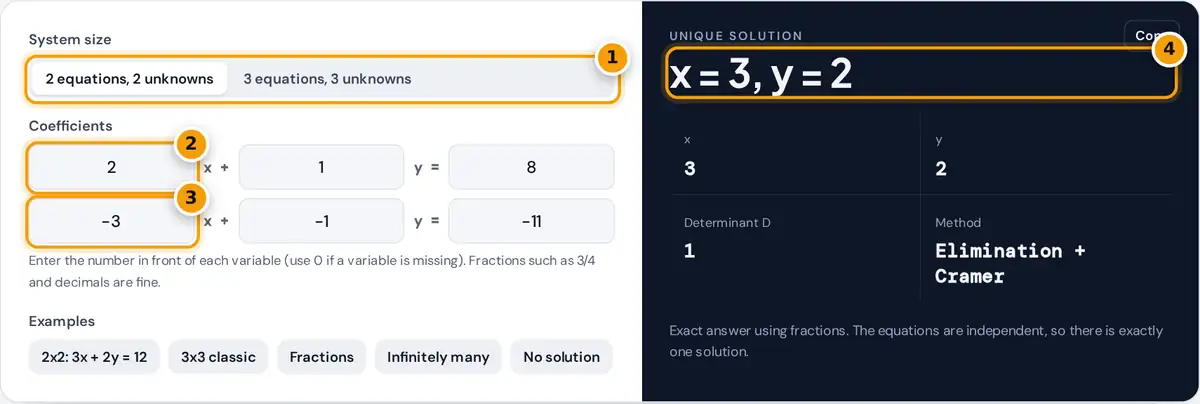
- Choose 2 equations with 2 unknowns or 3 equations with 3 unknowns.
- Enter the coefficients of the first equation and the number after the equals sign.
- Enter the second equation the same way. Use 0 for a missing variable.
- Read the solution, then follow the elimination steps and the check below.
Choose 2 equations with 2 unknowns or 3 equations with 3 unknowns, then type the coefficient in front of each variable and the constant on the right-hand side. Enter a 0 for any missing variable.
Fractions such as 3/4 and decimals such as 0.25 are accepted and converted to exact fractions, so the answer is exact. The example buttons load ready-made systems, including ones that have no single unique solution.
The result shows the solution, or tells you the system has no solution or infinitely many. Below the tool you can follow each step of elimination, see Cramer's rule and check the answer by substitution.
Gaussian Elimination Step by Step
Write the system of linear equations as an augmented matrix [A | b], where A holds the coefficients and b holds the constants. Each row of the matrix stands for one equation in the original system.
a₂x + b₂y + c₂z = d₂
a₃x + b₃y + c₃z = d₃
Cramer's rule: x = Dx/D, y = Dy/D, z = Dz/D, where D = det(A)
Then use the three row operations, none of which change the solutions: swap two rows, multiply a row by a nonzero number, and add a multiple of one row to another row of the matrix.
The goal is the reduced row echelon form, where the left side becomes the identity matrix and the right column holds the answer. This full version is often called Gauss-Jordan elimination in many algebra textbooks.
Worked Example: A 3×3 System
Solve 2x + y − z = 8, −3x − y + 2z = −11 and −2x + y + 2z = −3. Divide row 1 by 2, then add multiples of it to rows 2 and 3 to clear the whole x column.
Use the new row 2 to clear the y column, then row 3 for the z column. The reduced matrix gives x = 2, y = 3 and z = −1 as the unique solution of this system.
- Check equation 1: 2(2) + 3 − (−1) = 8
- Check equation 2: −3(2) − 3 + 2(−1) = −11
- Check equation 3: −2(2) + 3 + 2(−1) = −3
With Cramer's rule, the determinant of the coefficient matrix is D = −1, while Dx = −2, Dy = −3 and Dz = 1. Dividing each by D gives exactly the same three values found above.
Solving a 2×2 System
For two equations in two unknowns, take 3x + 2y = 12 and x − y = −1. Substitution solves the second equation for x, giving x = y − 1, and then substitutes that expression into the first original equation.
That gives 3(y − 1) + 2y = 12, so 5y = 15 and y = 3, and then x = 2. The elimination method reaches the same point by adding twice the second equation to the first, which cancels y.
Cramer's rule is quickest here. The determinant is a₁b₂ − a₂b₁, which is 3(−1) − 1(2) = −5, and each variable is its own determinant divided by −5. On a graph the two lines cross at (2, 3).
How Many Solutions Can a System Have?
Every linear system has exactly one solution, no solution or infinitely many solutions. Elimination tells you which case you have, and the calculator labels the result clearly before showing any of the working steps below.
| What elimination shows | Solutions | Geometry (2 unknowns) |
|---|---|---|
| A pivot in every column | Exactly one | Lines cross at one point |
| A row reading 0 = nonzero | None | Parallel lines |
| Fewer pivots than unknowns, no contradiction | Infinitely many | The same line twice |
A row that reads 0 = 4 is a contradiction, so the system is inconsistent and has no solution. For example, 2x + 4y = 6 and x + 2y = 5 describe two parallel lines that never actually meet.
When there are infinitely many solutions, the calculator sets each free variable equal to a parameter, t or s, and writes the other variables using it. The OpenStax College Algebra chapter explains these cases graphically.
When to Use Cramer's Rule
Cramer's rule is very quick for 2×2 systems and handy for 3×3 systems, especially when you only need one variable. Each unknown is a ratio of two determinants, so the method suits small systems best.
It works only when the determinant D is not zero. If D is zero, the system has either no solution or infinitely many, and only elimination can tell you which of the two it is.
Elimination works for every system, which is why the calculator always shows both methods together. For larger matrices, the free MIT OpenCourseWare linear algebra course shows why elimination is the standard approach used in practice.
Exact Fractions and Other Notes
All arithmetic uses exact fractions with whole numbers of any size, so there is never any rounding error. Decimals you type are read exactly, so 0.1 means 1/10 and stays exact through every single step.
Fractions work as well as whole numbers. A system such as x/2 + y/3 = 4 and 2x/3 − y/4 = 1 gives x = 96/25 and y = 156/25, shown as exact fractions with a decimal approximation beside each one.
This solver handles linear equations only. Products of variables, powers or functions of x are not supported, so nonlinear systems need a different method, such as careful substitution by hand or a graphing calculator tool.
Frequently asked questions
How do you solve a system of equations?
Use substitution, elimination or matrices. Elimination adds multiples of one equation to another to remove a variable, step by step, until each equation has one unknown. The calculator shows this as row operations on a matrix.
What does it mean if a system has no solution?
The equations contradict each other. In two variables the lines are parallel and never meet. Elimination produces a row that reads 0 = a nonzero number, which no values of the variables can satisfy.
When does a system have infinitely many solutions?
When at least one equation is a combination of the others, so after elimination there are fewer independent equations than unknowns and no contradiction. The solutions can be written using a free parameter such as t.
What is Cramer's rule?
A formula that gives each unknown as a ratio of determinants: x = Dx/D, where D is the determinant of the coefficient matrix and Dx replaces the x column with the constants. It needs D to be nonzero.
What is an augmented matrix?
An augmented matrix writes a system as a grid of coefficients with an extra column for the constants on the right-hand side. Each row is one equation, and row operations on it mirror operations on the equations.
Can I use fractions and decimals?
Yes. Type values such as 3/4, -2/5 or 0.125. They are converted to exact fractions, and the answer is given as an exact fraction with a decimal approximation beside it.