How to use the fraction calculator
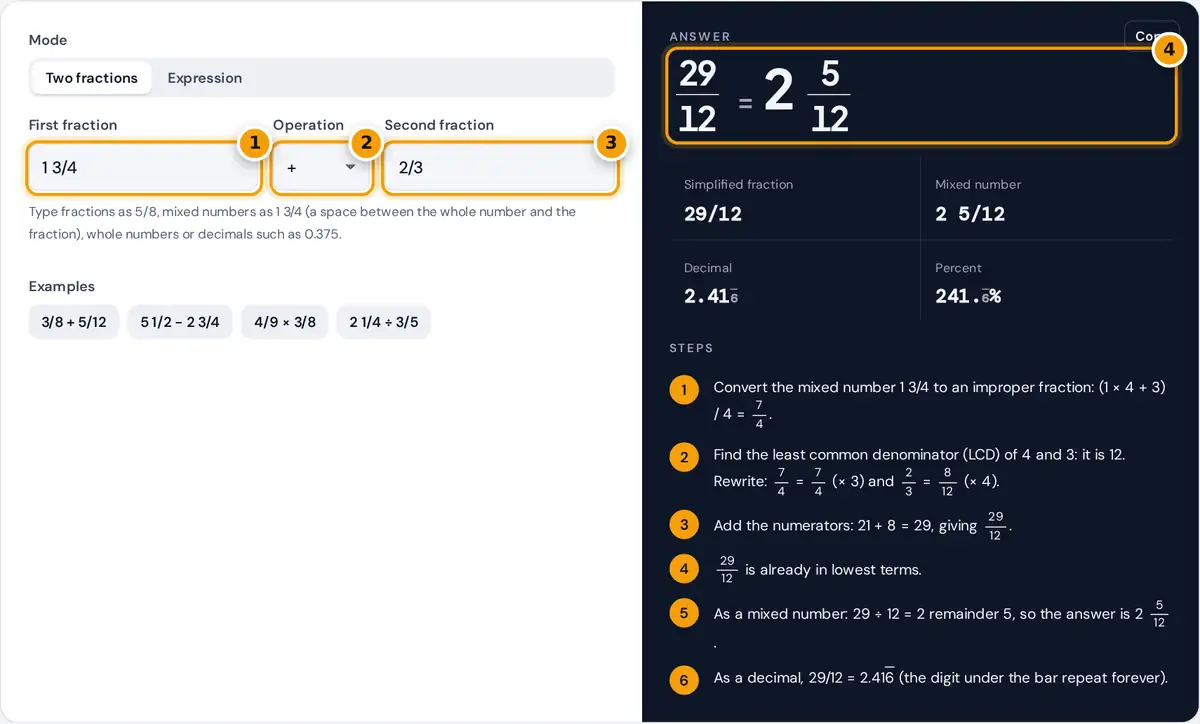
- Type the first fraction, mixed number (1 3/4), whole number or decimal.
- Choose add, subtract, multiply or divide.
- Type the second fraction or mixed number.
- Read the answer as a fraction and mixed number, then follow the steps below.
Enter two fractions, choose an operation and the answer appears instantly as a simplified fraction, a mixed number, a decimal and a percentage. Type a fraction as 5/8, a mixed number as 1 3/4 with a space between the whole number and the fraction, and negative values with a minus sign, such as -2 1/2. Whole numbers and decimals such as 0.375 also work.
Switch to Expression mode to evaluate a longer calculation such as 1/2 + 3/4 × (2 1/3 − 5/6). The calculator follows the order of operations and lists each intermediate result. All arithmetic is exact, using whole-number fractions of any size, so there is no rounding error.
Rules for fraction arithmetic
a/b − c/d = (ad − bc) / bd
a/b × c/d = ac / bd
a/b ÷ c/d = a/b × d/c = ad / bc
To add or subtract, the fractions need a common denominator. The least common denominator (LCD) is the least common multiple of the denominators, and it keeps the numbers small. To multiply, multiply straight across. To divide, flip the second fraction and multiply. Finally, simplify by dividing the numerator and denominator by their greatest common divisor.
Worked examples
Adding a mixed number and a fraction
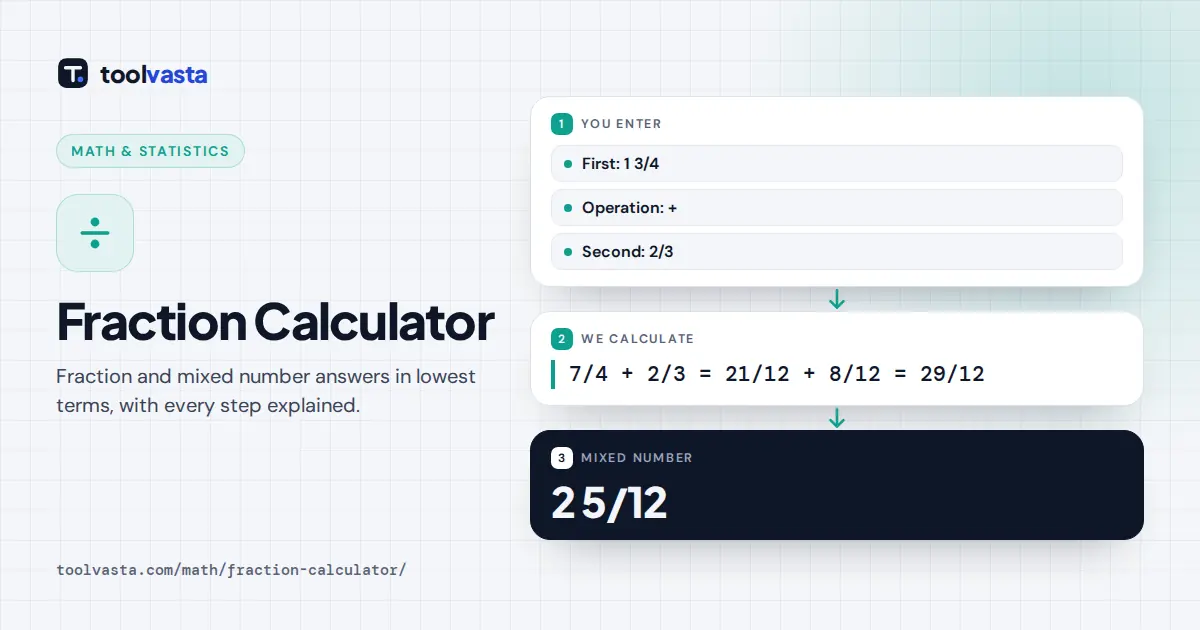
1 3/4 + 2/3: first convert 1 3/4 to (1 × 4 + 3)/4 = 7/4. The LCD of 4 and 3 is 12, so 7/4 = 21/12 and 2/3 = 8/12. Adding the numerators gives 29/12, which is already in lowest terms. As a mixed number, 29 ÷ 12 = 2 remainder 5, so the answer is 2 5/12 = 2.41666…
Dividing fractions
2 1/4 ÷ 3/5: convert 2 1/4 to 9/4, then multiply by the reciprocal 5/3. That gives 45/12, and dividing top and bottom by 3 simplifies it to 15/4 = 3 3/4 = 3.75.
Mixed numbers and improper fractions
| Mixed number | Improper fraction | Decimal |
|---|---|---|
| 1 1/2 | 3/2 | 1.5 |
| 2 3/4 | 11/4 | 2.75 |
| 3 1/3 | 10/3 | 3.333… |
| 5 5/8 | 45/8 | 5.625 |
To turn a mixed number into an improper fraction, multiply the whole number by the denominator and add the numerator. To go back, divide the numerator by the denominator: the quotient is the whole number and the remainder is the new numerator.
Terminating and repeating decimals
A fraction in lowest terms gives a terminating decimal only when its denominator has no prime factors other than 2 and 5. Otherwise the decimal repeats forever, and the calculator marks the repeating block with a bar. For example, 5/12 = 0.41666…, shown as 0.416.
Notes
Decimals you type are converted to exact fractions, so 0.1 is treated as exactly 1/10. In expression mode, powers must be whole numbers so that the answer stays a fraction. Very long repeating decimals are cut off after 60 digits in the display, but the fraction result is always exact.
Frequently asked questions
How do you add fractions with different denominators?
Rewrite both fractions with a common denominator, usually the least common multiple of the two denominators, then add the numerators and simplify. For 1/4 + 1/6, the LCD is 12, so 3/12 + 2/12 = 5/12.
How do you divide fractions?
Keep the first fraction, change division to multiplication and flip the second fraction. Then multiply across and simplify: 3/4 ÷ 2/5 = 3/4 × 5/2 = 15/8.
How do I enter a mixed number?
Type the whole number, a space, then the fraction, for example 2 3/8. For a negative mixed number, put the minus sign in front: -2 3/8.
How do you simplify a fraction?
Divide the numerator and the denominator by their greatest common divisor. For 18/24 the GCD is 6, so it simplifies to 3/4.
How do you turn an improper fraction into a mixed number?
Divide the numerator by the denominator. The whole-number result is the whole part and the remainder goes over the original denominator: 29/12 = 2 5/12.