How to Use the Moment of Inertia Calculator
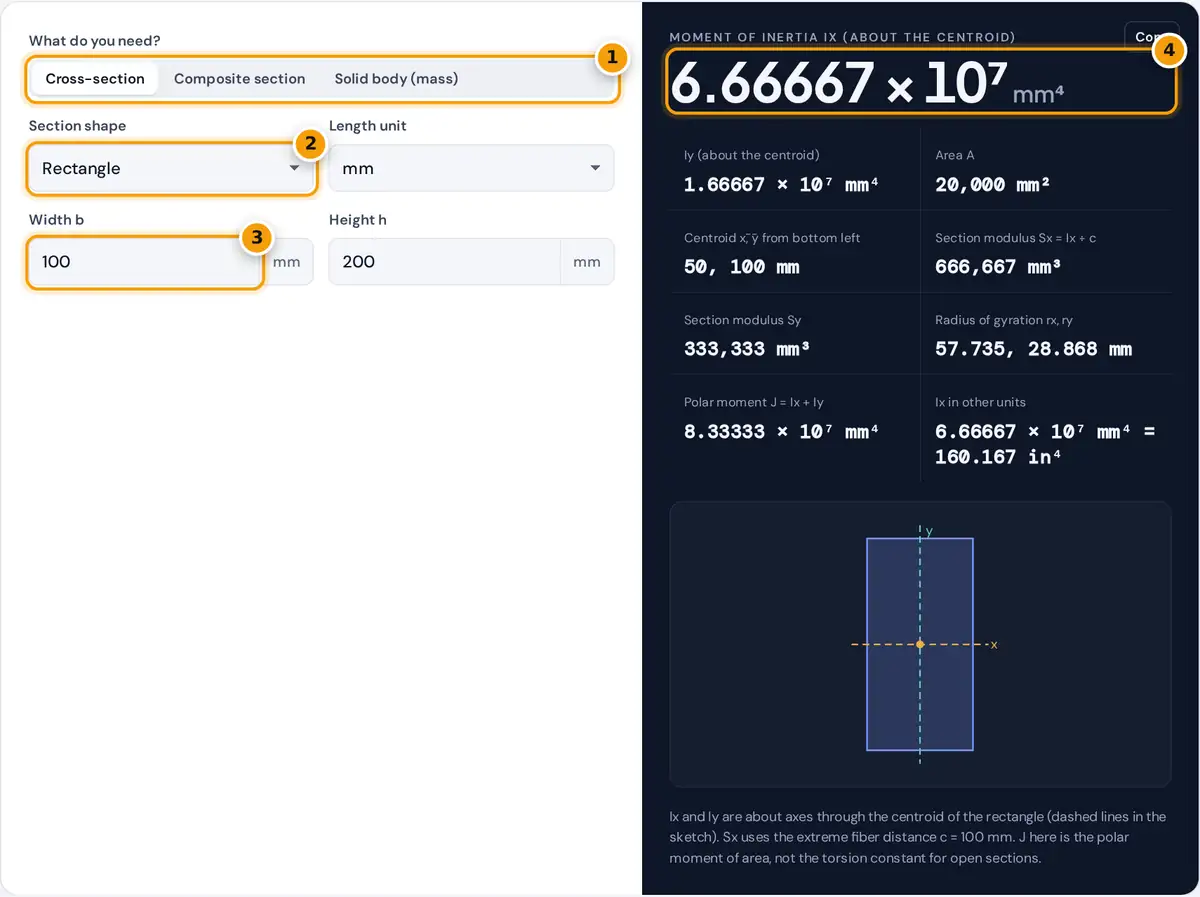
- Choose a standard cross-section, a composite of rectangles, or a solid body for mass moment.
- Pick the shape and the length unit.
- Enter the dimensions shown for that shape.
- Read Ix, then Iy, area, centroid, section modulus and radius of gyration.
Choose one of three modes. Cross-section gives the second moment of area of a standard shape: rectangle, box, solid circle, tube, triangle, I-beam, T-section, C-channel or angle. Composite section lets you build any shape from rectangles and subtract holes. Solid body gives the mass moment of inertia used in rotational dynamics.
Pick a length unit and enter the dimensions shown. The result panel gives Ix and Iy about the centroid, the area, the centroid position, the elastic section moduli, the radii of gyration and the polar moment, plus Ix in mm⁴ and in⁴. The sketch draws the shape to scale with the centroidal axes dashed.
In composite mode, describe each rectangle by its width, height and the position of its bottom left corner. The table lists every part’s own moment and its parallel axis term, so you can check the working line by line.
Formulas for Common Sections
| Section | Ix about the centroid | Iy about the centroid |
|---|---|---|
| Rectangle b × h | bh³/12 | hb³/12 |
| Solid circle, diameter d | πd⁴/64 | πd⁴/64 |
| Tube, outer D, inner d | π(D⁴ − d⁴)/64 | same |
| Triangle, base b, height h | bh³/36 | hb³/48 (isosceles) |
| Symmetric I-beam | [BH³ − (B − tw)(H − 2tf)³]/12 | [2tf·B³ + (H − 2tf)tw³]/12 |
Section modulus is S = I ÷ c, where c is the distance from the centroidal axis to the extreme fiber. For unsymmetric sections such as a T, the calculator uses the larger distance, which gives the smaller modulus and the higher bending stress. The radius of gyration is r = √(I ÷ A).
The Parallel Axis Theorem
Composite: ȳ = ΣAᵢȳᵢ ÷ ΣAᵢ, then Ix = Σ(Iᶜᵢ + Aᵢ(ȳᵢ − ȳ)²)
The theorem moves a moment of inertia from an axis through the centroid to any parallel axis a distance d away. To analyze a built-up section, find the overall centroid, then add each part’s own moment and its A·d² term. Holes are handled by subtracting both their area and their moment.
Worked Example: T-Section
A T-section has a 150 × 20 mm flange on top of a 20 × 180 mm web, 200 mm deep overall. The flange area is 3,000 mm² with its centroid 190 mm from the bottom, and the web area is 3,600 mm² with its centroid at 90 mm.
- Centroid: ȳ = (3,000 × 190 + 3,600 × 90) ÷ 6,600 = 135.4545 mm.
- Flange: 150 × 20³/12 + 3,000 × (190 − 135.4545)² = 100,000 + 8,925,620 mm⁴.
- Web: 20 × 180³/12 + 3,600 × (90 − 135.4545)² = 9,720,000 + 7,438,017 mm⁴.
- Total: Ix = 26,183,636 mm⁴, or 2.6184 × 10⁷ mm⁴. The smaller section modulus is Ix ÷ 135.4545 = 193,302 mm³.
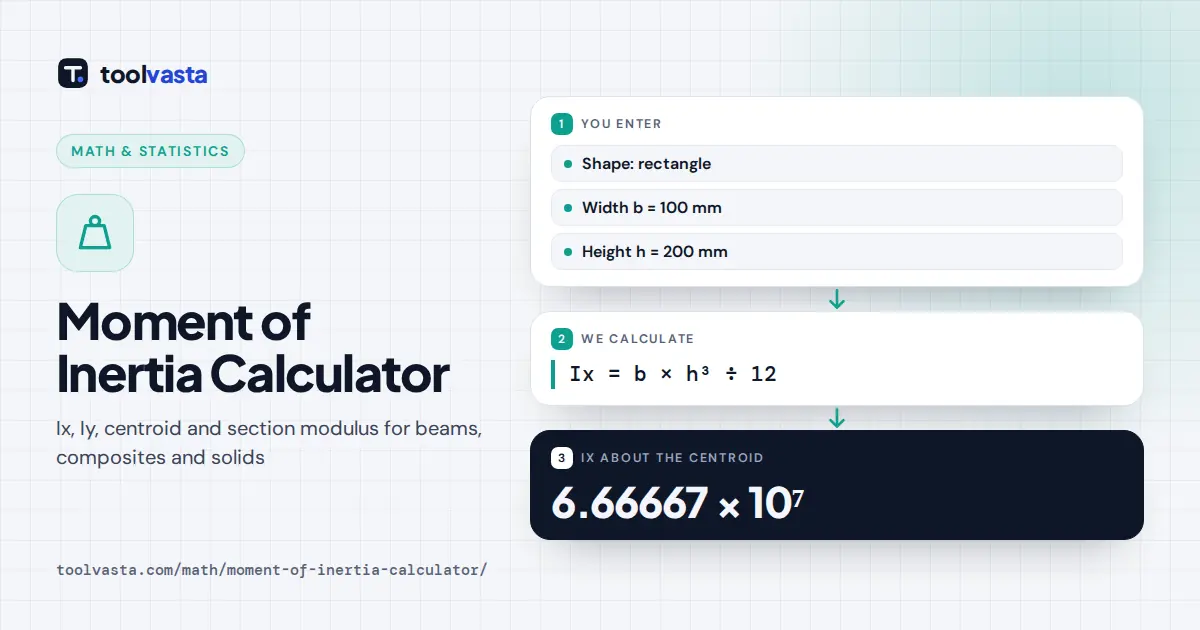
The default composite example builds exactly this T from two rectangles, and the T-section shape gives the same answer. For a 100 × 200 mm rectangle, bh³/12 = 6.6667 × 10⁷ mm⁴.
Mass Moment of Inertia
In dynamics, the moment of inertia measures resistance to angular acceleration: torque = I × angular acceleration. It has units of kg·m². A solid disk of mass 2 kg and radius 0.1 m has I = ½ × 2 × 0.1² = 0.01 kg·m². Moving the axis 0.2 m away adds m·d² = 0.08, giving 0.09 kg·m². A 1.2 kg rod 1.5 m long, swung from one end, has I = ⅓ × 1.2 × 1.5² = 0.9 kg·m².
Units and Conversions
Second moments of area scale with the fourth power of length, so unit conversions grow quickly: 1 cm⁴ = 10,000 mm⁴, 1 in⁴ = 416,231 mm⁴, and 1 m⁴ = 10¹² mm⁴. The calculator shows Ix in both mm⁴ and in⁴ to avoid conversion slips. Large values are written in scientific notation, so 6.66667 × 10⁷ mm⁴ means 66,666,667 mm⁴.
Tips and Limits
- Second moment of area (unit length⁴) governs beam bending and deflection. Mass moment of inertia (mass × length²) governs rotation. They are different quantities that share a name.
- Rolled steel sections have root fillets that add a little area. Use the manufacturer’s table for design values.
- Ix and Iy for the angle are about centroidal axes parallel to the legs, not the principal axes.
- The polar moment J = Ix + Iy equals the torsion constant only for solid and hollow circular sections.
Frequently asked questions
What is the moment of inertia of a rectangle?
About its centroidal axis parallel to the base, a rectangle has Ix = bh³/12, where b is the width and h is the height. About the base itself it is bh³/3, from the parallel axis theorem.
How do you calculate the moment of inertia of an I-beam?
Subtract the two empty side rectangles from the outer rectangle: Ix = [BH³ − (B − tw)(H − 2tf)³] ÷ 12. The calculator also gives Iy, the section modulus and the radius of gyration.
What is the parallel axis theorem?
It moves a moment of inertia to a parallel axis: I = I꜀ + A·d² for areas, or I = I꜀ₘ + m·d² for masses, where d is the distance between the axes. It is the key to composite sections.
What is the difference between area and mass moment of inertia?
The second moment of area, in length to the fourth power, describes a beam's resistance to bending. The mass moment of inertia, in kg·m², describes a body's resistance to angular acceleration.
What is section modulus?
Section modulus S = I ÷ c, where c is the distance from the neutral axis to the extreme fiber. Bending stress equals moment divided by S, so a larger section modulus means lower stress.
How do I find the centroid of a composite shape?
Multiply each part's area by its centroid position, add them up and divide by the total area: ȳ = ΣAᵢȳᵢ ÷ ΣAᵢ. Holes count as negative areas. The calculator shows this for every part.