How to Use the Percentage Change Calculator
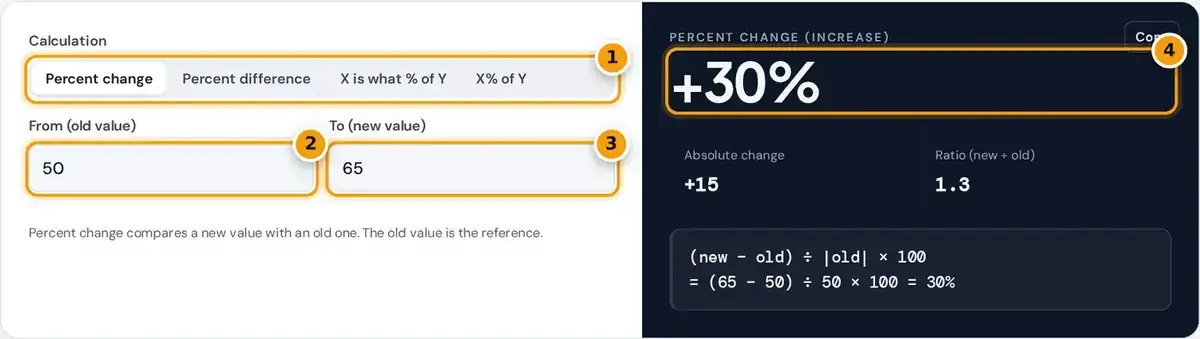
- Pick the calculation: percent change, percent difference, X is what % of Y, or X% of Y.
- Enter the old (starting) value.
- Enter the new value.
- Read the percent change, the absolute change and the worked formula.
Pick one of the four modes at the top, then enter two numbers. The result, two supporting figures and the formula with your own numbers filled in update instantly while you type into the boxes.
Percent change compares a new value with an old one. Percent difference compares two values with no reference. X is what % of Y finds a share, such as a test score out of a total.
X% of Y finds a percentage of a number, such as a 15% tip. The percentage change calculator also has a copy button, so you can paste the answer into a report, spreadsheet or message.
Percentage Change Formula
For percent change, subtract the old value from the new value, divide by the absolute value of the old value, and multiply by 100. A positive answer is an increase, a negative one a decrease.
Percent difference = |V1 − V2| ÷ ((V1 + V2) ÷ 2) × 100
X as a percent of Y = X ÷ Y × 100
X% of Y = X ÷ 100 × Y
A percentage increase can be any size, so going from 50 to 150 is a 200% increase. A percentage decrease can never pass 100%, because a value cannot fall below nothing when it starts positive.
The calculator shows the absolute change and the ratio of new to old. A ratio of 1.3 means the new value is 1.3 times the old one, which is the same as a 30% rise.
Worked Examples
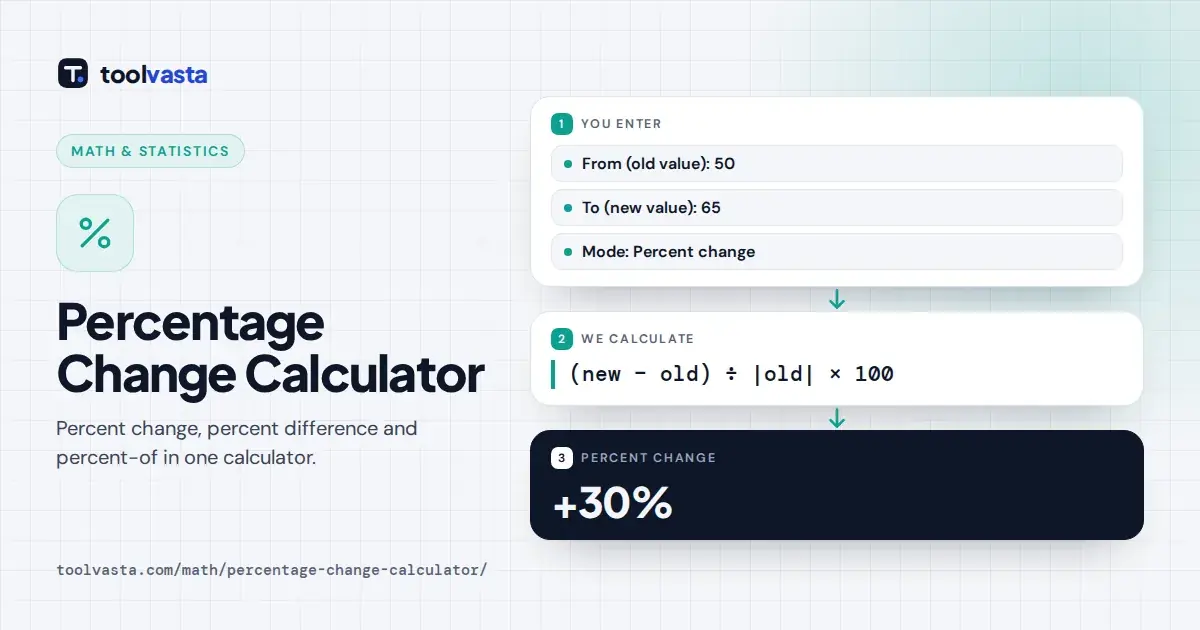
Monthly website visitors rise from 50 to 65. The change is 65 minus 50, which is 15. Dividing 15 by the old value of 50 gives 0.3, so 50 to 65 is a 30% increase.
Two stores price an item at 50 and 65. The difference is 15 and the average is 57.5, so the percent difference is 15 divided by 57.5 times 100, or 26.087%, smaller than the change.
If you scored 18 out of 72, 18 divided by 72 is 0.25, or 25%. For a tip, 15% of 80 is 12, leaving 68 after taking it off or 92 after adding it on.
Percent Change vs Percent Difference
Use percent change for a clear before and after, such as last year and this year. Direction matters: a rise from 50 to 65 is +30%, while a fall from 65 to 50 is −23.08%.
| Values | Percent change | Percent difference |
|---|---|---|
| 50 to 65 | +30% | 26.087% |
| 65 to 50 | −23.077% | 26.087% |
| 100 to 150 | +50% | 40% |
| 100 to 200 | +100% | 66.667% |
Use percent difference when comparing two separate measurements of equal standing, such as results from two labs. It measures against the midpoint, the average of the two, instead of against just one chosen reference value.
Percent difference gives the same answer whichever value you enter first, and it is always positive because it has no direction. That makes it the fairer choice when neither number is the true starting point.
Percent Change vs Percentage Points
When the values are already percentages, careful wording matters. If an interest rate goes from 4% to 5%, it rose by 1 percentage point, but the percent change is 1 divided by 4, or 25%.
Central banks describe rate moves in percentage points; the Bank of Canada policy interest rate table shows cuts such as 0.25. Traders often call that move 25 basis points, where each basis point is 0.01.
The same confusion appears with market share. A brand growing from 10% to 15% of a market gained 5 percentage points, which is a 50% increase in its share. News reports often mix these up.
Why Percentage Changes Are Not Symmetric
A 50% drop is not undone by a 50% rise, because the rise is calculated on a smaller number. 100 falls 50% to 50, and a 50% rise on 50 only brings it to 75.
To get back to 100, you need a full 100% rise. Likewise, a 25% loss needs a 33.33% gain to fully recover, which is why investment losses hurt more than equal-sized gains help you afterwards.
Percentages also do not simply add. Two yearly rises of 10% make 21% in total, not 20%, because of compounding. For a total change, compare the first and last values directly, which can exceed 100%.
Where Percent Change Is Used
Economists measure inflation as the percent change in the Consumer Price Index, over 12 months. Statistics Canada consumer price indexes report that 12-month change every month. Index values of 100 and 103 mean 3% inflation.
Businesses compare year-over-year sales, marketers track website traffic, and demographers report population growth as a percent change. Investors use it for share prices and returns, and many teachers use it to measure test score improvements.
In science, percent error compares a measured value with an accepted one. A measurement of 9.5 cm against an accepted 10 cm is a 5% error, which you can find with the percent change mode.
Limits
Percent change from zero is undefined, because the formula would then divide by zero. Percent difference is also undefined when the two values average to zero, so the calculator displays a clear warning message instead.
With negative numbers, the calculator divides by the absolute value of the old value, so an improvement from −20 to −10 correctly shows as a 50% increase rather than a confusing and misleading negative result.
Results are shown to up to eight significant digits, and very large or tiny numbers switch to scientific notation. Round the final answer to a sensible number of decimal places before you report it anywhere.
Frequently asked questions
How do I calculate percent change?
Subtract the old value from the new value, divide by the old value and multiply by 100. From 50 to 65 the change is 15, and 15 divided by 50 times 100 gives a 30% increase.
What is the difference between percent change and percent difference?
Percent change measures against the starting value and has a direction, up or down. Percent difference measures against the average of the two values and is always positive, whichever value comes first.
How do I find what percent one number is of another?
Divide the part by the whole and multiply by 100. For 18 out of 72, 18 divided by 72 is 0.25, and multiplying by 100 gives 25%.
Why is a 50% drop not undone by a 50% rise?
The rise is calculated on a smaller number. 100 falls 50% to 50, and a 50% rise on 50 only brings it to 75. You would need a 100% rise to get back to 100.
Is percent change the same as percentage points?
No. Going from 4% to 5% is a rise of 1 percentage point but a 25% percent change. Percentage points measure the gap between two percentages, while percent change measures the relative change.
Can a percentage change be more than 100%?
Yes, for increases. Going from 50 to 150 is a 200% increase. A decrease cannot go beyond 100% for a positive starting value, because a 100% decrease already takes the value to zero.