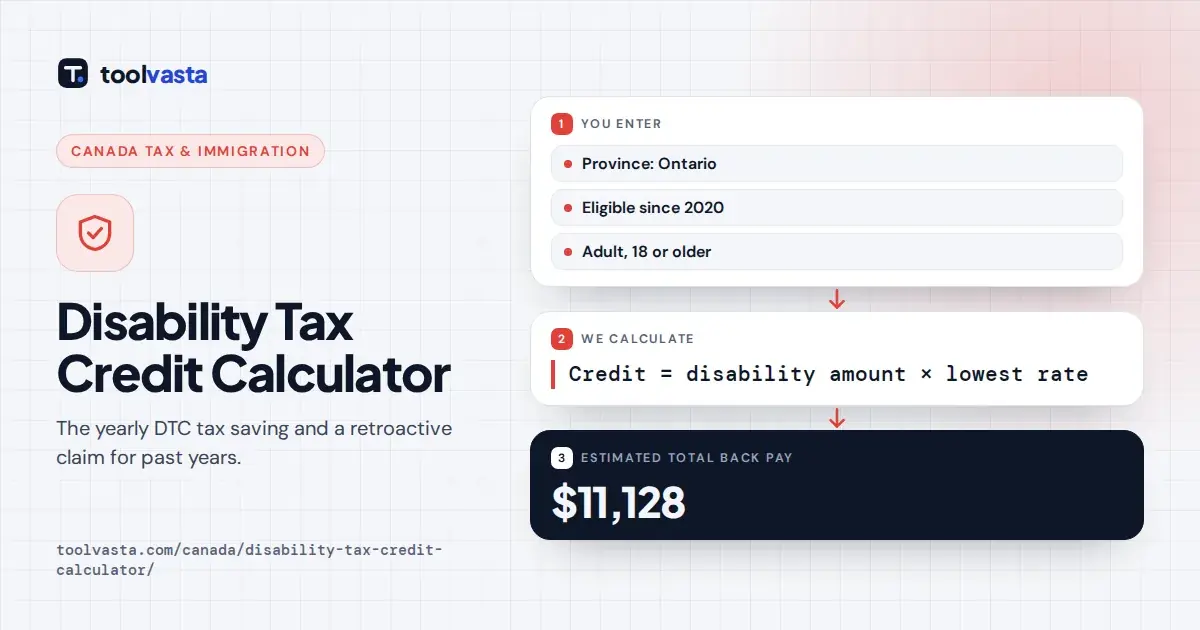
How to Use the Disability Tax Credit Calculator
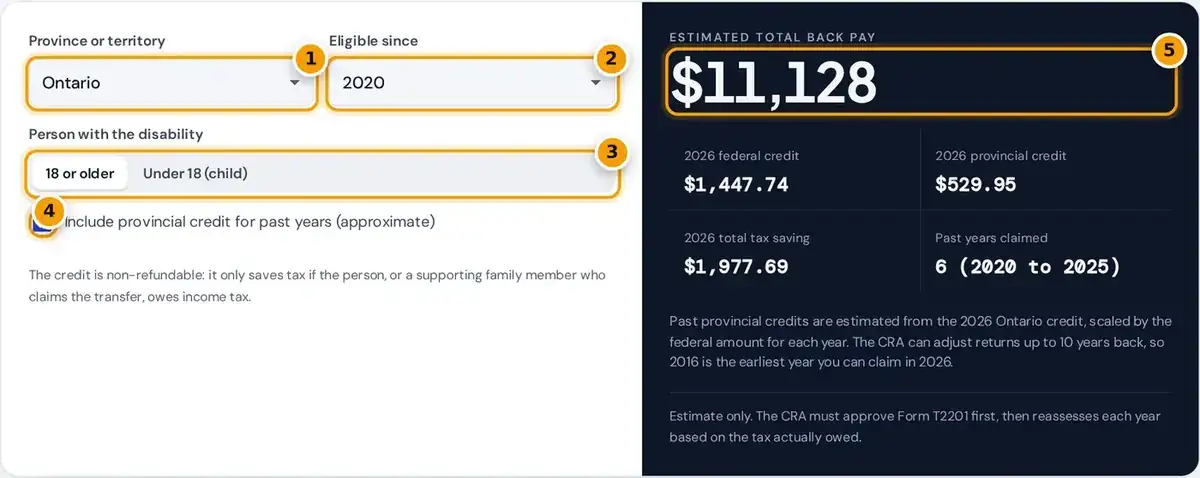
- Choose the province or territory where the person lives.
- Pick the year the disability began; claims go back up to 10 years.
- Choose adult or child; children under 18 get a supplement.
- Keep this ticked to include provincial credits for past years.
- Read the estimated back pay and the 2026 federal and provincial credit.
Pick your province or territory, then set the eligible since year, which is the year the impairment first met the CRA criteria. The calculator counts every year from then to 2025 as possible back pay.
Choose whether the person with the disability is 18 or older or under 18, because children also get an extra supplement. Leave the provincial box ticked to include an approximate provincial credit for past years.
The result shows the estimated total back pay, the 2026 federal and provincial credit, and a year-by-year table. Each row lists the federal amount, the federal credit and the provincial estimate for that tax year.
What the Disability Tax Credit Is
The disability tax credit is a non-refundable tax credit for people with a severe and prolonged impairment. It lowers tax owed rather than paying cash, so it only helps when there is tax to reduce.
To qualify, the impairment must last, or be expected to last, at least 12 months and markedly restrict basic activities of daily living such as walking, dressing, hearing or mental functions needed for everyday life.
The Canada Revenue Agency decides eligibility, not this calculator. The tool estimates value only after approval, so it cannot tell you whether the CRA will accept a claim. Treat every figure as a planning estimate.
How the Credit Is Calculated
The CRA sets a new disability amount each year, indexed to inflation. The federal credit equals that amount times the lowest tax rate, so the 2026 federal credit is $10,341 times 14 percent, or $1,447.74.
Provincial credit = provincial disability amount × lowest provincial rate
Child supplement = extra amount for a person under 18 at year end
The lowest rate was 15% through 2024 and 14.5% for 2025, because the bottom federal rate fell to 14% on July 1, 2025. Using a flat 15% for every single year would overstate recent credits.
Provinces and territories add their own disability amount at their lowest rate. The 2026 figures here come from the federal and provincial TD1 values, and past provincial credits are scaled from 2026 using federal amounts.
2026 Amounts by Province
| 2026 | Disability amount | Under 18 supplement | Rate | Credit value (adult) |
|---|---|---|---|---|
| Federal | $10,341 | $6,032 | 14% | $1,447.74 |
| Ontario | $10,494 | $6,121 | 5.05% | $529.95 |
| British Columbia | $9,913 | $5,783 | 5.6% | $555.13 |
| Alberta | $17,563 | $13,180 | 8% | $1,405.04 |
| Quebec (impairment amount) | $4,208 | None | 14% | $589.12 |
In Ontario an adult's 2026 provincial credit is $529.95, bringing the combined 2026 saving to $1,977.69. British Columbia gives $555.13, while Alberta's unusually large disability amount produces a provincial credit of $1,405.04 for each adult.
Saskatchewan also stands out, because its supplement for children equals its full adult amount. Provincial credits therefore vary by almost $1,000 a year, which is exactly why choosing the right province matters so much here.
Quebec works quite differently. Its impairment amount of $4,208 applies to adults only, and the federal credit shrinks by the 16.5% Quebec abatement, so a Quebec adult's 2026 federal credit is $1,208.86 instead of $1,447.74.
Retroactive DTC Claims
| Year | Disability amount | Under 18 supplement | Federal rate |
|---|---|---|---|
| 2025 | $10,138 | $5,914 | 14.5% |
| 2024 | $9,872 | $5,758 | 15% |
| 2023 | $9,428 | $5,500 | 15% |
| 2022 | $8,870 | $5,174 | 15% |
| 2021 | $8,662 | $5,053 | 15% |
| 2020 | $8,576 | $5,003 | 15% |
| 2019 | $8,416 | $4,909 | 15% |
| 2018 | $8,235 | $4,804 | 15% |
| 2017 | $8,113 | $4,733 | 15% |
| 2016 | $8,001 | $4,667 | 15% |
If the person qualified earlier but never claimed, the CRA can adjust past returns once T2201 is approved. It can reassess up to 10 years back, so 2016 is the earliest year claimable in 2026.
Take the default example: an Ontario adult eligible since 2020. Federal credits for the six tax years from 2020 to 2025 total $8,281.21, and the estimated Ontario credits lift the retroactive total to about $11,128.
Claiming all ten years from 2016 gives about $13,196 in federal credits alone for an adult. Actual back pay can be lower, because each year only saves tax if there was tax to reduce then.
The Child Supplement
A person under 18 at the end of the year gets a supplement on top of the base disability amount. In 2026 the federal supplement is $6,032, worth up to $844.48 in additional federal credit.
With the supplement, a child's 2026 federal credit reaches $2,292.22 instead of $1,447.74. Most provinces add a similar child amount of their own, and the calculator includes it when you choose the under 18 option.
The supplement can be reduced when child care expenses or attendant care costs are claimed elsewhere on the return. A parent usually claims the child's credit through a transfer, as explained in the next section.
Transferring the Credit
Many people with a disability have little income and so little tax owing. In that case the unused amount can move to a spouse, a common-law partner or a supporting family member who pays tax.
The transfer uses the same disability amount, so the credit cannot be claimed twice. Whoever receives it needs enough tax of their own to absorb the credit, otherwise part of the value is simply lost.
For children, a parent normally claims the full amount, including the supplement. When you estimate a family transfer, treat the calculator result as the maximum the family could possibly save, not a guaranteed refund cheque.
Applying and Other Benefits
To apply, the person completes Part A of Form T2201 and a medical practitioner completes Part B to certify the impairment. The CRA charges no fee to apply, though some practitioners bill for their part.
Approval can open other support. A valid DTC is required to open a registered disability savings plan, or RDSP, and also counts for the Canada Disability Benefit and several provincial programs for people with disabilities.
Federal rules and amounts come from the CRA page on claiming the disability tax credit, and the Quebec amount from the Revenu Québec line 376 guide. Check both before filing, since amounts change every year.
Frequently asked questions
How much is the disability tax credit worth in 2026?
The federal disability amount for 2026 is $10,341, which reduces federal tax by up to $1,447.74. The provincial or territorial credit adds more, for example about $530 in Ontario, for a combined saving of $1,977.69.
How far back can I claim the DTC?
The CRA can reassess returns for up to 10 years. In 2026 that means you can claim back to the 2016 tax year, as long as the approved Form T2201 shows the person was eligible then.
How much is DTC back pay?
It depends on the years approved and the tax paid. Ten years of federal credits alone are worth about $13,196 for an adult, plus provincial credits, if there was enough tax to reduce each year.
Can I transfer the disability tax credit?
Yes. If the person with the disability does not need all of the credit, a spouse, common-law partner or supporting family member can claim the unused part, provided they have enough tax of their own.
Is the child DTC amount higher?
Yes. A person under 18 at the end of the year can also claim a supplement of up to $6,032 in 2026, which adds up to $844.48 to the federal credit, plus any provincial supplement.
Is the disability tax credit a monthly payment?
No. The DTC is a non-refundable tax credit that reduces income tax owed when you file. It is not paid monthly, although approval can unlock other benefits, such as the RDSP and the Canada Disability Benefit.