How to Use the Ontario Salary Calculator
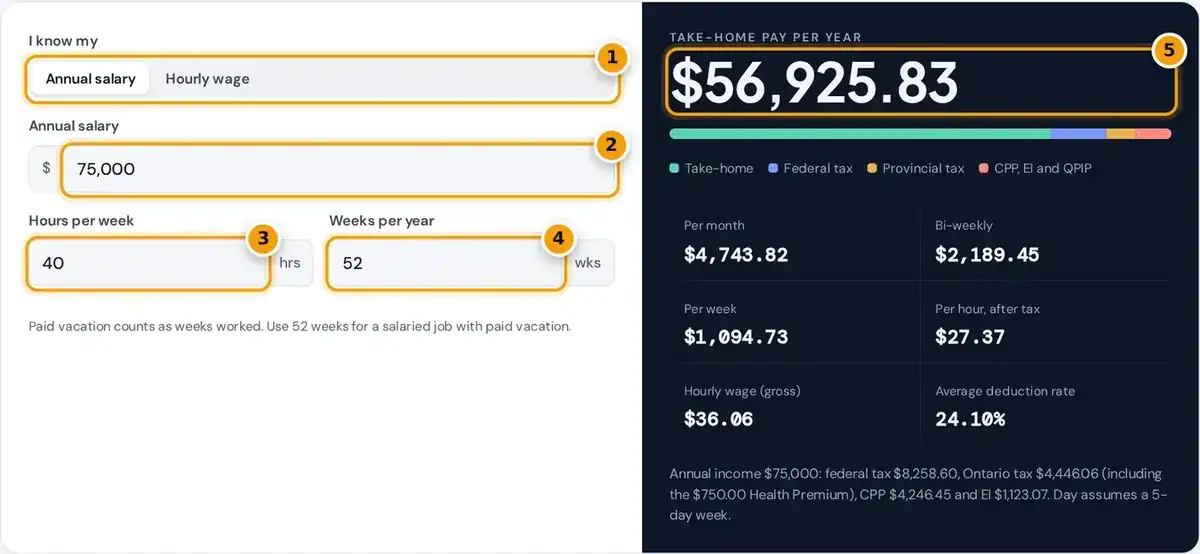
- Choose whether you know your annual salary or your hourly wage.
- Enter your annual salary in Ontario.
- Set the hours you work each week.
- Set weeks worked a year; use 52 for a salaried job with paid vacation.
- Read take-home pay per year, then per month, bi-weekly, week and hour.
Choose whether you know your annual salary or your hourly wage, then enter the amount. Add your usual hours per week and the weeks per year you are paid, which default to 40 and 52.
The calculator instantly converts between salary and hourly pay, then shows your estimated take-home pay per year, per month, bi-weekly and per week, plus your hourly pay after tax and your overall average deduction rate.
It applies 2026 federal and Ontario income tax, CPP and EI, so it works as a monthly salary calculator and a federal and provincial tax calculator for a single job held all year in Ontario.
Salary to Hourly and Hourly to Salary
Converting between the two is simple multiplication and division. The calculator uses your own hours and weeks rather than a fixed year, so part-time schedules, unpaid leave and seasonal contracts give accurate hourly figures too.
Annual salary = hourly wage × hours per week × weeks per year
At 40 hours a week for 52 weeks, a year has 2,080 hours of gross pay. A $75,000 salary works out to $36.06 an hour, and $25 an hour equals $52,000 a year before deductions.
Many office jobs use 37.5 hours a week, which gives 1,950 paid hours, so the same $75,000 salary becomes $38.46 an hour. Divide your salary by hours actually worked to find your effective hourly rate.
How Take-Home Pay Is Worked Out
Take-home pay, often called net income, is your salary minus income tax and payroll deductions. The calculator works through each item in order, using the same rates and credits that the CRA publishes for 2026.
CPP is 5.95% of earnings between $3,500 and $74,600, up to $4,230.45. CPP2 adds 4% between $74,600 and $85,000, up to $416. EI premiums are 1.63% of insurable earnings, up to a $1,123.07 yearly maximum.
Income tax allows the basic personal amount, the Canada employment amount and credits for CPP and EI. Ontario then adds the Ontario surtax and Ontario Health Premium, and subtracts the tax reduction and LIFT credit.
2026 Federal and Ontario Tax Brackets
Canada's income tax is progressive: each rate applies only to the slice of taxable income inside its bracket. Your marginal tax rate is the combined federal and Ontario rate on the next dollar you earn.
| Federal taxable income | Rate | Ontario taxable income | Rate |
|---|---|---|---|
| Up to $58,523 | 14% | Up to $53,891 | 5.05% |
| $58,523 to $117,045 | 20.5% | $53,891 to $107,785 | 9.15% |
| $117,045 to $181,440 | 26% | $107,785 to $150,000 | 11.16% |
| $181,440 to $258,482 | 29% | $150,000 to $220,000 | 12.16% |
| Over $258,482 | 33% | Over $220,000 | 13.16% |
Federal rates run from 14% to 33%, and Ontario rates run from 5.05% to 13.16%. The CRA tax rates and income brackets page lists the official 2026 thresholds, and most rise with inflation each year.
A raise never lowers your take-home pay. Crossing into a higher bracket taxes only the extra dollars at the higher rate, while everything below the threshold keeps its original rate, so net pay always rises.
Worked Example: $75,000 a Year in Ontario
Take the default salary of $75,000 at 40 hours a week for 52 weeks. CPP and CPP2 total $4,246.45, and EI is $1,123.07, the yearly maximum, because earnings exceed the $68,900 insurable limit for 2026.
After credits, federal tax comes to $8,258.60 and Ontario tax is $4,446.06, which includes a $750 Ontario Health Premium. Total deductions add up to $18,074.17, so the take-home pay is $56,925.83 a year in Ontario.
That equals $4,743.82 per month, $2,189.45 bi-weekly, $1,094.73 per week and $27.37 for each of the 2,080 hours worked. The average deduction rate, counting income tax, CPP and EI together, is about 24.1% of salary.
Ontario Take-Home Pay at Common Salaries (2026)
The table shows take-home pay at common salaries for a full-time year of 2,080 hours, calculated with the same engine as the tool above. Enter your exact salary for a figure that fits you exactly.
| Salary | Hourly (2,080 h) | Take-home per year | Per month |
|---|---|---|---|
| $40,000 | $19.23 | $33,331.79 | $2,777.65 |
| $60,000 | $28.85 | $47,339.75 | $3,944.98 |
| $75,000 | $36.06 | $56,925.83 | $4,743.82 |
| $100,000 | $48.08 | $74,206.13 | $6,183.84 |
| $120,000 | $57.69 | $87,342.77 | $7,278.56 |
Moving from $100,000 to $120,000 adds $20,000 of gross pay but only about $13,137 of extra take-home pay, because the additional income is taxed at a higher marginal rate than your first dollars of earnings.
The same figures apply in Toronto, Ottawa and every other Ontario city, because Ontario municipalities do not charge a separate income tax. Rent and other living costs differ, but payroll deductions stay exactly the same.
What the Estimate Does Not Include
The calculator assumes one job, a full year of Ontario residence and basic credits only. RRSP contributions, workplace pension deductions, benefit premiums, union dues, overtime and bonuses are left out, so adjust for them separately.
Payroll withholding can differ slightly from your final tax because each paycheque is taxed as if it repeated all year. Your tax return settles the difference, and the Ontario Fall Statement explains the provincial provisions.
Self-employed workers pay both halves of CPP and usually no EI, so this tool overstates their take-home pay. Treat every result as an estimate for planning, not tax advice, and confirm details with the CRA.
Frequently asked questions
What is $75,000 a year per hour in Ontario?
At 40 hours a week for 52 weeks, $75,000 is $36.06 an hour before tax. After 2026 federal and Ontario tax, CPP and EI, it is about $27.37 an hour of take-home pay.
How much is $25 an hour per year?
At 40 hours a week for 52 weeks, $25 an hour is $52,000 a year before deductions. At 37.5 hours a week, the same wage gives $48,750 a year of gross pay.
What is the take-home pay on $60,000 in Ontario?
For 2026, a $60,000 salary leaves about $47,339.75 a year after federal and Ontario income tax, CPP and EI. That works out to about $3,944.98 a month before any other deductions.
Does this include the Ontario Health Premium?
Yes. The premium depends on taxable income, starts above $20,000 and reaches $750 for incomes between $72,600 and $200,000, with a maximum of $900. It is included in the Ontario tax figure.
How many working hours are in a year in Canada?
A standard full-time year is 2,080 hours, based on 40 hours a week for 52 weeks. With a 37.5 hour week it is 1,950 hours. Change both inputs to match your actual schedule.
Why is my paycheque slightly different?
Payroll estimates tax one pay period at a time and stops CPP and EI once you reach the yearly maximums, so individual paycheques vary. Your total for the year is settled when you file your tax return.