How to Use the Vacation Pay Calculator
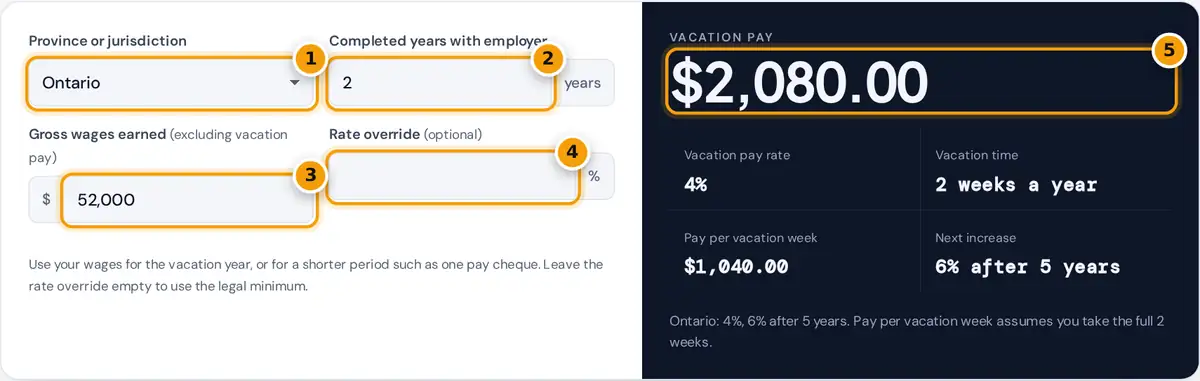
- Choose your province or territory, or Federal for jobs under the Canada Labour Code.
- Enter how many full years you have worked for this employer. Longer service raises the rate.
- Enter your gross wages for the vacation year or one pay period, not counting vacation pay.
- Leave the rate empty for the legal minimum, or type your contract rate if it is higher.
- Read your vacation pay, then check the rate, weeks of vacation and pay per vacation week.
Start by picking your province or territory. Choose Federal instead if you work in a federally regulated industry such as banking, airlines, telecommunications or interprovincial trucking, because the Canada Labour Code then sets your minimum.
Next, enter your completed years with the same employer and the gross wages you earned for the period. Leave out any vacation pay already received, since the calculator applies the rate to your other earnings.
Results update instantly: vacation pay, the rate, weeks of vacation time, pay per vacation week and the next increase. If your contract promises more than the minimum, type that rate into the rate override box.
How Vacation Pay Is Calculated
The vacation pay formula is simple multiplication. Take gross wages earned in the vacation year, or a shorter period such as one pay cheque, and multiply by the percentage that matches your years of service.
Pay per vacation week = vacation pay ÷ weeks of vacation
Vacationable wages include regular pay, overtime, commissions, non-discretionary bonuses and public holiday pay. They exclude tips, discretionary bonuses, expense allowances and vacation pay itself. Each province writes its own definition, so check unusual pay types.
Pay per vacation week divides the vacation pay by your weeks of entitlement. It shows what each week away from work should be worth, assuming you take the full block of time your province grants.
Worked Example: Ontario Vacation Pay on $52,000
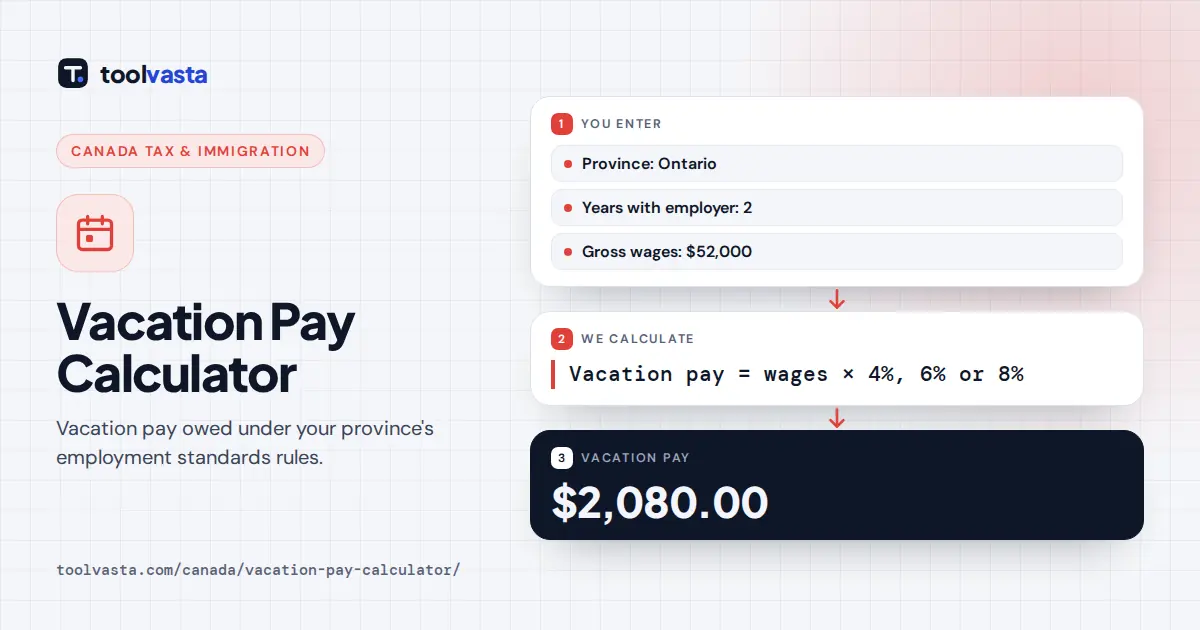
Say you have worked for your employer in Ontario for 2 years and earned $52,000 during the vacation year. Ontario sets 4% vacation pay for anyone under five years, so the calculation is $52,000 × 4%.
That gives $2,080 of vacation pay. With two weeks of vacation, each week pays $1,040. Once you reach 6% after five years, the same wages earn $3,120, and the time off grows to three weeks.
| Scenario | Rate | Vacation pay | Weeks |
|---|---|---|---|
| Ontario, 2 years, $52,000 | 4% | $2,080 | 2 |
| Ontario, 5+ years, $52,000 | 6% | $3,120 | 3 |
| Saskatchewan, 10+ years, $52,000 | 4/52 (7.69%) | $4,000 | 4 |
The method is identical for hourly wages: add up every eligible dollar you were paid and apply the percentage. In Saskatchewan, a worker with 10 years of service earns 4/52 of $52,000, which is $4,000.
Vacation Pay Rates by Province and Territory
Most of Canada starts at 4% with two weeks and moves to 6% with three weeks after five years. The differences sit in the timing of that step and a few places that go further.
| Jurisdiction | Vacation pay | Vacation time |
|---|---|---|
| Alberta | 4% / 6% after 5 years | 2 weeks / 3 weeks after 5 years |
| British Columbia | 4% / 6% after 5 years | 2 weeks / 3 weeks after 5 years |
| Manitoba | 4% / 6% after 5 years | 2 weeks / 3 weeks after 5 years |
| New Brunswick | 4% / 6% after 8 years | 2 weeks / 3 weeks after 8 years |
| Newfoundland and Labrador | 4% / 6% after 15 years | 2 weeks / 3 weeks after 15 years |
| Nova Scotia | 4% / 6% after 7 years | 2 weeks / 3 weeks after 8 years |
| Northwest Territories | 4% / 6% after 5 years | 2 weeks / 3 weeks after 5 years |
| Nunavut | 4% / 6% after 5 years | 2 weeks / 3 weeks after 5 years |
| Ontario | 4% / 6% after 5 years | 2 weeks / 3 weeks after 5 years |
| Prince Edward Island | 4% / 6% after 5 years | 2 weeks / 3 weeks after 5 years |
| Quebec | 4% / 6% after 3 years | 2 weeks / 3 weeks after 3 years |
| Saskatchewan | 5.77% / 7.69% after 10 years | 3 weeks / 4 weeks after 10 years |
| Yukon | 4% | 2 weeks |
| Federal (Canada Labour Code) | 4% / 6% after 5 years / 8% after 10 years | 2 weeks / 3 weeks after 5 years / 4 weeks after 10 years |
Saskatchewan is clearly the most generous province: 5.77%, which is 3/52 of wages, from the start, and 7.69% after 10 years. Quebec reaches 6% after only three years, while Newfoundland and Labrador waits fifteen years.
Nova Scotia raises pay to 6% at the start of the eighth year, and New Brunswick after eight full years. Prince Edward Island follows the five-year pattern, and Yukon keeps 4% regardless of service length.
Vacation Pay vs Vacation Time
Vacation time and vacation pay are separate rights. Your vacation entitlement in weeks is earned after each completed 12-month vacation year, while vacation pay is a percentage that starts to accrue from your first day.
Employers may pay the money before your holiday or, where the rules or an agreement allow, add it directly to each pay cheque. Either way, the dollar total for the year should match the percentage.
Part-time employees and casual staff earn the same percentage as full-time colleagues, so smaller wages simply produce a smaller dollar amount. Statutory holidays are an entirely different entitlement and are not counted as vacation days.
Vacation Pay in Alberta, Ontario and B.C.
Alberta, Ontario and British Columbia all use 4% with two weeks of vacation, rising to 6% with three weeks after five years with the same employer. The details of payment differ only slightly between them.
In Alberta, monthly salaried employees on vacation receive normal wages, and the province uses 4.3333 weeks per month to find a weekly figure. Ontario explains its rules in its Employment Standards Act guide to vacation.
In British Columbia, employees are owed vacation pay once they have been employed for more than five calendar days, and vacation time becomes available after 12 months. The calculator applies these same legal minimum rates.
Termination, Taxes and Limits
If you quit or are let go, unpaid vacation pay on wages earned must be paid out at termination. Unused vacation cannot simply disappear, because statutory minimums are protected even when a contract says otherwise.
Vacation pay is employment income, so income tax, CPP and EI deductions apply when it is paid. Federal workers can read their own rules on the Government of Canada vacations page before raising any concern.
This tool shows minimum entitlements and is not legal advice. Collective agreements and contracts often give more, and construction has special rules. Contact your employment standards office if you think your vacation pay was wrong.
Frequently asked questions
How is vacation pay calculated in Ontario?
Ontario vacation pay is 4% of gross wages for employees with under five years of service and 6% after five years. On $52,000 of wages, 4% equals $2,080 for two weeks of vacation.
What is the vacation pay rate in Alberta?
Alberta employees earn 4% vacation pay with two weeks of vacation, rising to 6% with three weeks after five years with the same employer. Monthly salaried staff receive normal wages while on vacation.
Do federal employees get 8% vacation pay?
Yes. Under the Canada Labour Code, federally regulated employees get 4% with two weeks, 6% with three weeks after five years and 8% with four weeks after ten years of service.
Which province has the highest vacation pay?
Saskatchewan has the highest minimum. Workers earn 5.77% of wages with three weeks of vacation from the start, and 7.69% with four weeks once they reach 10 years with the same employer.
Is vacation pay paid out when I quit?
Yes. When employment ends for any reason, the employer must pay all vacation pay earned and not yet paid. Statutory minimums cannot be forfeited, even if a contract or policy says otherwise.
Is vacation pay taxable in Canada?
Yes. Vacation pay is employment income, so income tax, CPP contributions and EI premiums are deducted when it is paid, whether it arrives as a lump sum or as a percentage added to each cheque.