How to Use the Retirement Calculator Canada
- Enter your current age, then your retirement age and how long to plan for.
- Set the yearly income you want in retirement, in today's dollars.
- Enter your current RRSP, TFSA and other savings.
- Add how much you save each month, then your expected returns and inflation.
- Read your savings gap and the extra monthly saving that would close it.
Enter your current age, your planned retirement age and the age you want income to last until. Then add the target income you want per year, stated in today's dollars rather than future inflated dollars.
Next, add your current savings, your monthly saving and the returns you expect before and during retirement. Your personal CPP estimate at 65 is in your My Service Canada Account, or keep the default average.
Enter your years in Canada after 18 and when you plan to start CPP and OAS. The result shows your gap or surplus, the extra monthly saving needed and a year by year income table.
How Much Do You Need to Retire in Canada?
The honest answer to how much do I need to retire is that it depends on your spending. Many planners start with a replacement rate of 60% to 80% of your pre-retirement income before tax.
Your planning horizon matters as much as the income. Life expectancy keeps rising, so this calculator plans income to age 90 by default, and you can extend it to 95 or beyond for extra safety.
Government benefits cover part of the target. The calculator subtracts CPP and OAS from your target each year, then works out the savings needed at retirement to pay the remaining amount until your chosen age.
How the Retirement Calculation Works
Everything is shown in today's dollars because CPP and OAS are indexed to inflation. The calculator first converts each nominal rate of return into a real return, which is the growth left over above inflation.
Savings at retirement = S(1 + r)n + monthly saving × ((1 + rm)12n − 1) / rm
Savings needed = Σ (target − CPP − OAS) / (1 + rret)year
Your savings then steadily grow with compound growth until retirement, with each regular monthly saving added on top. That gives the savings you will have, expressed in the buying power of money you hold today.
The savings needed figure is the present value of every future shortfall between your target income and your government pensions. The difference between the two amounts is your savings gap or your surplus at retirement.
Worked Retirement Example
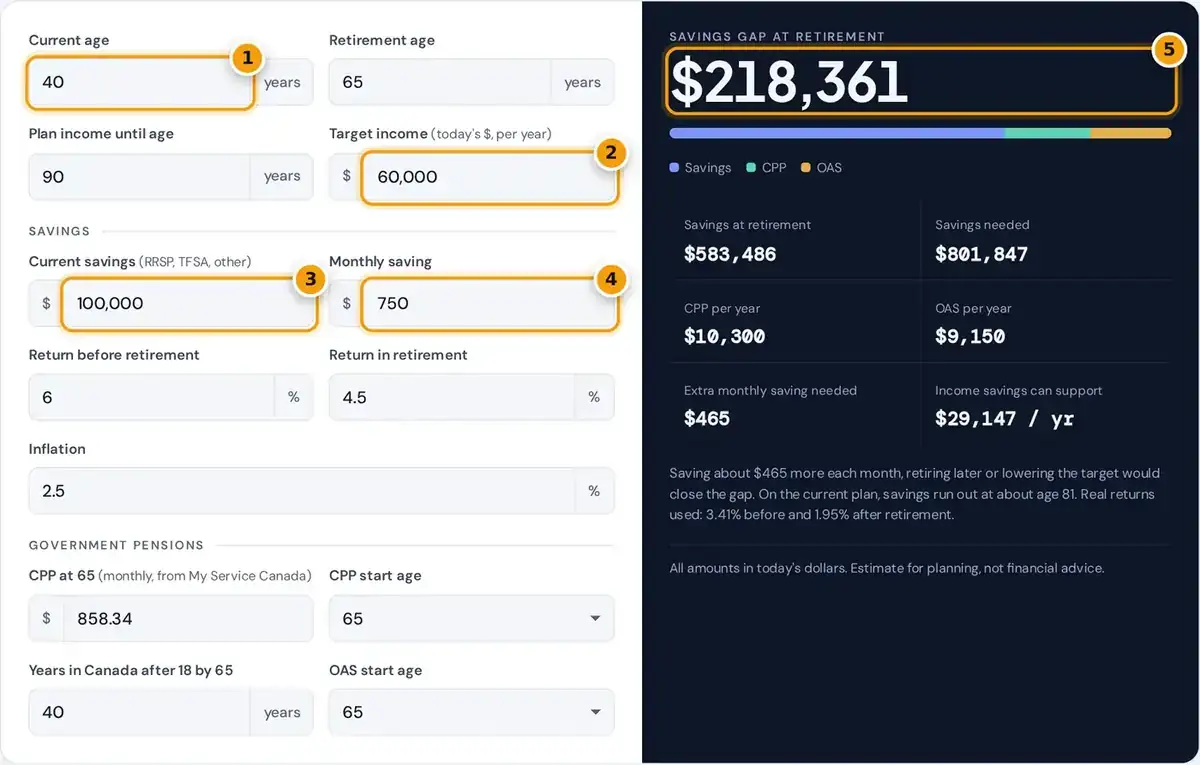
A 40-year-old has $100,000 saved already and adds $750 a month at a 6% return with 2.5% inflation. At 65, the savings are worth about $583,486 in today's dollars, according to the calculator's own projection.
With average CPP of about $10,300 a year and full OAS of $9,150 a year, rising at 75, a $60,000 income to age 90 at a 4.5% return needs about $801,800 in savings at 65.
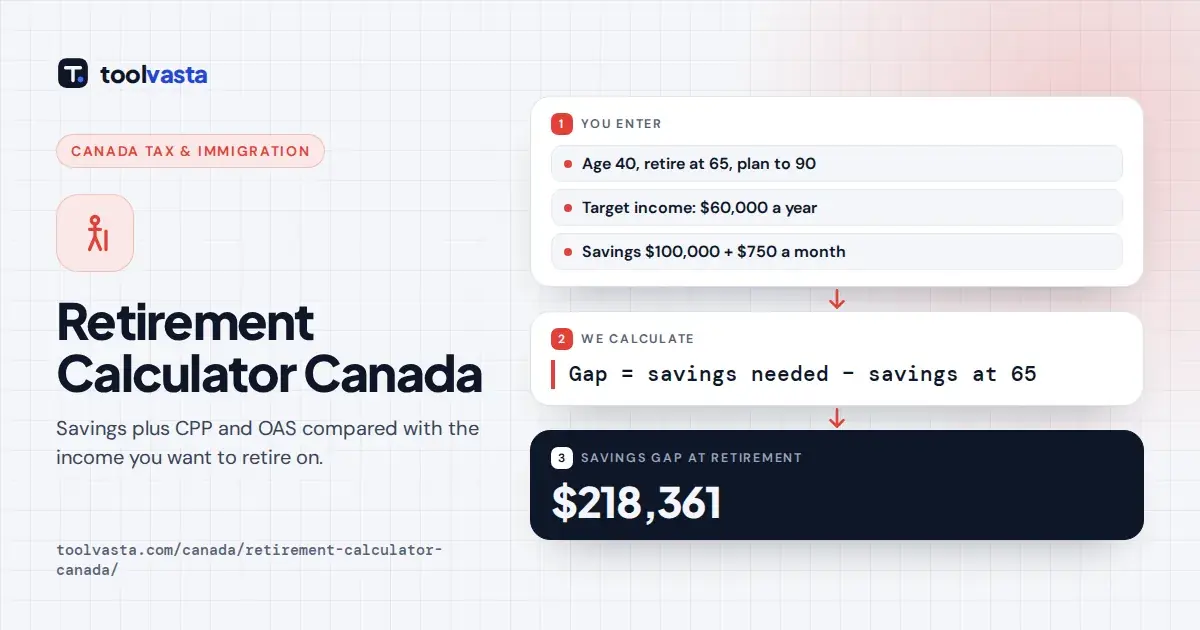
The gap is $218,361. Closing it takes roughly $465 more each month from now until 65. Retiring two or three years later instead or trimming the target income would also shrink the gap very quickly.
Canada Pension Plan Amounts and Start Age
The Canada Pension Plan pays a lifetime pension based on contributions. The CPP maximum at 65 is $1,507.65 a month in 2026, while average CPP for new retirees at 65 was $858.34 in July 2026.
You may start CPP at 60, but then the pension falls by 0.6% per month before 65, a 36% permanent cut. Waiting past 65 raises it by 0.7% per month, reaching 142% at age 70.
In the example, delaying CPP to 70 lifts the yearly amount from about $10,300 to $14,626. Delaying suits people in good health who have enough savings to bridge the years before the larger pension starts.
Old Age Security and the Guaranteed Income Supplement
Old Age Security is paid from age 65 based on residence, not work. You need 40 years in Canada after age 18 for the full amount, and 10 to 39 years gives a partial pension.
OAS was $762.50 a month for ages 65 to 74 in late 2026, and it rises 10% automatically from age 75. Deferring to 70 adds 0.6% a month, so the example becomes $12,444 a year.
Higher earners lose part of OAS through the OAS clawback, and low income seniors may receive the Guaranteed Income Supplement. This calculator ignores both, so treat its OAS figure as the standard gross amount only.
| Benefit (2026) | Amount |
|---|---|
| CPP maximum at 65 | $1,507.65 a month |
| CPP average for new retirees at 65 (July 2026) | $858.34 a month |
| OAS, ages 65 to 74 (October to December 2026) | $762.50 a month |
| OAS, age 75 and over | $838.75 a month |
RRSP, TFSA and Workplace Pensions
Enter all your savings as one total, whether they sit in an RRSP, a TFSA or a non-registered account. The calculator treats them as a single pool that grows at the single return you enter.
If you have a workplace pension, lower your target income by the yearly pension it will pay. That keeps the final result focused on the part your own savings must cover after CPP and OAS.
An RRSP becomes a RRIF by the end of the year you turn 71, with yearly minimum withdrawals. Reinvesting each RRSP tax refund into your TFSA is a simple way to raise your saving rate.
Ways to Close a Retirement Savings Gap
The first lever is simply to save more. Even small increases help when they start early, and raising your monthly saving each time your pay rises keeps the change painless and steady over many years.
The second lever is to retire later. Working just two or three extra years adds more savings, shortens the period you draw on them and allows larger CPP and OAS payments if you defer them.
The third lever is a lower target. Paying off the mortgage before retirement or choosing to downsize can cut the income you need. When results show a surplus, you may be able to retire earlier.
Limits and Assumptions
This is a planning estimate. It ignores income tax, RRIF minimum withdrawals and fees, and it assumes steady returns every year, while real portfolios face market volatility that can change outcomes significantly in either direction.
The 2026 benefit amounts in this calculator come from the official CPP payment amounts and OAS payment amounts pages. OAS is indexed every quarter, so the figures here will likely change again during the year.
Use the result to decide whether to adjust your plan, not as a guarantee. A fee-only financial advisor can add taxes, pension splitting and withdrawal order to build a full Canadian retirement plan for you.
Frequently asked questions
How much do I need to retire in Canada?
It depends on your target income and what CPP and OAS will pay. A $60,000 target with average CPP and full OAS needs about $800,000 at 65 to last to age 90 at a 4.5% return.
How much CPP will I get?
The CPP maximum at 65 is $1,507.65 a month in 2026, but the average for new retirees at 65 was $858.34 in July 2026. Your personal estimate is in My Service Canada Account.
Should I take CPP at 60 or 70?
Taking CPP at 60 cuts it by 36% for life, while waiting to 70 raises it by 42%. Delaying usually pays off if you are healthy and have other savings to bridge the gap.
Who qualifies for Old Age Security?
Canadian residents aged 65 or older who lived in Canada at least 10 years after age 18 qualify. Forty years of residence gives the full pension, and fewer years give a proportional partial pension.
Is the retirement calculator in today's dollars?
Yes. Every result is adjusted for the inflation rate you enter, so the amounts show buying power in today's money. That makes it easy to compare the target with what you spend now.
What return should I use for retirement planning?
Use a return that matches your mix of investments after fees. The defaults are 6% before retirement and 4.5% during retirement, with 2.5% inflation. Test lower returns to see how sensitive your plan is.