How to Use the One Rep Max Calculator
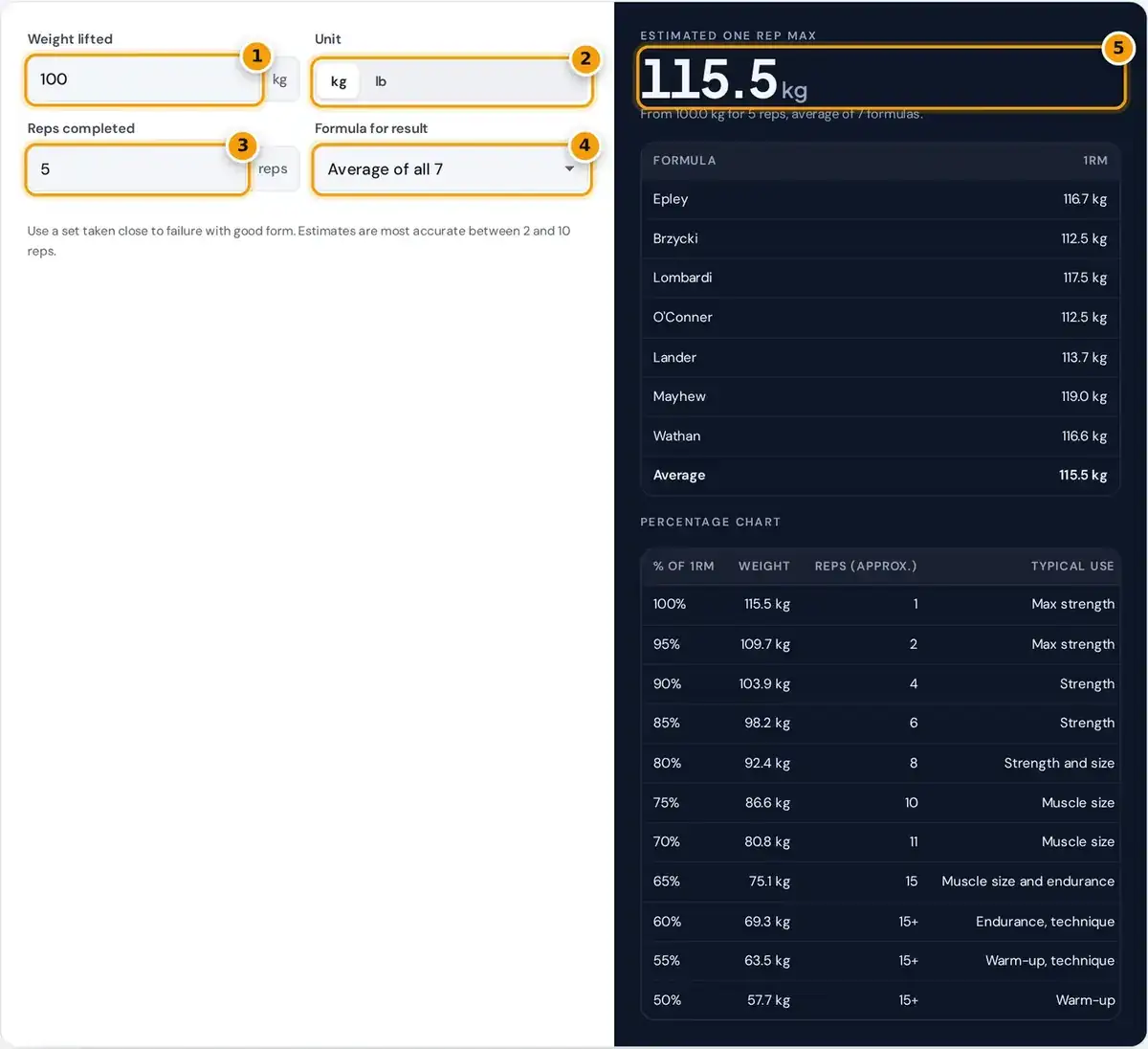
- Enter the weight you lifted for your set.
- Choose kg or lb.
- Enter the reps you completed with good form, ideally 2 to 10.
- Pick a formula for the headline result, or keep the average of all 7.
- Read your estimated one rep max, then use the percentage chart to set training weights.
Pick a recent set of any lift and enter the weight lifted and the reps completed with good form. Choose kg or lb, and the result updates as soon as both numbers are valid entries.
The best input is a set taken close to failure, between 2 and 10 reps. That gives a reliable estimate of your one rep max without the risk of actually testing a single maximal lift.
Keep the average of all 7 formulas or pick one you prefer. Used this way, it works as a 1RM max calculator or a max lift calculator for the bench press, squat, deadlift and more.
One Rep Max Formulas
Each formula was fitted to data from lifters who tested both multi-rep sets and true maxes. In each one, w is the weight lifted and r is the number of reps completed in the set.
Brzycki: 1RM = w × 36 / (37 − r)
Lombardi: 1RM = w × r0.10
O'Conner: 1RM = w × (1 + 0.025 × r)
Lander: 1RM = 100w / (101.3 − 2.67123 × r)
Mayhew: 1RM = 100w / (52.2 + 41.9 × e−0.055r)
Wathan: 1RM = 100w / (48.8 + 53.8 × e−0.075r)
Epley and Brzycki are the most widely used. Lombardi uses a power curve, O'Conner is a simple linear rule, and Lander, Mayhew and Wathan come from larger regression studies of trained and untrained lifters alike.
The calculator shows all seven results side by side, plus their average. A single rep simply returns the weight you entered, since that already is your one rep max for that lift on the day.
Worked Example: A Five Rep Bench Press Set
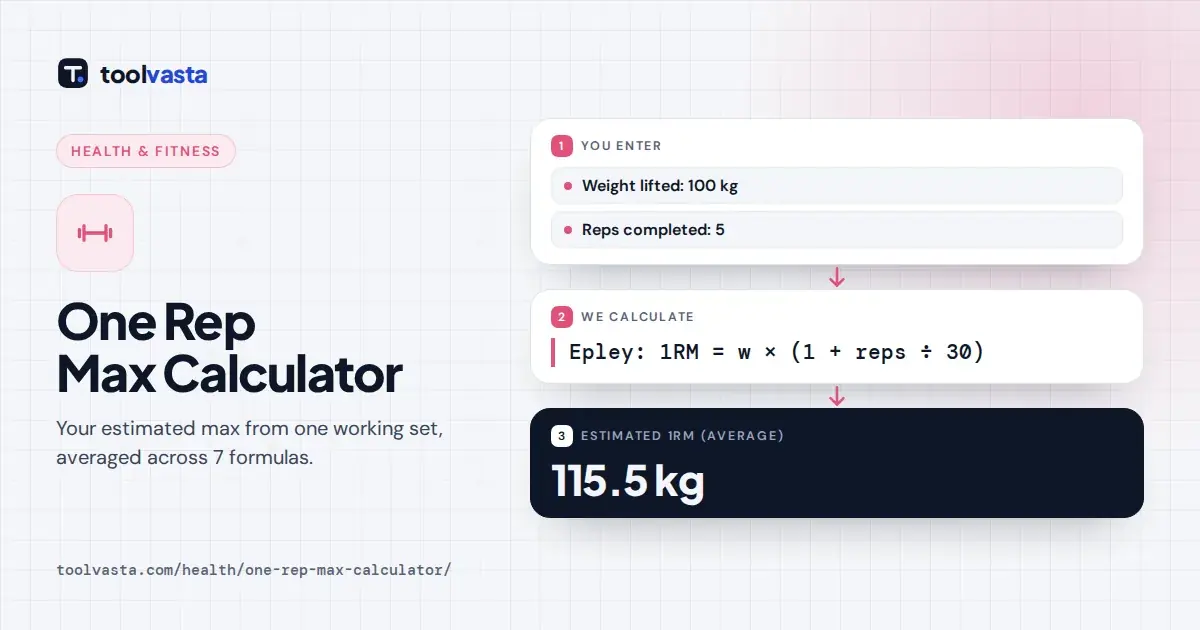
You bench 100 kg for 5 reps. Epley gives 100 times the sum of 1 plus 5 over 30, which is 116.7 kg. Brzycki gives 100 times 36 divided by 32, which is 112.5 kg.
The other formulas give 117.5 for Lombardi, 112.5 for O'Conner, 113.7 for Lander, 119.0 for Mayhew and 116.6 kg for Wathan. The average of all seven results is 115.5 kg, the headline estimate shown above.
At 80% of that max, a working set would be about 92.4 kg for around 8 reps. In pounds, 225 lb lifted for 8 reps gives an average estimate of 280.6 lb across the formulas.
Percentage of 1RM Chart
The percentage chart turns your estimate into training weights from 50% to 100%. Each row shows the weight, the approximate reps you can do and the typical training goal best suited to that particular load.
Rep counts follow the percentage table published by the NSCA, the National Strength and Conditioning Association. Loads of 85% and above suit max strength, 70% to 80% suit muscle size, and lighter loads build endurance.
| % of 1RM | Approximate reps | Typical use |
|---|---|---|
| 100% | 1 | Max strength |
| 95% | 2 | Max strength |
| 90% | 4 | Strength |
| 85% | 6 | Strength |
| 80% | 8 | Strength and size |
| 75% | 10 | Muscle size |
| 70% | 11 | Muscle size |
| 65% | 15 | Size and endurance |
Below 65%, the number of possible reps varies widely between people and lifts, so the chart shows 15 or more. The lightest rows are best used as a warm-up before your main heavy working sets.
Which 1RM Formula Should You Use?
Epley and Brzycki give almost the same answer at 10 reps. Brzycki tends to be a little lower on low rep sets, while Mayhew and Wathan usually come out a little higher than the rest.
Research such as LeSuer and colleagues in the Journal of Strength and Conditioning Research found that prediction accuracy falls as the number of reps rises, especially beyond 10 reps, and that errors differ between lifts.
Averaging several formulas smooths out the bias of any single equation, which is why the calculator uses the average by default. Whatever you choose, stick with the same formula so your progress stays truly comparable.
Using Your 1RM for Percentage-Based Training
Percentage-based training sets each working weight as a share of your max. A program might call for five sets of five at 80%, which the chart then converts to a real weight on the barbell.
Many programs use a training max of about 85% to 90% of your estimated 1RM. Working from that slightly lower number leaves room for the bad days and supports steady progressive overload over many months.
Retest every few training blocks by entering a fresh hard set. As your strength grows, the estimate rises, and your percentages move up with it without the need for a risky true max test day.
RPE and Reps in Reserve
RPE, or rate of perceived exertion, scores how hard a set felt from 1 to 10. A score of 10 means you could not do another rep, while 8 means about two reps in reserve.
The formulas assume your set was close to failure. If you stopped with several reps in reserve, the estimate will be too low, so add those unused reps to the count before calculating the result.
Rating effort honestly takes practice. Beginners often stop well short of failure, which makes their estimated max lower than their real strength. Filming your sets or training with an experienced partner helps you judge effort.
Bench Press, Squat and Deadlift Estimates
Estimates work best for compound lifts such as the bench press, squat, deadlift and overhead press. These movements use large muscle groups and a steady bar path, which suits the prediction equations very well indeed.
Each lift has its own max, and one does not predict another. Many people can do more reps at a given percentage on the squat or leg press than on the bench or overhead press.
Isolation exercises such as curls or lateral raises rarely get tested for a true max. Use rep ranges for them instead, and keep the 1RM figures for the big lifts that drive your whole program.
Limits and Safety
Accuracy drops above about 10 reps because endurance starts to matter more than strength. Fatigue, sleep, technique and even the time of day can all shift a single estimate by several percent in either direction.
If you test a true 1RM, warm up thoroughly and use a spotter or safety bars. Estimating from a submaximal set is safer for most people and carries less injury risk than repeated max attempts.
Canada's 24-Hour Movement Guidelines advise muscle strengthening that uses major muscle groups at least twice a week. These results are estimates, not medical advice, so check with a doctor first if you have an injury.
Frequently asked questions
How do I calculate my one rep max?
Lift a weight for as many good reps as you can, then use a formula such as Epley: weight times (1 + reps / 30). The calculator does this with seven formulas and shows the average.
Which 1RM formula is most accurate?
Studies find Epley, Brzycki, Mayhew and Wathan are all reasonably accurate for sets of up to about 10 reps. Averaging several formulas reduces the error of any single one, so the average is the default.
How many reps should I use to estimate 1RM?
Sets of 3 to 6 reps taken close to failure give the most reliable estimates. Above 10 reps the prediction becomes much less accurate, because endurance starts to limit the set more than strength.
What percentage of 1RM should I train at?
About 85% to 100% suits strength work with 1 to 6 reps, 65% to 85% suits muscle growth with 6 to 12 reps, and lighter loads suit endurance, technique and warm-up sets.
Is it safe to test a true one rep max?
It can be for experienced lifters with a good warm-up and a spotter or safety bars. For most people an estimate from a multi-rep set is safer and accurate enough for planning training.
How often should I retest my one rep max?
Retest every few training blocks, often every 8 to 12 weeks, by entering a fresh hard set. Frequent max attempts add fatigue and injury risk without making your training any more effective.