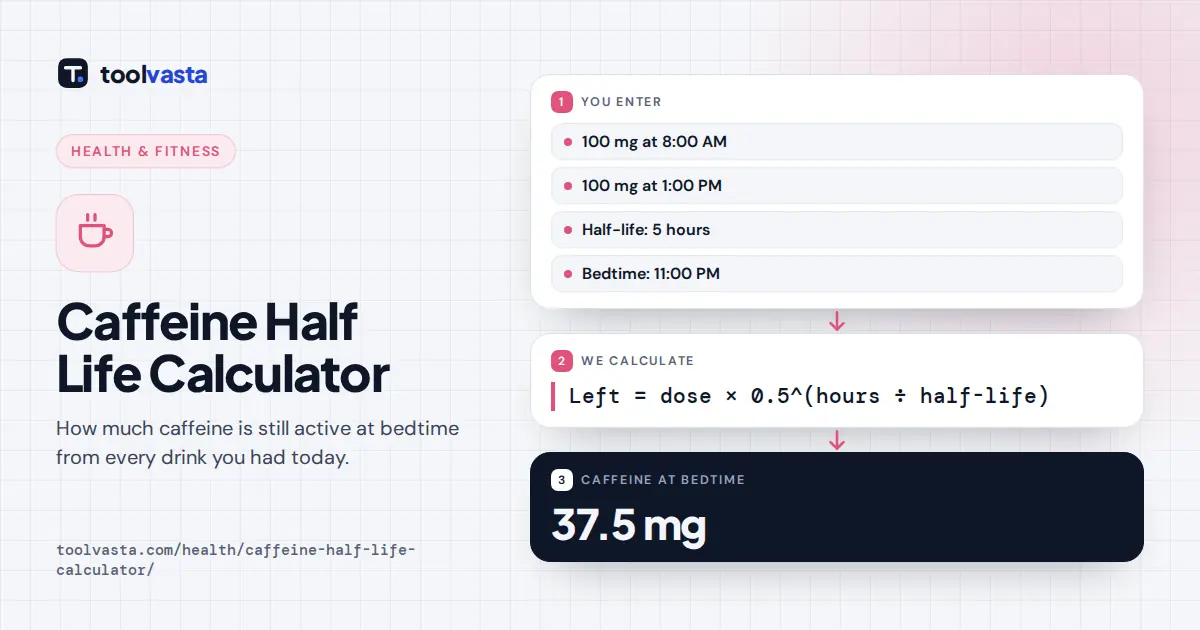
How to Use the Caffeine Half Life Calculator
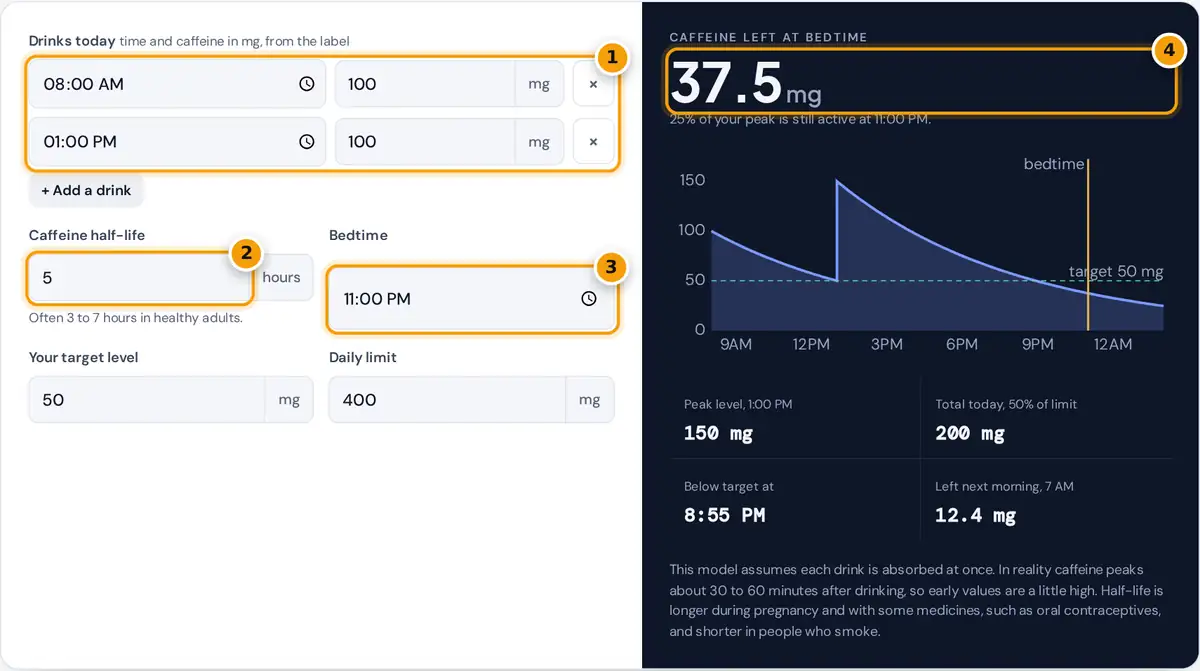
- Add each drink with the time you had it and its caffeine in mg.
- Set the caffeine half-life. Five hours is a common average for adults.
- Enter your bedtime, a target level and your daily limit.
- Read the caffeine left at bedtime, then check the decay chart, peak and when you drop below target.
Add one row for each caffeinated drink: the time you had it and its caffeine in milligrams. The amount is printed on most energy drinks and many coffee chains publish it online. Brewed coffee varies widely by bean, size and strength, so use the figure from the label or the shop when you can. Press Add a drink for more rows, up to eight.
Set your bedtime and the half-life. Five hours is a common average for healthy adults, but you can change it. You can also set a target level, the amount you feel is low enough for sleep, and a daily limit. The result shows caffeine left at bedtime, a decay chart, your peak, the time you drop below your target and what remains the next morning.
Caffeine Half-Life Formula
total = sum of what is left from every drink
Caffeine is cleared by the liver at a rate proportional to how much is in the blood. That is first-order elimination, which means the same fraction disappears in each half-life, whatever the starting amount.
Worked Example
You drink 100 mg at 8:00 AM and another 100 mg at 1:00 PM, with a 5 hour half-life and bedtime at 11:00 PM.
- The first drink has had 15 hours, three half-lives: 100 × 0.5³ = 12.5 mg
- The second drink has had 10 hours, two half-lives: 100 × 0.5² = 25 mg
- Caffeine left at bedtime = 37.5 mg
Your level peaks at 150 mg just after the 1:00 PM drink (50 mg left from the morning plus 100 mg). It falls below 50 mg at about 8:55 PM. With a 4 hour half-life the bedtime figure drops to about 25 mg.
Remaining After Each Half-Life
| Half-lives passed | Hours at 5 h half-life | Left from 200 mg |
|---|---|---|
| 1 | 5 | 100 mg (50%) |
| 2 | 10 | 50 mg (25%) |
| 3 | 15 | 25 mg (12.5%) |
| 4 | 20 | 12.5 mg (6.25%) |
| 5 | 25 | 6.25 mg (3.1%) |
After about five half-lives, roughly a day for most adults, only a few percent of a drink is left. That is why a large afternoon coffee can still be active at midnight.
Why Caffeine Half-Life Varies
Studies report average half-lives of about 3 to 7 hours in healthy adults, with wide differences between people. Genetics, liver health, smoking, pregnancy and some medicines all change how fast caffeine is cleared. Pregnancy and oral contraceptives make it last longer, and smoking makes it shorter. If you are sensitive to caffeine, try a longer half-life such as 6 or 7 hours.
For daily intake, Health Canada advises most healthy adults to stay at or below 400 mg of caffeine a day, with lower amounts for pregnant people and children. The daily limit field defaults to 400 mg, and you can change it to your own target. See Health Canada for current guidance.
Finding Your Caffeine Cutoff Time
Work backward from bedtime. With a 5 hour half-life, a 100 mg drink at 6:00 PM still leaves 50 mg at 11:00 PM, because exactly one half-life has passed. To be under 50 mg at bedtime from that single drink, it needs to be finished more than 5 hours before bed. Larger drinks, a longer half-life or a second cup push the cutoff earlier. Try moving your last drink in the calculator until the bedtime figure falls below your target.
Limits
The model treats every drink as absorbed instantly, while real caffeine peaks 30 to 60 minutes after drinking. It also assumes your half-life stays the same all day. Use the result to plan a caffeine cutoff time, not as a medical measurement.
Results are estimates for general information, not medical advice. Talk with a doctor or registered dietitian before big changes to diet, exercise or sleep, especially if you are pregnant, under 18 or managing a health condition.
Frequently asked questions
What is the half-life of caffeine?
For healthy adults it is usually about 3 to 7 hours, and 5 hours is a common average. After one half-life, half of the caffeine you drank is still in your body.
How long does caffeine stay in your system?
It takes about five half-lives to clear almost all of it. With a 5 hour half-life that is around 25 hours, although the effects fade well before then for most people.
How much caffeine is left at bedtime from an afternoon coffee?
A 100 mg drink at 1:00 PM leaves about 25 mg at 11:00 PM with a 5 hour half-life. Add any morning drinks too, because their leftovers stack.
When should I stop drinking coffee before bed?
Many sleep experts suggest a cutoff around 8 hours before bed. Use the calculator to find when your level drops below a target such as 50 mg.
Why does caffeine affect some people more?
Genetics, pregnancy, liver health, some medicines and smoking change how quickly caffeine is cleared. Body size and regular use also change how strongly you feel it.
How much caffeine is safe per day?
Health Canada advises most healthy adults to stay at or below 400 mg a day. Pregnant or breastfeeding people and children should have less. Check current official guidance for your situation.