How to Use the Ovulation Calculator
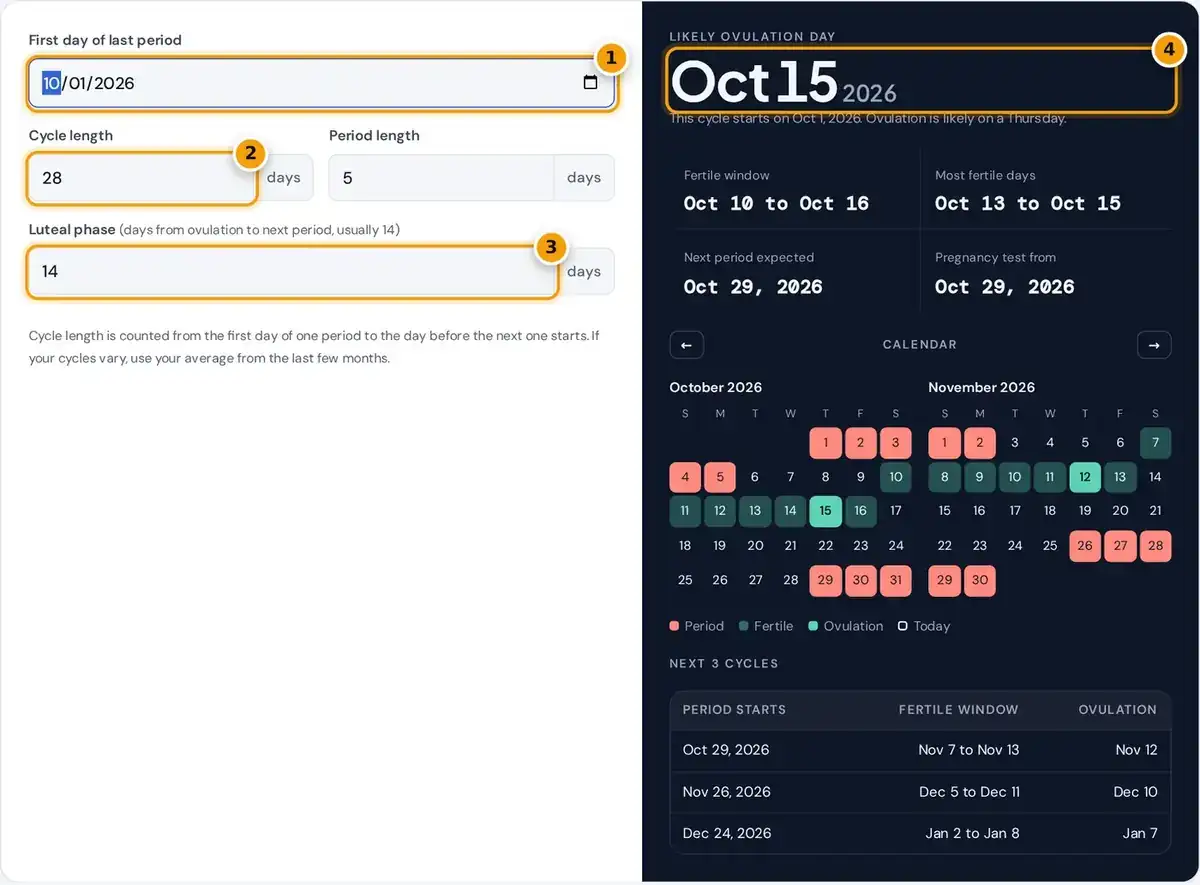
- Enter the first day of your last period.
- Enter your average cycle length in days.
- Keep the luteal phase at 14 days unless you know yours is different.
- Read your likely ovulation day, then your fertile window, next period and the calendar.
Enter the first day of your last period, your average cycle length and your usual period length. Leave the luteal phase at 14 days unless you have tracked your own cycles and know it differs.
The ovulation calculator then shows your likely ovulation day, the fertile window, your most fertile days, the date when your next period is due and the earliest day a home pregnancy test is usually reliable.
A color-coded calendar marks period days, fertile days and ovulation, and the arrows move between months. A table below lists the next three upcoming cycles, so you can plan ahead and compare the dates easily.
How Ovulation Day Is Estimated
A menstrual cycle has two halves. The follicular phase, from cycle day 1 to ovulation, varies widely between people. The luteal phase, from ovulation to the next period, is more stable at about 14 days.
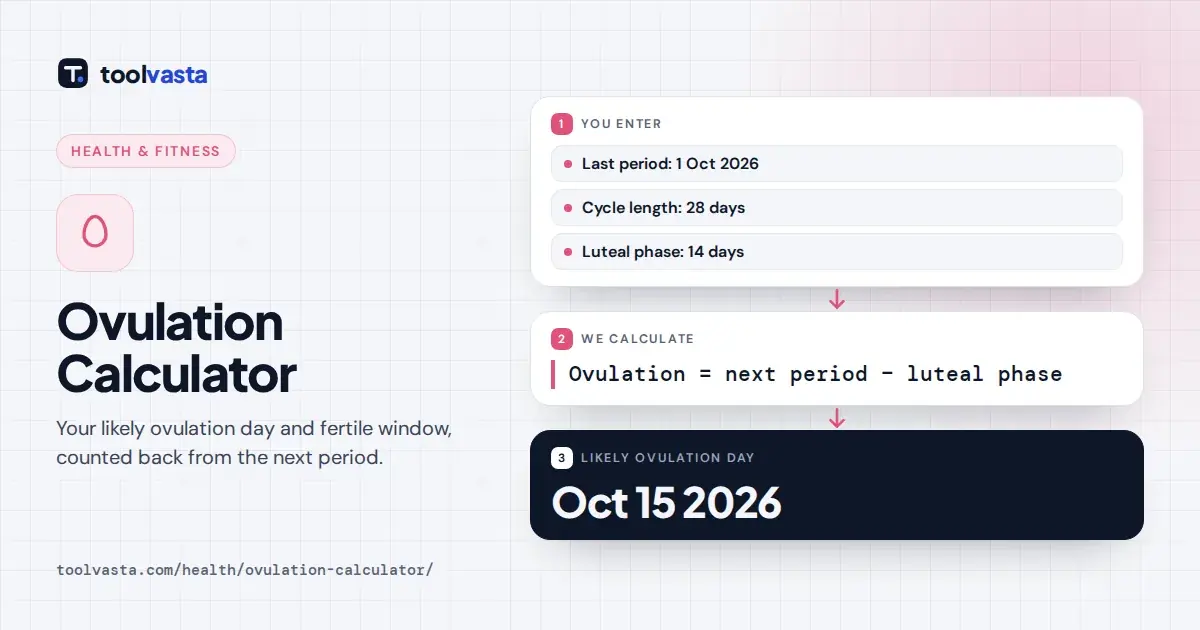
Ovulation day = next period − luteal phase
Fertile window = ovulation day − 5 days to ovulation day + 1
The calculator does not count forward from your period. It finds the next period, then it will count back by the luteal phase. That is why longer cycles move ovulation later rather than lengthening everything.
If your luteal phase is shorter or longer than 14 days, enter your own tracked figure between 9 and 17. The Office on Women's Health notes that this gap can vary from person to person.
The Fertile Window Explained
Sperm can survive in the reproductive tract for up to five days, while an egg lives for about 12 to 24 hours after release. Together these set how many days pregnancy is possible each cycle.
The fertile window therefore covers the five days before ovulation, the day of ovulation and the day after. The chance of pregnancy is highest from two days before ovulation to the day of ovulation itself.
Couples trying to conceive are often advised to have sex every other day during the fertile window. That helps keep sperm present when the egg is released, without the pressure of pinpointing one exact day.
Worked Example: A 28-Day Cycle
Here is a worked example using real dates. Your last period began on September 1, 2026, with a regular 28-day cycle and a 14-day luteal phase. The next period is due on September 29, 2026.
Counting back 14 days gives ovulation on Tuesday, September 15, and a fertile window from September 10 to September 16. The most fertile days, which are shown separately, run from September 13 to September 15.
With a 32-day cycle and a 12-day luteal phase, ovulation moves later, to September 21 and the fertile window to September 16 to 22. The next period would then be due on October 3, 2026.
Ovulation by Cycle Length
Cycle day 1 is the first day of your period. On a 28-day cycle, ovulation falls 14 days after the period starts, which is cycle day 15, not day 14 as it is often quoted.
| Cycle length | Likely ovulation (14-day luteal phase) | Fertile window |
|---|---|---|
| 24 days | Cycle day 11 | Days 6 to 12 |
| 26 days | Cycle day 13 | Days 8 to 14 |
| 28 days | Cycle day 15 | Days 10 to 16 |
| 30 days | Cycle day 17 | Days 12 to 18 |
| 32 days | Cycle day 19 | Days 14 to 20 |
| 35 days | Cycle day 22 | Days 17 to 23 |
The calculator accepts cycles between 21 and 45 days. Cycles outside that range, or cycles that change by more than a few days each month, are worth discussing with a family doctor or nurse practitioner.
The average cycle is about 28 days, but normal cycles vary in length. With irregular cycles, use your average cycle length and treat the fertile window as a rough guide rather than a fixed date.
Signs That Confirm Ovulation
A calendar estimate works best for fairly regular cycles. Ovulation predictor kits detect the rise in luteinizing hormone, the LH surge, which usually comes about 24 to 36 hours before the egg is actually released.
Cervical mucus becomes clear, slippery and stretchy near ovulation. Basal body temperature, taken each morning before getting up, shows a small but lasting rise after ovulation, confirming that ovulation has already happened in that cycle.
Some people notice mild cramping on one side or breast tenderness around ovulation. After a few months of tracking these signs, enter your real luteal phase length for a more personal estimate from the calculator.
When to Take a Pregnancy Test
The calculator gives the earliest reliable test date as the day your next period is due. Home tests detect the hormone hCG, which starts to build after implantation of a fertilized egg in the uterus.
Testing before a missed period can give a false negative, because hormone levels may still be too low. If the result is negative but your period does not arrive, test again a few days later.
A positive home test should be followed by a visit to a doctor or midwife, who can confirm the pregnancy and date it. Early care matters, so book that appointment soon after a positive result.
Limits of an Ovulation Estimate
Every result here is an estimate for general information, not medical advice. Stress, illness, travel, breastfeeding and conditions such as polycystic ovary syndrome can shift ovulation or stop it entirely for a cycle or more.
This calculator is not a method of birth control, because it cannot detect early or late ovulation. For fertility awareness methods, see the ACOG guide and speak with a clinician about options that suit you.
If you are under 35 and have been trying to conceive for 12 months, or 35 or older and trying for 6 months, it is a good time to see a doctor about fertility testing.
Frequently asked questions
How do I calculate my ovulation day?
Add your cycle length to the first day of your last period to find your next period, then subtract 14 days for the luteal phase. On a 28-day cycle, ovulation falls around cycle day 15.
How many days is the fertile window?
About seven days: the five days before ovulation, the day of ovulation and the day after. You are most likely to conceive in the two days before ovulation and on the day itself.
Can I ovulate if my cycle is irregular?
Yes, but the day changes from cycle to cycle, so a calendar estimate is less reliable. Ovulation test strips or basal body temperature tracking can show when it actually happens.
When should I take a pregnancy test?
Most home tests are reliable from the day your period is due, about 14 days after ovulation. Testing earlier can give a false negative because hormone levels are still low.
Is an ovulation calculator a form of birth control?
No. It estimates average timing and cannot account for early or late ovulation in any given cycle. Talk to a health professional about reliable contraception that suits you.
Are ovulation calculators accurate?
They are a reasonable estimate for regular cycles, because the luteal phase is fairly stable. They cannot confirm ovulation, so combine the calendar with LH tests or temperature tracking for better accuracy.