How to Use the Body Fat Calculator
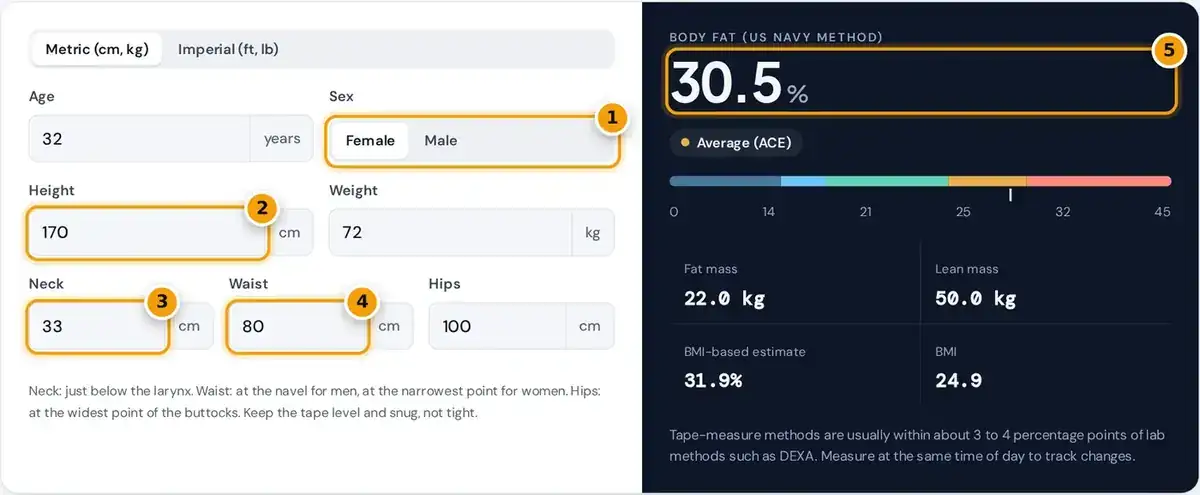
- Select female or male; women also need a hip measurement.
- Enter your height and weight.
- Measure your neck just below the larynx and enter it.
- Enter your waist and, for women, hips, keeping the tape level and snug.
- Read your body fat percentage, ACE category, fat mass and lean mass.
You need a soft tape measure. Stand relaxed, breathe out gently and measure on bare skin. Measure your neck just below the larynx, with the tape sloping slightly down toward the front of your throat.
Men measure the waist at the navel. Women measure the waist at its narrowest point and the hips at the widest part of the buttocks. Measure each two or three times and use the average.
Then enter your sex, height, weight and age in metric or imperial. The body fat calculator shows your body fat percentage, its category, your fat mass and lean mass, and a second estimate from BMI.
The US Navy Body Fat Formula
The US Navy body fat calculator method comes from Hodgdon and Beckett, in the original 1984 Naval Health Research Center report. It predicts body density from circumferences and height, using the logarithm of each measurement.
Density is then converted to body fat with the Siri equation, which is where the 495 and 450 in each formula come from. All measurements enter the equations in centimeters, even when you enter inches.
Men use the waist minus the neck, while women use the waist plus the hips minus the neck. The separate equations reflect real differences in where men and women usually store fat on the body.
Women: %BF = 495 / (1.29579 − 0.35004 log10(waist + hip − neck) + 0.22100 log10(height)) − 450
The BMI-Based Deurenberg Estimate
The calculator also shows the Deurenberg estimate from the 1991 Deurenberg study, which uses only BMI, age and sex. It needs no tape measure, so it works as a quick cross-check on the tape method.
Knowing only height and weight, it cannot see where weight is carried. A muscular person with a slim waist may get a high BMI estimate while the navy body fat calculator shows much less fat.
When the results differ a lot, trust the Navy figure for tracking, since it uses your actual shape. When they agree closely, you can be more confident that your estimate sits in the right range.
(sex = 1 for men, 0 for women)
Worked Example With Real Measurements
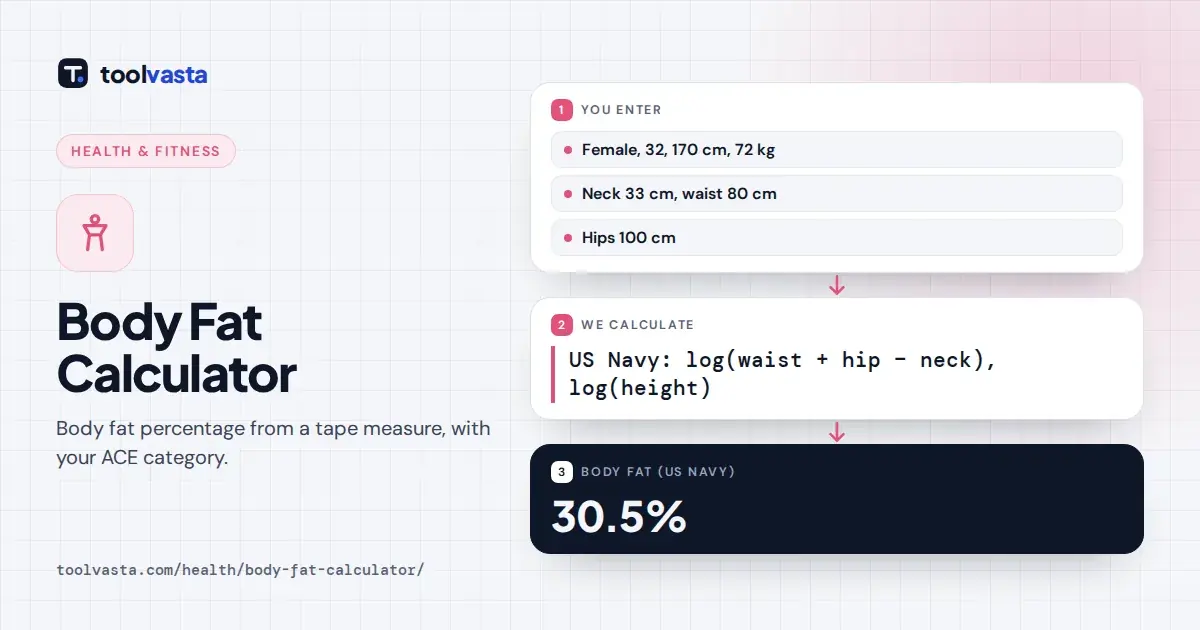
In this worked example, a 32-year-old woman is 170 cm tall and weighs 72 kg, with a 33 cm neck, 80 cm waist and 100 cm hips. Waist plus hips minus neck is 147 cm.
The Navy formula then gives 30.5% body fat, which places her in the ACE Average range. Her fat mass is 72 times 0.305, or 22.0 kg, and her lean mass is the remaining 50.0 kg.
Her BMI is 24.9, giving a Deurenberg estimate of 31.9%, near the tape result. For comparison, a 40-year-old man 180 cm tall with a 38 cm neck and 90 cm waist comes out at 19.8%.
Body Fat Percentage Chart From ACE
The categories in the result come from the American Council on Exercise, usually known as ACE. The chart splits body fat percentage into essential fat, athletes, fitness, average and obese ranges for women and men.
Women naturally carry more essential fat than men, which the body needs for hormone and reproductive health. That is why every range for women sits several percentage points higher than the matching range for men.
The ACE chart does not change with age, although body fat tends to rise slowly as people get older. Treat the category as a guide to where you stand, rather than a precise health target.
| Category | Women | Men |
|---|---|---|
| Essential fat | 10 to 13% | 2 to 5% |
| Athletes | 14 to 20% | 6 to 13% |
| Fitness | 21 to 24% | 14 to 17% |
| Average | 25 to 31% | 18 to 24% |
| Obese | 32% and above | 25% and above |
How Accurate Is the Navy Method?
For most adults, tape-measure methods land within about 3 to 4 percentage points of lab methods such as a DEXA scan or underwater weighing. That is similar to a careful skinfold test done with calipers.
Home scales that use bioelectrical impedance can swing with hydration, while the Navy method depends mainly on measuring technique. Use the same tape, the same spots and the same time of day for every reading.
The trend over several weeks matters more than any single number. If your waist falls while your weight stays steady, the calculator will show body fat dropping, even when the scale barely moves at all.
Limits and Health Notes
The formulas were developed in adults and are not designed for children, pregnant people or older adults with significant muscle loss. Very lean or muscular bodies can fall outside the range they were built on.
- Not designed for children, pregnant people or older adults with major muscle loss.
- Very lean, very muscular or very large bodies may fall outside the equations.
- Body fat alone does not describe health.
Body fat alone does not describe health. Waist size, fitness, blood pressure and routine blood tests all add to the picture, and two people with the same percentage can have very different health risks overall.
Results are estimates for general information only and are not medical advice. Talk with a doctor or registered dietitian before making any big changes, especially if you are pregnant, breastfeeding or managing a health condition.
Frequently asked questions
How does the US Navy body fat calculator work?
It uses your height and neck and waist measurements, plus hips for women, in equations developed for the US Navy in 1984. The result is an estimate of your body fat percentage.
What is a healthy body fat percentage?
According to ACE, 21 to 31% is typical for women in the fitness and average ranges, and 14 to 24% for men. Essential fat is about 10 to 13% for women and 2 to 5% for men.
Why are my Navy and BMI results different?
The Navy method uses your actual body measurements, while the Deurenberg estimate uses only BMI, age and sex. The Navy result is usually more personal, especially for muscular people.
Where do I measure my waist for body fat?
Men measure at the navel. Women measure at the narrowest part of the waist, usually just above the navel. Keep the tape level and snug against the skin, but do not pull it tight.
How accurate is the US Navy body fat method?
It is usually within about 3 to 4 percentage points of lab tests such as DEXA. Consistent measuring technique makes it much more reliable for tracking change over weeks and months.
How often should I measure my body fat?
Every two to four weeks is enough to see a real trend. Measure at the same time of day, ideally in the morning before eating, and use the average of two or three readings.