How to Use the Midparental Height Calculator
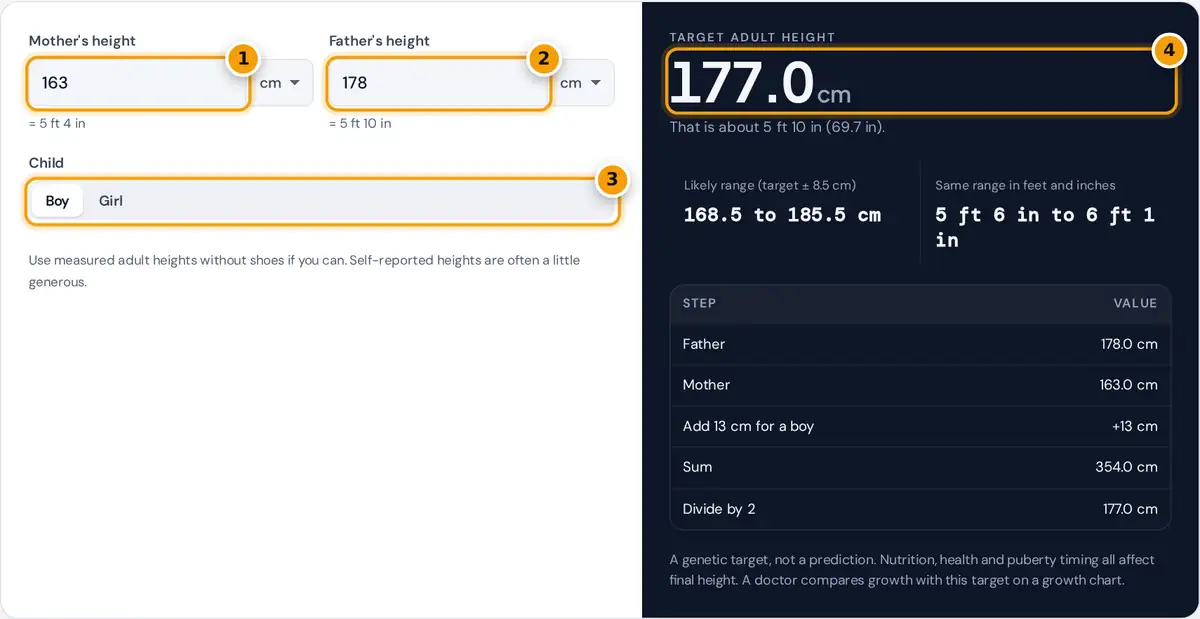
- Enter the mother's height in cm or inches.
- Enter the father's height in cm or inches.
- Choose boy or girl.
- Read the target adult height and the likely range in both unit systems.
Enter the biological mother's height and the biological father's height. Each can be in centimeters or inches, and switching the unit converts the number already typed. Choose whether the child is a boy or a girl. The result updates as you type.
The large number is the midparental target height, the adult height the child would reach if they grew along the average of their parents' heights adjusted for sex. Below it you get the likely range in both unit systems and a step by step table, so you can check the math or explain it to someone else.
Midparental Height Formula
The method used here is the one described by British pediatrician James Tanner and colleagues. Men are on average about 13 cm (5 in) taller than women, so one parent's height is adjusted by 13 cm before averaging. Halving the sum means the net adjustment is 6.5 cm.
girl: (father + mother − 13 cm) ÷ 2
imperial: (father + mother ± 5 in) ÷ 2
likely range = target ± 8.5 cm
Worked Example
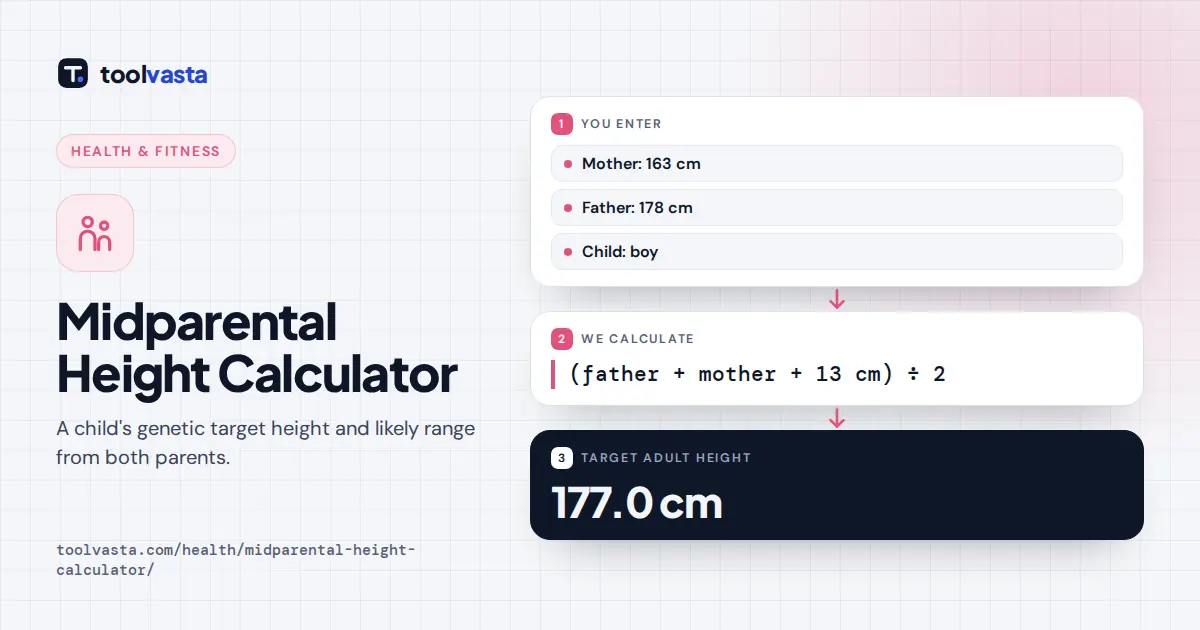
The mother is 163 cm and the father is 178 cm. For a boy, (178 + 163 + 13) ÷ 2 = 177.0 cm, about 5 ft 10 in. The likely range is 168.5 to 185.5 cm. For a girl, (178 + 163 − 13) ÷ 2 = 164.0 cm, about 5 ft 5 in, with a range of 155.5 to 172.5 cm. In imperial units, parents of 64 in and 70 in give a boy about 69.6 in (5 ft 9.6 in).
Quick Reference Table
| Mother | Father | Boy target | Girl target |
|---|---|---|---|
| 155 cm | 170 cm | 169.0 cm | 156.0 cm |
| 160 cm | 175 cm | 174.0 cm | 161.0 cm |
| 165 cm | 180 cm | 179.0 cm | 166.0 cm |
| 170 cm | 185 cm | 184.0 cm | 171.0 cm |
| 175 cm | 190 cm | 189.0 cm | 176.0 cm |
Metric and Imperial Results
The calculator always works in centimeters and converts afterwards, so mixing units is fine: you can enter one parent in inches and the other in centimeters. In imperial units the usual sex adjustment is 5 inches, which is 12.7 cm, so a hand calculation in inches can differ from the metric result by a fraction of an inch. That gap is far smaller than the normal range around the target, so either version gives the same practical answer.
When you use the result, focus on the range rather than the single number. A boy with a target of 177 cm finishing at 172 cm or 182 cm is still well within the expected spread for his family.
How Doctors Use the Target
Pediatricians plot a child's height on a growth chart and compare the child's track with the midparental target. A child growing steadily along a line that leads into the target range is usually following the family pattern. A child whose track sits well outside the range, or who crosses percentile lines over time, may get a closer look. That comparison needs repeated measurements, which only a health professional can interpret.
Limits of the Estimate
- The range of about ± 8.5 cm covers most children, but some healthy children end up outside it.
- Children of very tall or very short parents tend to land a little closer to the population average than the formula suggests.
- It needs both biological parents' heights. It cannot account for nutrition, chronic illness or the timing of puberty.
- Methods based on bone age or the child's current height are separate tools used by specialists.
For growth chart information, see the WHO Child Growth Standards.
Results are estimates for general information, not medical advice. Talk with a doctor or registered dietitian before big changes to diet, exercise or sleep, especially if you are pregnant, under 18 or managing a health condition.
Frequently asked questions
How do you calculate midparental height?
Add the father's and mother's heights. For a boy add 13 cm, for a girl subtract 13 cm, then divide by 2. In inches, use 5 in instead of 13 cm. The result is the child's target adult height.
How accurate is the midparental height method?
It gives a genetic target, not an exact prediction. Most children finish within about 8.5 cm of the target, but nutrition, health and puberty timing can move final height up or down.
Why is 13 cm added for boys?
Adult men are on average about 13 cm taller than adult women. Adding 13 cm for boys, or subtracting it for girls, puts both parents on the same scale before taking the average.
Can a child be taller than both parents?
Yes. Children often differ from the target, and populations have grown taller over generations with better nutrition. The range of about plus or minus 8.5 cm shows how much variation is normal.
Does the calculator work for adopted children?
No. The method relies on the heights of the biological parents, because it estimates inherited growth potential. Without those heights, a doctor would track the child on a growth chart instead.
When should I talk to a doctor about my child's height?
Speak with your child's doctor if growth seems to slow or stop, if your child crosses percentile lines on the growth chart, or if their height is far from the family pattern.