How to Use the Creatine Water Calculator
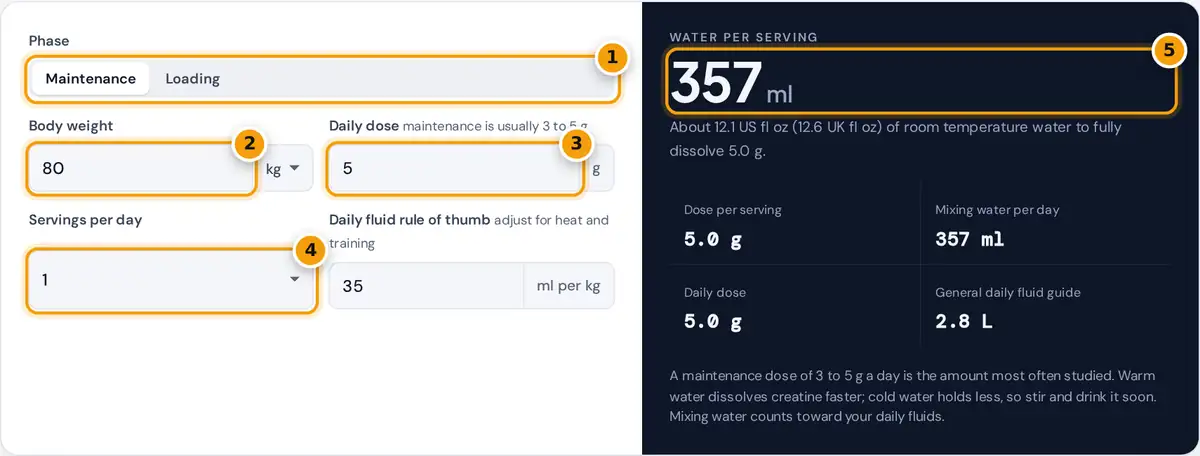
- Choose maintenance or the optional loading phase.
- Enter your body weight in kg or lb.
- Set your daily dose in maintenance mode.
- Pick how many servings you split the day into.
- Read the water per serving, daily mixing water and dose.
Choose Maintenance for the everyday dose or Loading for the optional first week. Enter your body weight in kilograms or pounds. In maintenance you can type your own daily dose, while loading sets the dose from your weight. Pick how many servings you split the day into.
The large result is the amount of room temperature water that fully dissolves one serving of creatine monohydrate. You also see the dose per serving, the total mixing water for the day, the daily dose and a general daily fluid figure based on a simple per kilogram rule of thumb that you can adjust.
How the Water Amount Is Calculated
water to dissolve (ml) = dose (g) ÷ 14 g per liter × 1,000
loading dose = 0.3 g × body weight (kg) per day
fluid guide = ml per kg × body weight
Creatine monohydrate dissolves in water at about 14 g per liter at 20 °C, a figure reported in reviews of creatine forms. That is why a 5 g scoop often leaves grit in a small glass: about 357 ml is needed to dissolve it completely. Warmer water holds more, and acidic drinks such as juice also help it dissolve. Undissolved creatine is still absorbed once swallowed, so a little sediment is a texture issue rather than a wasted dose.
Worked Example
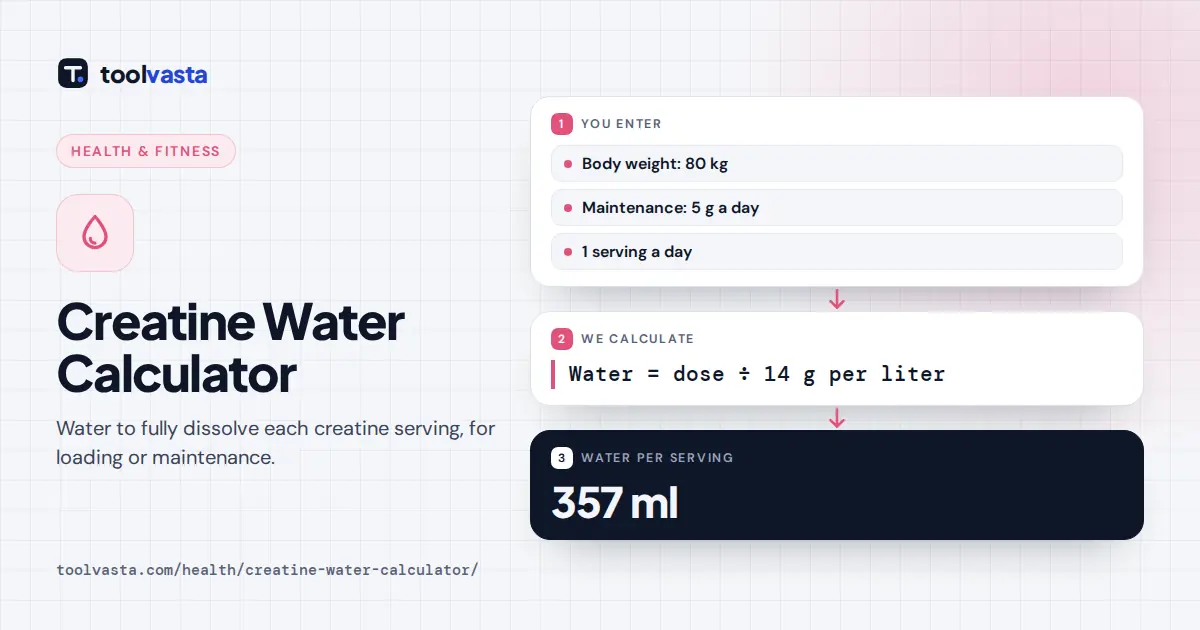
An 80 kg lifter takes 5 g of creatine once a day. Dissolving 5 g at 14 g per liter needs 5 ÷ 14 × 1,000 = 357 ml of water, about 12.1 US fl oz. If the same lifter loads at 0.3 g per kg, the daily dose is 24 g. Split into 4 servings of 6 g, each needs about 429 ml, or 1,714 ml across the day. A rule of thumb of 35 ml per kg gives a general fluid figure of 2.8 L a day.
Water per Creatine Serving
| Creatine per serving | Water to dissolve | US fl oz |
|---|---|---|
| 3 g | 214 ml | 7.2 |
| 5 g | 357 ml | 12.1 |
| 6 g | 429 ml | 14.5 |
| 10 g | 714 ml | 24.2 |
Loading Versus Maintenance
Loading is optional. A common protocol is 0.3 g per kg of body weight a day, often about 20 g, split into four or five servings for five to seven days, followed by 3 to 5 g a day. Loading fills muscle creatine stores in about a week. Skipping it and taking 3 to 5 g daily reaches similar levels in roughly three to four weeks. Splitting large loading doses helps many people avoid stomach upset.
Whichever route you choose, consistency matters more than timing. Taking creatine at the same time every day, for example with breakfast or a post training shake, makes it easier to remember.
Practical Tips
- Stir creatine into water, juice, a shake or yogurt. Timing around training matters far less than taking it daily.
- Creatine can add a little water to muscle, so early weight gain of about 1 kg is common and is not fat.
- Drink to thirst and pale yellow urine. Training in heat or sweating heavily raises fluid needs above any simple rule.
- Choose a product that is third party tested, because supplements are not checked the same way as medicines.
Limits
This calculator gives general guidance only and makes no health claims. The fluid figure is a simple rule of thumb, not a personal requirement. People with kidney disease, those taking medicines that affect the kidneys, and anyone pregnant, breastfeeding or under 18 should speak with a doctor or pharmacist before taking creatine. Health Canada lists licensed natural health products on its website.
Results are estimates for general information, not medical advice. Talk with a doctor or registered dietitian before big changes to diet, exercise or sleep, especially if you are pregnant, under 18 or managing a health condition.
Frequently asked questions
How much water should I mix with 5 g of creatine?
About 357 ml (12 US fl oz) of room temperature water fully dissolves 5 g of creatine monohydrate, based on a solubility of about 14 g per liter at 20 °C. Less water leaves some grit.
Does creatine need to fully dissolve?
No. Undissolved creatine is still absorbed after you swallow it, so a little sediment is mostly a texture issue. Stir well and drink the last sip to get the whole dose.
How much creatine should I take a day?
A maintenance dose of 3 to 5 g a day is the amount most often studied. An optional loading phase uses about 0.3 g per kg of body weight a day for 5 to 7 days.
Do I need to drink more water on creatine?
Creatine draws some water into muscle, so many people drink a little more. There is no exact official figure. Drink to thirst, aim for pale urine and increase fluids in heat or during heavy training.
Can I mix creatine with hot water or juice?
Yes. Warm water and acidic drinks such as juice dissolve creatine more easily. Drink it soon after mixing rather than storing a mixed drink for days.
Is creatine safe to take?
Creatine monohydrate is one of the most studied supplements. People with kidney problems, those on related medicines, and anyone pregnant or under 18 should ask a doctor or pharmacist first.