How to Use the Snowboard Length Calculator
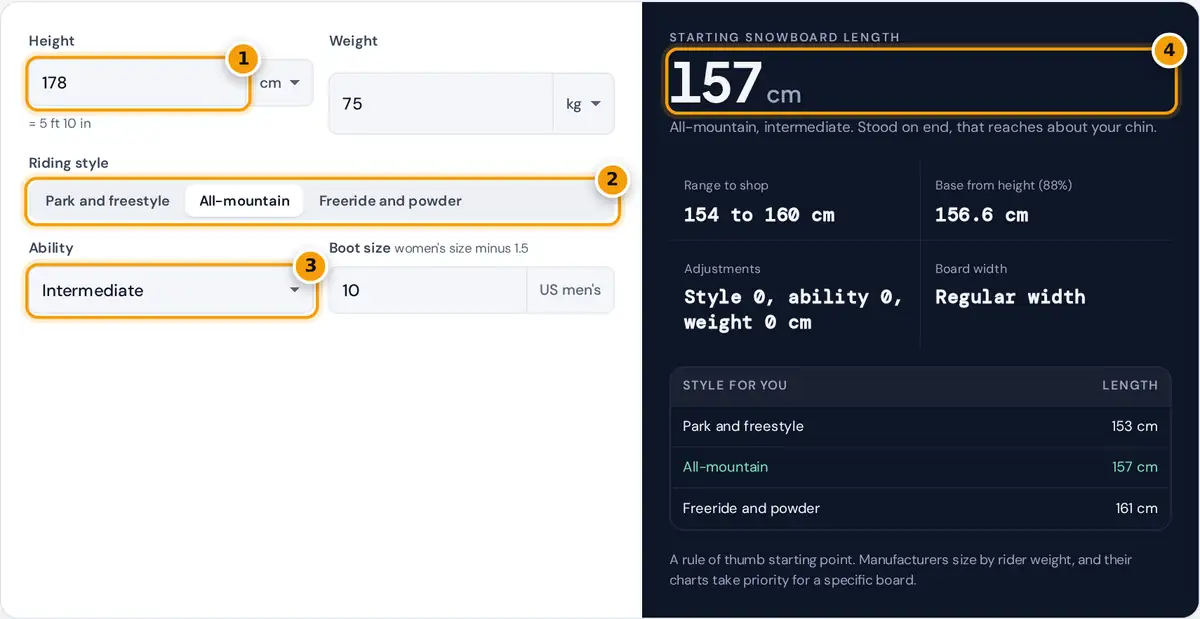
- Enter height and weight in metric or imperial units.
- Choose your main riding style.
- Pick your ability and add your boot size.
- Read your starting length, range, adjustments and width advice.
Enter your height in centimeters or inches and your weight in kilograms or pounds. Choose the style you ride most: park and freestyle, all-mountain, or freeride and powder. Then pick your ability and, if you know it, your boot size in US men's sizes. For women's sizes, subtract about 1.5 to convert.
The result is a starting length in centimeters with a range of 3 cm either side to shop within. The panel shows the base length from your height, each adjustment that was applied, a width suggestion from your boot size, and the length you would get for each riding style so you can compare.
How the Snowboard Length Is Estimated
style: park −4 cm, all-mountain 0, freeride +4 cm
ability: beginner −3 cm, intermediate 0, advanced +2 cm
weight (by BMI): under 20 −2 cm, 20 to 25 0, 25 to 30 +3 cm, 30+ +5 cm
range = result ± 3 cm
The 88% of height starting point reflects the long standing rule that a board stood on end should reach somewhere between your chin and your nose. Shorter boards turn and spin more easily, which suits park riding and beginners. Longer boards are more stable at speed and float better in powder. Riders who are heavy for their height need more board to support them, so weight relative to height shifts the result.
Worked Example
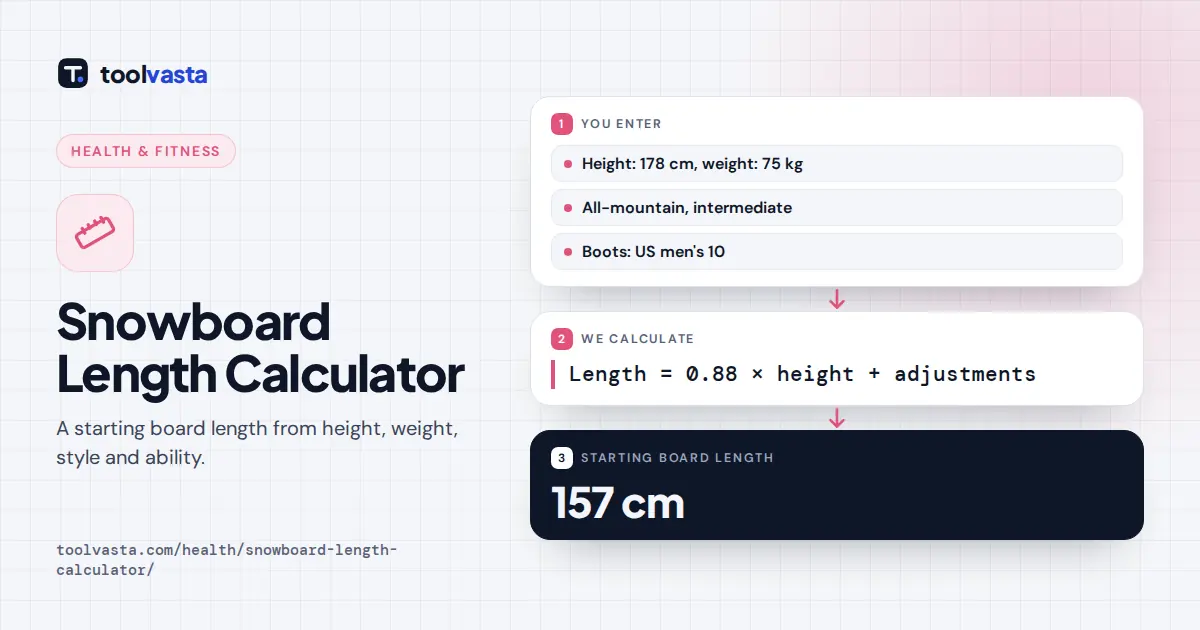
A rider who is 178 cm tall and weighs 75 kg has a base length of 178 × 0.88 = 156.6 cm. Their BMI is 23.7, so there is no weight adjustment. Riding all-mountain at an intermediate level adds nothing either, so the starting length is 157 cm, with a range of 154 to 160 cm. The same rider would start at 153 cm for park riding and 161 cm for freeride. With US men's size 10 boots, a regular width board fits.
Snowboard Size Chart by Height
| Height | Park | All-mountain | Freeride |
|---|---|---|---|
| 155 cm (5 ft 1 in) | 132 cm | 136 cm | 140 cm |
| 165 cm (5 ft 5 in) | 141 cm | 145 cm | 149 cm |
| 175 cm (5 ft 9 in) | 150 cm | 154 cm | 158 cm |
| 185 cm (6 ft 1 in) | 159 cm | 163 cm | 167 cm |
| 195 cm (6 ft 5 in) | 168 cm | 172 cm | 176 cm |
The chart is for an intermediate rider of average build. Use the calculator for your own weight and ability.
Length, Shape and Flex
Two boards of the same length can ride very differently. Rocker profiles lift the tip and tail off the snow, so they feel shorter and looser, while camber boards hold an edge with more of their length. Directional freeride boards often set the stance back for float in powder. If you choose a rocker or a volume shifted board, many riders go a few centimeters longer or wider than usual. Softer boards suit park riding and learning, and stiffer boards suit speed.
Choosing Board Width
If your boots hang too far over the edges, the toe or heel can drag in the snow during deep turns. As a rough guide, riders in US men's size 11 boots and larger usually look at wide boards, and size 10.5 is a borderline case for mid-wide models. Boot design and binding angles also change overhang, so check the waist width listed for each board.
Limits
- This is a rule of thumb starting point, not a manufacturer chart. Each board model lists a recommended rider weight range: stay inside it.
- Board shape matters as much as length. Rocker and volume shifted boards often ride shorter than their length suggests.
- Rent or demo before buying if you are between sizes, and ask a shop to check stance width and boot fit.
Frequently asked questions
What size snowboard do I need for my height?
A common starting point is about 88% of your height, so the board stood on end reaches between your chin and nose. A 178 cm rider starts around 157 cm for all-mountain riding.
Does weight matter more than height for snowboard size?
Manufacturers size boards mainly by rider weight, because weight decides how the board flexes. Height gives a quick starting point. Always check the weight range listed for the board you choose.
Should a beginner get a shorter snowboard?
Yes, usually by a few centimeters. A shorter board is easier to turn and control at low speed. This calculator takes about 3 cm off for beginners.
What length snowboard is best for park riding?
Park and freestyle riders often choose a board about 3 to 5 cm shorter than their all-mountain length. Shorter boards are lighter to spin and easier to press on rails and boxes.
When do I need a wide snowboard?
If you wear US men's size 11 boots or larger, a wide board usually prevents toe and heel drag. Size 10.5 is borderline, so compare the board's waist width with your boot length.
Is this snowboard size chart accurate for every board?
No. It is a starting point only. Board shape, rocker profile and flex all change how a length rides, so use the maker's size chart for the specific model you buy.