How to Use the Conception Date Calculator
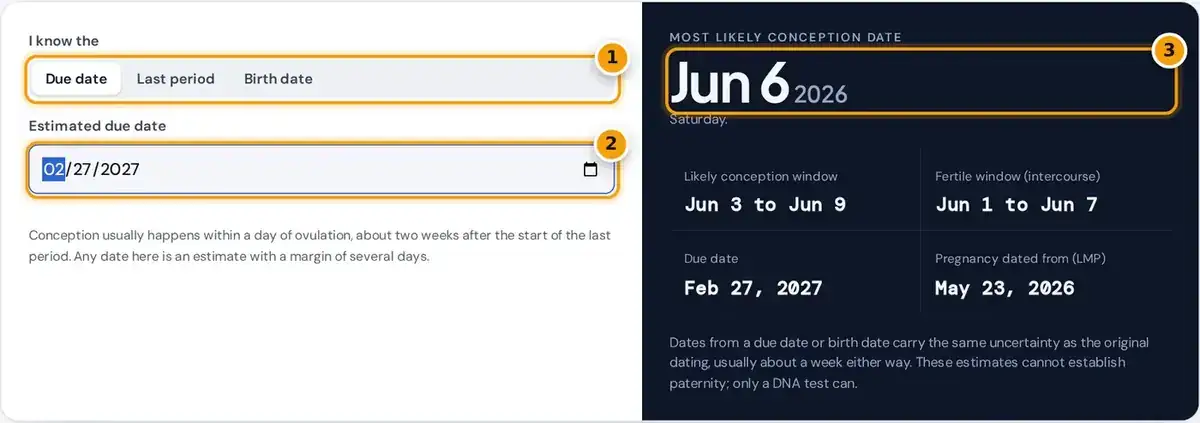
- Choose what you know: due date, last period or birth date.
- Enter the estimated due date from your care provider or scan.
- Read the most likely conception date, then the likely window and fertile days around it.
Choose what you know: an estimated due date, the first day of the last period, or a baby's birth date. A due date from your care provider or an ultrasound is usually the most accurate.
For the last period option, also enter your usual average cycle length. For the birth date option, enter how many weeks pregnant you were at birth, plus any extra days, between 22 and 44 weeks.
The conception date calculator then shows the most likely conception date and its weekday, a likely window of about a week around it, and the fertile window when intercourse most likely led to the pregnancy.
How the Conception Date Is Estimated
Pregnancy is dated from the first day of the last menstrual period, or LMP, and the due date is 280 days later. That count is gestational age, and it runs two weeks ahead of conception.
From last period: conception = LMP + cycle length − 14 days
From birth date: conception = birth date − (gestational age at birth in days − 14)
Fertile window = conception − 5 days to conception + 1 day
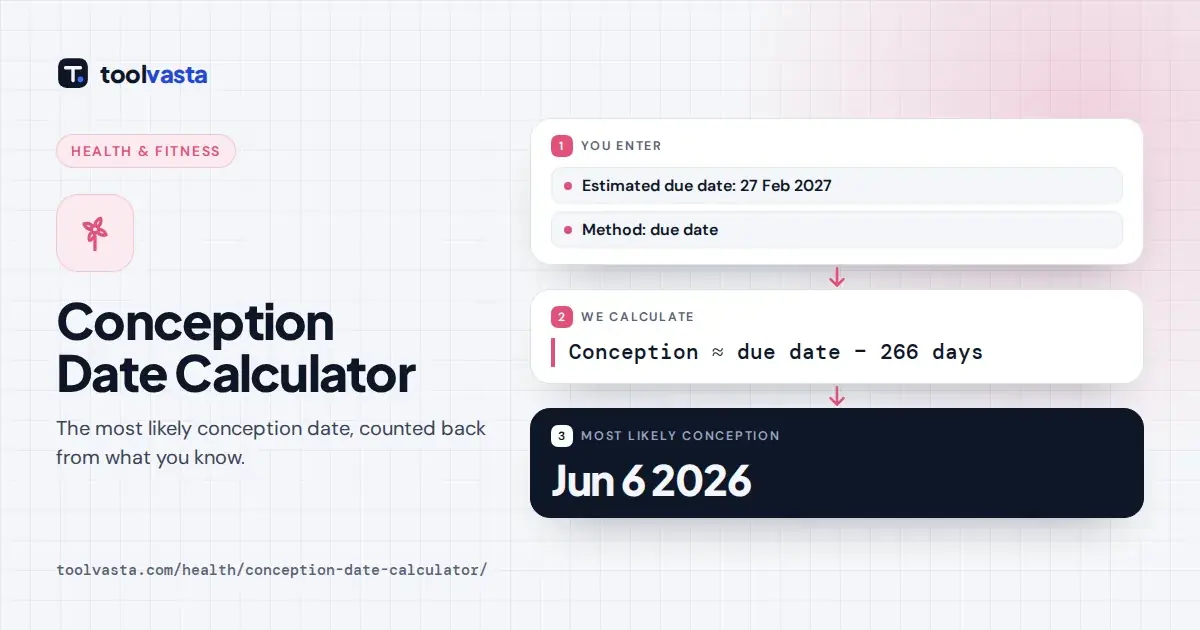
Ovulation, and with it conception, usually happens about 14 days before the next period. So conception sits about 266 days, or 38 weeks, before the due date. Fetal age counts from that point onward instead.
With the last period method, a longer cycle pushes ovulation later. The calculator adds your cycle length to the LMP and subtracts 14 days, so a 30-day cycle moves conception two days later than 28.
Fertilization, Conception and Implantation
Conception means fertilization: a sperm joining an egg, usually in a fallopian tube. The egg can be fertilized for only about 12 to 24 hours after ovulation, so the biological timing window is quite narrow.
Sperm can survive for up to five days, so intercourse several days before ovulation can lead to pregnancy. That is why the calculator shows a fertile window from five days before to one day after.
The fertilized egg travels to the uterus, and implantation follows several days later. Only after implantation does the pregnancy hormone start to rise, which is why home pregnancy tests work from around the missed period.
Worked Example: Due Date of December 25, 2026
A worked example: your due date is December 25, 2026. Counting back 266 days gives a most likely conception date of Friday, April 3, 2026, with a likely window from March 31 to April 6.
The fertile window runs from March 29 to April 4, because sperm can live for up to five days. The implied last period started on March 20, 2026, exactly 280 days before the due date.
From a birth date instead, a baby born on June 15, 2026, at 38 weeks and 3 days, or 269 days, was likely conceived about 255 days earlier, around October 3, 2025, give or take.
Conception From Due Date: Quick Reference
This quick reference table applies the 266-day rule, sometimes called a reverse due date calculation, to four sample due dates. Use the calculator above for any other date, including the weekday and both full windows.
| Due date | Likely conception |
|---|---|
| January 1, 2027 | April 10, 2026 |
| March 1, 2027 | June 8, 2026 |
| June 1, 2027 | September 8, 2026 |
| September 1, 2027 | December 9, 2026 |
For the last period method, a February 10, 2026 period with a 30-day cycle gives conception on February 26, 2026. The calculator projects a due date of November 19, 2026, adjusted for the longer cycle.
Remember that each date in the table is the single most likely day. The real conception date could fall a few days either side, which the likely window and the fertile window make clearly visible.
How Accurate Is a Conception Date?
Conception dates are always estimates, not exact facts. Ovulation can happen earlier or later than expected, even in regular cycles, and sperm can wait inside the body for several days before an egg is released.
A due date set by a first-trimester ultrasound, which measures crown-rump length, is accurate to within about 5 to 7 days, per ACOG guidance on estimating the due date. Any conception date inherits that uncertainty.
Dates based on a birth date are less precise, because babies are born across a range of weeks and due date accuracy is limited. For IVF pregnancies, timing is known exactly from the embryo transfer.
Can a Conception Date Prove Paternity?
No. When possible conception dates are close together, natural variation in ovulation and pregnancy length is larger than the gap between them. The margin of error is simply too wide to tell them apart reliably.
Only a DNA test can reliably establish paternity. Prenatal and postnatal tests are available through clinics and accredited laboratories, and a doctor or midwife can explain which option best suits your own situation and timing.
If this question is weighing on you, a family doctor, midwife or trained counselor can talk through all your options in confidence. You do not need to decide anything based on a calculator estimate alone.
Limits of the Estimate
This calculator gives an estimate for general information, not medical advice. The last period method assumes a luteal phase of about 14 days, which actually varies from person to person and from cycle to cycle.
Irregular cycles, recent hormonal contraception and breastfeeding make period-based dates less reliable. If your care provider gave you an updated due date after an ultrasound, always use the updated date instead of the original one.
Gestational age and fetal age differ by about two weeks, as MedlinePlus explains. Only your doctor, midwife or care provider can confirm your pregnancy dates, so ask them about anything that seems unclear or worrying.
Frequently asked questions
How do I calculate my conception date from my due date?
Subtract 266 days, or 38 weeks, from your due date. This gives the most likely day of conception, with a likely window of about three days either side of that date.
How accurate is a conception date calculator?
It is an estimate. Ovulation timing varies and even first-trimester ultrasound dating has a margin of about a week, so the real date can be several days earlier or later.
Can I find my conception date from my baby's birth date?
Yes, if you know how many weeks pregnant you were at birth. Subtract the length of the pregnancy in days, minus 14, from the birth date to find the likely conception date.
Can a conception date prove who the father is?
No. The margin of error is too large to separate dates that are close together, because ovulation and pregnancy length both vary. Only a DNA test can confirm paternity.
What is the difference between gestational age and fetal age?
Gestational age counts from the first day of the last period, while fetal age counts from conception. Fetal age is about two weeks less, which is why pregnancies are dated as 40 weeks.
When is my conception date if I know my last period?
Add your cycle length to the first day of your last period, then subtract 14 days. With a 28-day cycle, conception is most likely about two weeks after your period started.