How to Use the Weight Loss Calculator
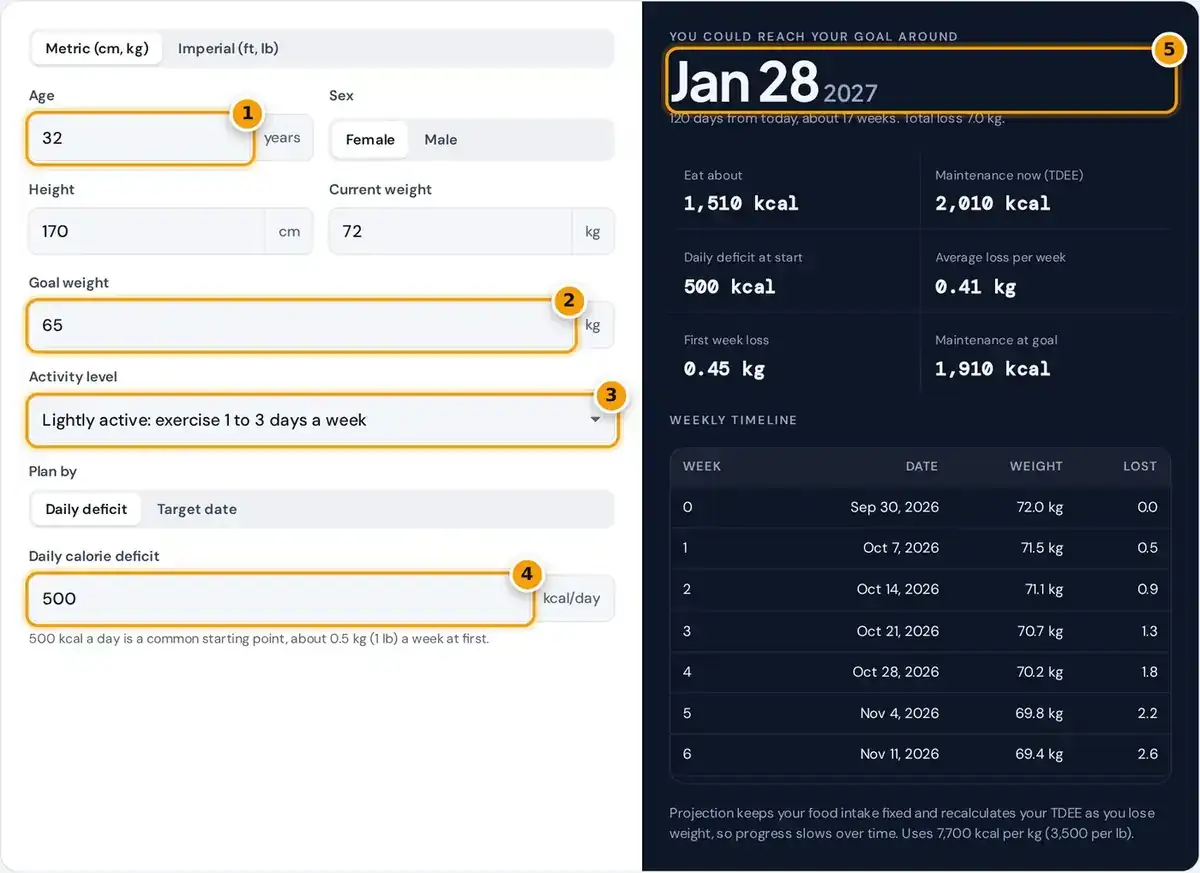
- Enter your age, sex, height and current weight.
- Enter your goal weight.
- Choose your usual activity level.
- Set a daily calorie deficit, or switch to Target date to plan backwards.
- Read your projected goal date, daily calories and the week by week timeline.
Enter your age, sex, height, current weight and goal weight, using metric or imperial units. Then choose the activity level that matches a normal week, from a mostly seated desk job to daily hard training.
Pick how you want to plan. With Daily deficit, you set how many calories below maintenance you will eat and the calculator finds your goal date. With Target date, it works out daily calories instead.
Results show the date you could reach your goal, the calories to eat, your maintenance now and at goal, and the average loss per week. A weekly timeline lists your projected weight for every week.
The Formula Behind the Projection
Maintenance calories, or total daily energy expenditure (TDEE), come from the Mifflin-St Jeor equation for BMR multiplied by your chosen activity factor. It is widely used as the most accurate general equation for healthy adults.
BMR (men) = 10W + 6.25H − 5A + 5
TDEE = BMR × activity factor
Daily change in weight (kg) = (TDEE − calories eaten) / 7,700
W is weight in kg, H is height in cm and A is age in years. Each kilogram lost is counted as 7,700 kcal, the metric version of the familiar 3,500 calories per pound rule.
The calculator runs this one day at a time. Calories eaten stay fixed, but TDEE is recalculated from your new weight daily, so the deficit shrinks and progress slows, giving a more honest goal date.
Worked Example: Losing 7 Kilograms
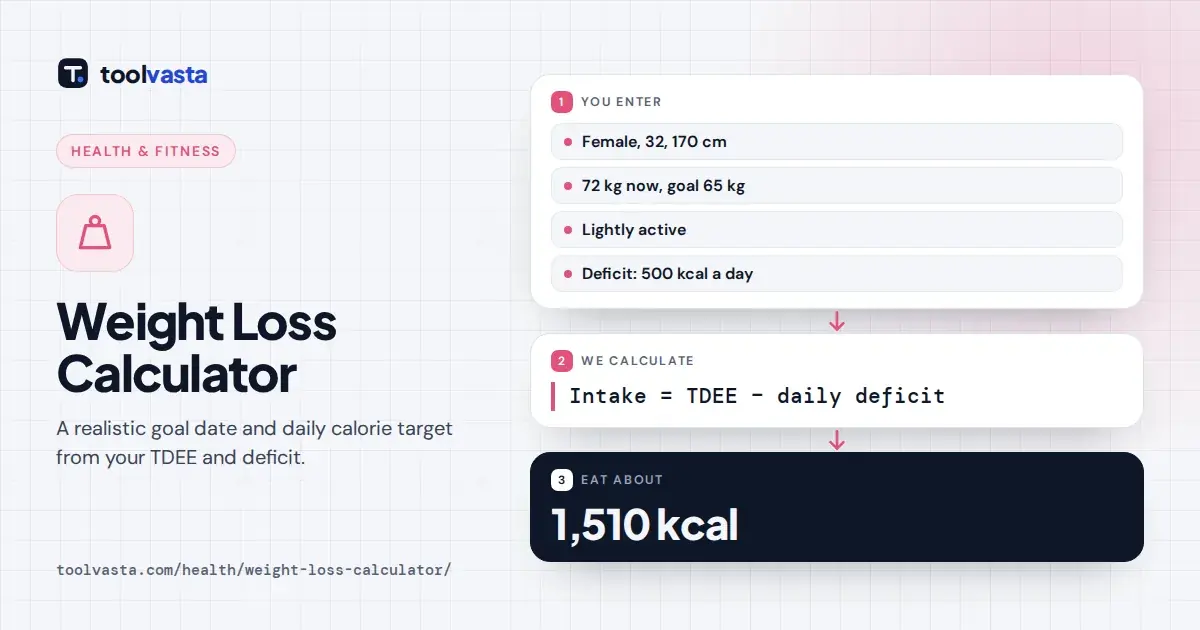
A 32-year-old woman, 170 cm tall and 72 kg, is lightly active with a factor of 1.375. Her BMR works out to 1,461.5 kcal, so her TDEE, or maintenance, is about 2,010 kcal a day.
With a 500 kcal daily deficit, she eats about 1,510 kcal a day. She loses about 0.45 kg in the very first week, and the model reaches the 65 kg goal weight after 120 days.
That is an average loss per week of about 0.41 kg, slower than the first week because her needs fall as she gets lighter. At 65 kg, her maintenance drops to roughly 1,910 kcal daily.
Maintenance Calories and Daily Calorie Intake
The results panel also doubles as a handy maintenance calorie calculator. Maintenance now shows the calories that would keep your weight stable today, and Maintenance at goal shows what you can eat once you arrive.
| Activity level | Factor | Typical week |
|---|---|---|
| Sedentary | 1.2 | Desk job, little exercise |
| Lightly active | 1.375 | Exercise 1 to 3 days |
| Moderately active | 1.55 | Exercise 3 to 5 days |
| Very active | 1.725 | Hard exercise 6 to 7 days |
| Extra active | 1.9 | Physical job plus daily training |
The Eat about figure works like a daily calorie intake calculator: it is simply your starting TDEE minus the deficit. Choose your activity level honestly, because overestimating it inflates maintenance and quietly delays your results.
Moving from sedentary to very active raises maintenance by more than 40% for the same body size. Plan on the activity level you actually keep up most weeks, not the level you hope to reach.
What Is a Safe Rate of Weight Loss?
Most health agencies suggest losing about 0.5 to 1 kg, or 1 to 2 lb, a week. A steady calorie deficit is easier to keep up and protects muscle better than aggressive, very short-term dieting.
| Daily deficit | Approximate loss at first | Notes |
|---|---|---|
| 250 kcal | 0.25 kg (0.5 lb) a week | Gentle, easy to sustain |
| 500 kcal | 0.5 kg (1 lb) a week | Common starting point |
| 750 kcal | 0.7 kg (1.5 lb) a week | Upper end for many people |
| 1,000 kcal | 0.9 kg (2 lb) a week | Usually only with a higher starting weight |
The calculator warns you when the first week is faster than that range or faster than 1% of your body weight. It also flags intake below 1,200 kcal for women or 1,500 kcal for men.
A goal weight below a BMI of 18.5 triggers a separate warning too, because it falls under the healthy adult range. In target date mode, an impossible deadline is rejected with a clear explanatory message.
Protein, Muscle and Making the Plan Work
Ideally, weight loss should come mostly from body fat, not muscle. Eating enough protein and doing strength training two or more days a week helps protect lean muscle while you are in a calorie deficit.
A protein needs calculator turns your weight into a daily target in grams, and Canada's Food Guide shows how to build balanced meals around vegetables, whole grains and protein foods at your chosen calorie level.
Weigh yourself at the same time of day a few times a week and track the weekly average. Recalculate after every 4 to 5 kg lost, because your maintenance calories fall as you lose weight.
Limits of This Estimate
The 7,700 kcal per kg figure is an approximation. Early loss is often faster because of water weight and stored glycogen, which is why the scale can drop quickly and then slow in week two.
Metabolic adaptation can also lower energy use slightly beyond what the equation predicts. The original Mifflin-St Jeor study was built on healthy adults, so results can vary for very muscular athletes and some medical conditions.
Results are estimates for general information, not medical advice. Talk with a doctor or registered dietitian before big changes, especially if you are pregnant, breastfeeding or managing a health condition. The calculator accepts adults only.
Frequently asked questions
How long will it take to reach my goal weight?
It depends on the size of your calorie deficit and how much you want to lose. With a 500 kcal daily deficit most people lose about 0.5 kg (1 lb) a week at first, with progress slowing as they get lighter.
How many calories should I eat to lose weight?
Start with your maintenance calories (TDEE) and subtract 250 to 750 kcal. Women should generally not go below 1,200 kcal a day and men below 1,500 kcal without medical supervision.
Why does weight loss slow down over time?
A lighter body burns fewer calories, so the same food intake creates a smaller deficit. This calculator recalculates your TDEE every day to reflect that, which is why the projected weekly loss shrinks.
What are maintenance calories?
Maintenance calories are the calories you need to keep your weight stable. They equal your total daily energy expenditure, shown as Maintenance now, and a separate figure shows maintenance at your goal weight.
How much weight can I safely lose in a week?
The usual guidance is 0.5 to 1 kg (1 to 2 lb) a week, or about 1% of body weight. Faster loss raises the risk of muscle loss and gallstones, so talk to a doctor first.
Will walking help me lose weight?
Yes, walking raises your daily energy use, which increases the deficit if you keep eating the same amount. Update your activity level in the calculator only if the extra walking is a regular habit.