How to Use the Loan Interest Calculator
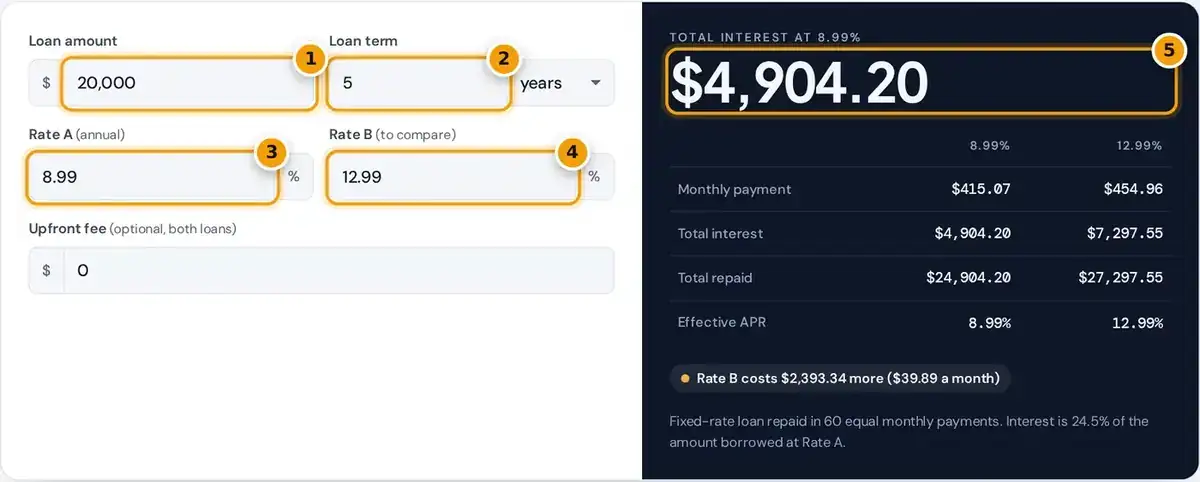
- Enter the amount you want to borrow.
- Set the loan term in years or months.
- Enter the interest rate you were offered.
- Enter a second rate to compare, such as another lender's offer.
- Read the total interest, then compare payments and total repaid for both rates.
Enter the loan amount and the loan term in years or months. Put the rate you were offered in Rate A, and a second offer, or a rate you hope to get, in Rate B.
The calculator shows the monthly payment, total interest and total repaid for both rates side by side, plus the difference in dollars. A yearly schedule shows the interest paid and balance left for each rate.
If the lender charges an upfront fee, enter it there too. The loan interest calculator then works out the effective APR for each offer, which is the true annual cost once the fee is included.
How Loan Interest Is Calculated
Personal loans and most bank loans are amortized, which means they are repaid in equal monthly payments. Each month, interest is charged on the remaining balance, and the rest of the payment reduces the principal.
The formula uses the loan amount L, the monthly rate i, which is the annual rate divided by 12, and the number of payments n. Total interest is every payment added up, minus the principal.
Early payments are mostly interest, because the balance is largest at the start. As the balance falls, the interest portion shrinks and more of each payment goes to principal, although the payment itself never changes.
Total interest = payment × n − L
Simple Interest Versus Amortized Interest
Simple interest multiplies the principal by the rate and the time in years. It suits loans repaid in one lump sum, but it overstates the cost of a loan you repay a little every month.
With an amortized loan, you pay interest only on the balance owed. Because the balance falls with every payment, total interest is much lower than the simple interest figure for the same rate and term.
Interest on these loans is calculated monthly, so the rate compounds at the same frequency as your payments. For a loan with a lump sum due at the end, use our simple interest calculator instead.
Worked Example: Comparing Two Loan Offers
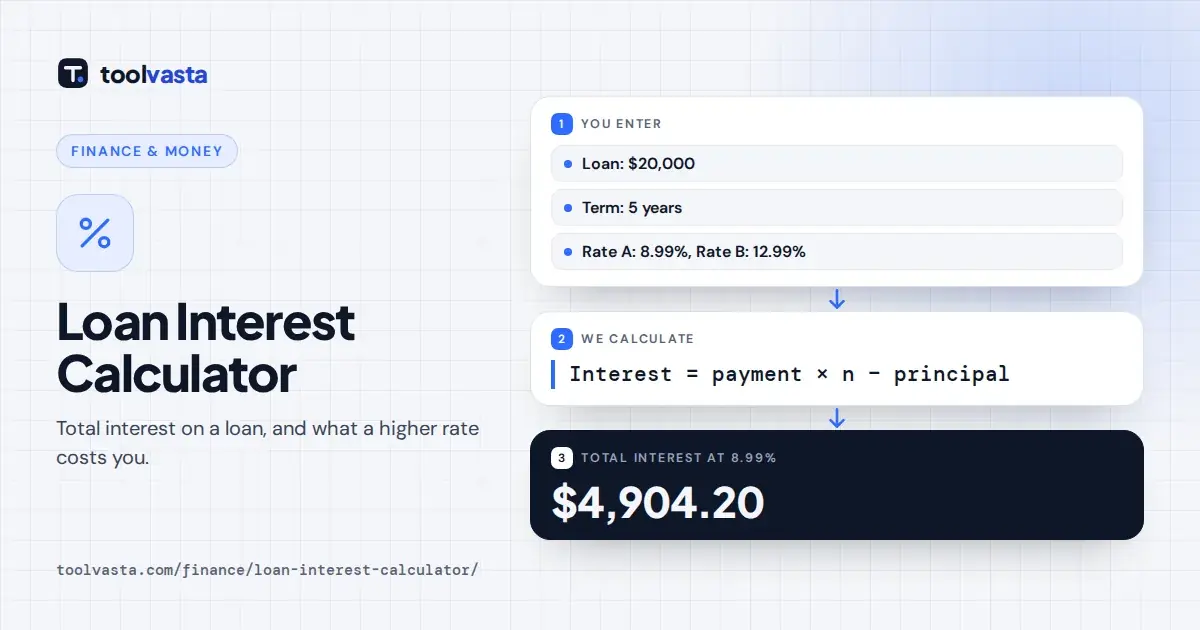
In this worked example you borrow $20,000 as an unsecured personal loan over 5 years, which means 60 monthly payments. At the 8.99% rate the payment is $415.07 a month and total interest is $4,904.20.
At 12.99%, the payment is $454.96 and total interest is $7,297.55. The higher rate costs $2,393.34 more over the full life of the loan, a difference of about $39.89 every month for all five years.
Now add a one-time $500 upfront fee to the 8.99% offer. The total repaid rises to $25,404.20, and the effective APR becomes about 10.08%, which is the right figure to compare against other loan offers.
How the Loan Term Changes Total Interest
A longer term lowers the monthly payment but raises total interest, because you owe money for longer. A shorter term does the opposite: higher payments, but far less interest over the life of the loan.
The table shows the same $20,000 at 8.99%. Stretching from 3 years to 7 years cuts the payment by $314.22 a month, yet the total interest rises by $4,128.67, more than doubling the borrowing cost.
Choose the shortest term whose payment fits comfortably in your budget. If money is tight now, pick a longer term with no prepayment penalty, then pay extra later to shorten the loan when you can.
| Term ($20,000 at 8.99%) | Monthly payment | Total interest |
|---|---|---|
| 3 years | $635.90 | $2,892.46 |
| 5 years | $415.07 | $4,904.20 |
| 7 years | $321.68 | $7,021.13 |
Interest Rate Versus APR
The interest rate is the price of borrowing the money. The annual percentage rate, or APR, also includes mandatory fees such as an administration fee or origination fee, all expressed as one single yearly rate.
In Canada, lenders must disclose the APR and total cost of borrowing before you sign, as the Financial Consumer Agency of Canada explains. When offers carry different fees, compare the APR rather than the rate.
The effective APR in the calculator treats the fee as money you pay but never receive. You still repay the full amount, so a fee raises the true cost even at the same quoted rate.
Ways to Pay Less Interest
Lenders price loans on your credit score, income, debt-to-income position and whether the loan is secured. A secured loan, backed by a car or savings, usually carries a noticeably lower rate than an unsecured loan.
Compare banks, credit unions and online lenders, and enter each quote in Rate B to see the dollar difference. Online and alternative lenders may accept weaker credit, but often at much higher rates than banks.
Ask about prepayment options before you sign anything. Many personal loans allow extra payments without penalty, and every extra dollar you pay goes straight to principal, which cuts the interest charged on all later payments.
- Improve your credit score before you apply.
- Borrow only what you need, over the shortest term you can afford.
- Ask whether extra payments are allowed without penalty.
- Compare banks, credit unions and online lenders with Rate B.
Canadian Rate Limits and Assumptions
Under section 347 of the Criminal Code, an annual percentage rate above 35% is a criminal interest rate for most consumer loans. A quote anywhere near that level is very expensive borrowing and worth refusing.
The calculator assumes a fixed rate, monthly payments, and no missed or extra payments. Variable-rate loans and a line of credit can change over time, so treat results for those products as rough estimates only.
For a full payment-by-payment amortization schedule, use the amortization calculator. Results here are estimates for planning purposes only, so always confirm the final numbers in your loan agreement before you sign anything with a lender.
Frequently asked questions
How much interest will I pay on a $20,000 loan?
At 8.99% over 5 years you pay $4,904.20 in interest with a monthly payment of $415.07. At 12.99% the interest rises to $7,297.55, so the rate you qualify for matters a lot.
How is interest calculated on a personal loan?
Interest is charged each month on the remaining balance at the annual rate divided by 12. Because the balance falls with every payment, the interest part of each payment shrinks over time.
Is a lower monthly payment always better?
No. A lower payment often comes from a longer term, which increases total interest. Compare the total interest and total repaid as well as the payment before you choose a loan.
What is the difference between interest rate and APR?
The APR includes the interest rate plus required fees, expressed as a yearly rate. It shows the true cost of borrowing, so it is the better number for comparing loan offers.
Does paying extra on a loan reduce interest?
Yes. Extra payments go to principal, so the balance falls faster and less interest is charged each month afterward. Check that your loan allows prepayment without a penalty first.
What is the maximum legal interest rate in Canada?
Under the Criminal Code, an annual percentage rate above 35% on credit advanced is a criminal rate for most consumer loans. Some regulated loans, such as payday loans, follow separate provincial rules.