How to Use the EI Calculator
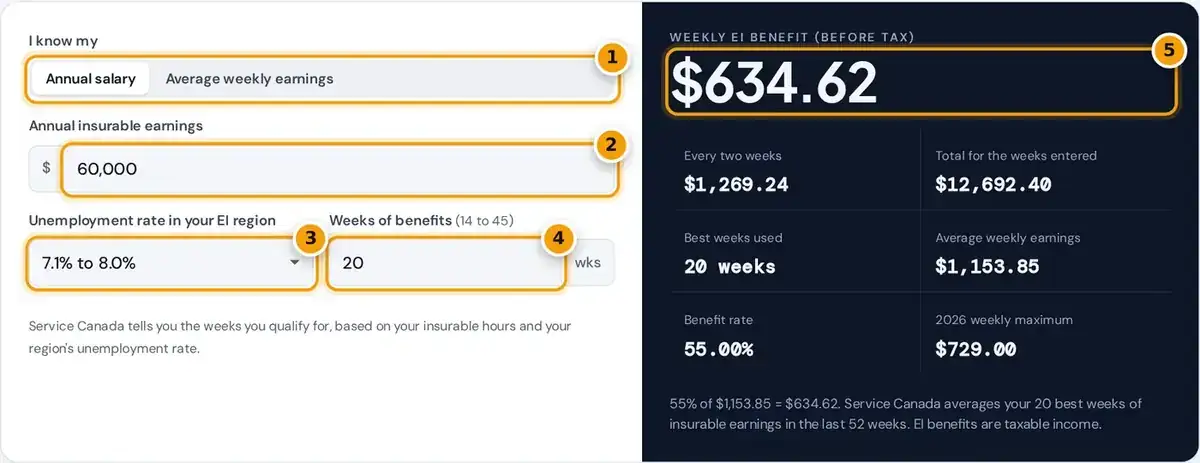
- Choose whether you know your annual salary or your average weekly earnings.
- Enter your annual insurable earnings.
- Pick your EI region's unemployment rate; it sets how many best weeks are averaged.
- Enter the weeks of benefits you expect, between 14 and 45.
- Read your weekly EI benefit before tax, the bi-weekly payment and the total.
Enter your annual salary as insurable earnings, or switch to average weekly earnings if your pay varied between weeks. The calculator assumes steady pay when you give a yearly figure and divides it by 52.
Next, choose the unemployment rate for your EI economic region. That rate sets how many best weeks are averaged. Then enter the weeks of benefits you expect, from 14 to 45 for a regular claim.
The result shows your weekly benefit before tax, the amount paid every two weeks and the total for the weeks entered. It covers Ontario, BC, Alberta and every other province, because the formula is federal.
How EI Regular Benefits Are Calculated
Weekly benefit = 55% × average weekly earnings, up to $729
Employment Insurance regular benefits replace part of lost pay. Service Canada looks at your insurable earnings during the qualifying period, usually the last 52 weeks before your claim, and then picks out your highest-earning weeks.
Those best weeks are averaged to give your average weekly earnings. The benefit rate is 55% of that average, so someone who earned $1,000 a week receives $550 a week, subject to the weekly maximum.
If your pay was steady, your best weeks simply equal your normal weekly pay. If it varied, the best weeks method helps you, because slow weeks with low earnings are left out of the average.
Worked Example
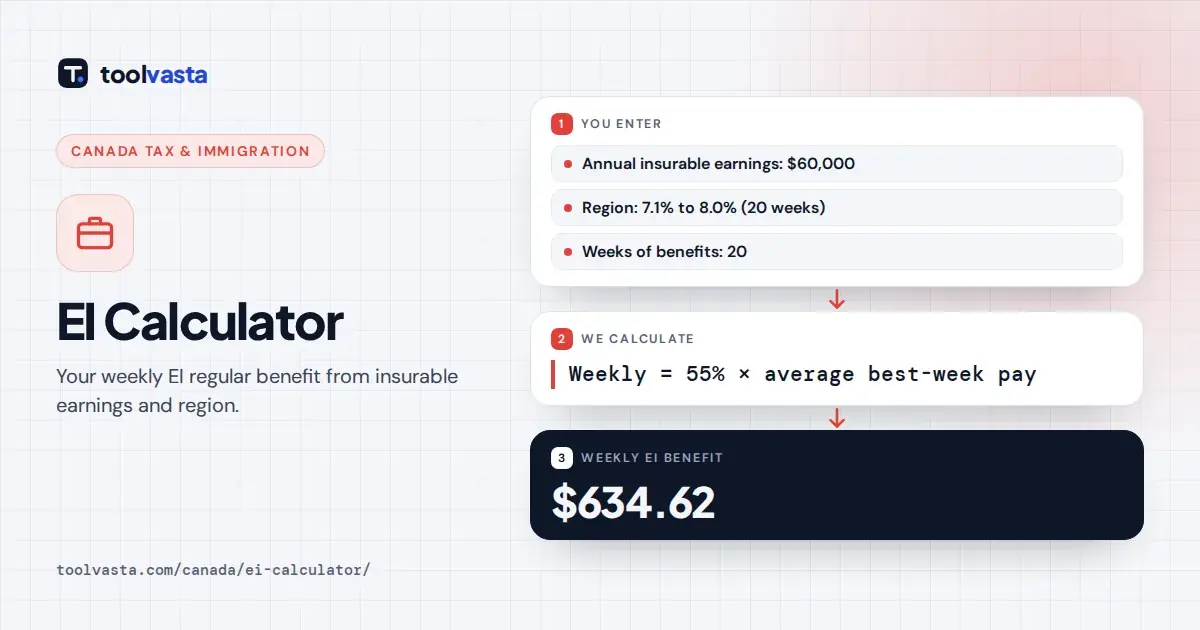
Take the default input: $60,000 a year in steady pay, which is $1,153.85 a week. EI pays 55% of that, or $634.62 a week before tax, which works out to $1,269.24 paid every two weeks.
Over 20 weeks of benefits the total comes to $12,692.40. The regional rate does not change this result for steady pay, because every one of the best weeks is worth the same $1,153.85 in earnings.
Now try $80,000 a year. Weekly earnings rise to $1,538.46, and 55% of that is $846.15, so the benefit is capped at the $729 maximum. Any salary above the ceiling produces that same capped amount.
Best Weeks by Regional Unemployment Rate
| Regional unemployment rate | Best weeks used |
|---|---|
| 6.0% or less | 22 |
| 6.1% to 7.0% | 21 |
| 7.1% to 8.0% | 20 |
| 8.1% to 9.0% | 19 |
| 9.1% to 10.0% | 18 |
| 10.1% to 11.0% | 17 |
| 11.1% to 12.0% | 16 |
| 12.1% to 13.0% | 15 |
| 13.1% or more | 14 |
The number of best weeks depends on the regional unemployment rate where you live. It runs from 22 weeks where unemployment is 6% or less down to just 14 weeks where it is above 13%.
This rule is called variable best weeks. In a high unemployment region fewer weeks are averaged, which makes it easier for seasonal or part-time workers to base their benefit on their strongest stretch of work.
Service Canada updates regional rates every month and applies the rate in force when you file. Check your region with the official lookup, then pick the matching row in the calculator for an accurate estimate.
2026 EI Maximums
For 2026 the maximum insurable earnings are $68,900 a year, so the highest weekly benefit is $729 before tax. You reach that weekly maximum once your average weekly insurable earnings are about $1,325 or more.
The word maximum also appears on the premium side. EI premiums in 2026 are 1.63% of insurable earnings outside Quebec and 1.30% in Quebec, where a separate plan covers parental benefits and premiums are lower.
Both maximums usually rise each year in line with average wages. The benefit figures in this tool follow the official Service Canada benefit amount page, and premium rates follow the CRA EI premium rates table.
Qualifying and How Long EI Lasts
To qualify for regular benefits you need enough insurable hours in the qualifying period, usually 420 to 700 hours depending on region, and you must have lost your job through no fault of your own.
Your employer issues a record of employment showing your hours and earnings, and Service Canada uses it to confirm eligibility. Apply right after you stop working, even before the record arrives, to avoid losing weeks.
Regular benefits last 14 to 45 weeks. The exact number depends on your insurable hours and the regional unemployment rate, and Service Canada confirms it during processing, so this tool asks you to enter it.
Waiting Period, Severance and Working While on Claim
There is normally an unpaid one week waiting period at the start of a claim. Severance pay and vacation pay paid on separation can also be allocated to later weeks, which delays the first payment.
Working while on claim is allowed. You keep 50 cents of benefits for every dollar earned, up to 90% of your previous weekly earnings, and anything above that is deducted dollar for dollar from benefits.
You must complete biweekly reports to keep receiving payments, declaring any work, earnings and availability. Missing or incorrect reports are a common cause of overpayments that Service Canada later asks you to repay in full.
Maternity, Parental and the Family Supplement
This tool estimates EI regular benefits only. Maternity benefits and standard parental benefits use the same 55% rate and $729 cap, so the weekly figure also works as a rough maternity leave estimate outside Quebec.
Extended parental benefits spread payments over more weeks at 33% of earnings. Quebec residents claim maternity and parental benefits through QPIP instead, and sickness benefits have their own weeks and rules under the federal program.
Low-income families with children may receive a higher rate through the Family Supplement, up to 80% of insurable earnings. The supplement depends on net family income and is added automatically when you qualify for it.
Tax, Repayment and Limits
EI benefits are taxable income. You receive a T4E slip each year, and tax withheld at source is often too low, so setting a little aside from each payment avoids a surprise bill in spring.
Higher earners may face a benefit repayment when their net income for the year passes a threshold, clawing back part of the benefits received. This calculator does not model that repayment or provincial income tax.
This page is an estimate for planning, not legal or financial advice. Your actual benefit, weeks and start date are set by Service Canada when it processes your claim, so confirm important numbers with them.
Frequently asked questions
How much EI will I get?
EI regular benefits pay 55% of your average insurable weekly earnings. In 2026 the maximum is $729 a week, which you reach at about $1,325 of average weekly earnings, or $68,900 a year.
What is the maximum EI payment in 2026?
The maximum weekly EI benefit in 2026 is $729 before tax, based on maximum insurable earnings of $68,900. Earning more than that does not increase the weekly payment, even though premiums stop at the same ceiling.
How long does EI last?
Regular benefits last from 14 to 45 weeks. The number of weeks depends on your insurable hours and the unemployment rate in your region, and Service Canada confirms it when it processes your claim.
Is EI taxable?
Yes. EI benefits are taxable income. You receive a T4E slip and report the benefits on your tax return, and higher earners may have to repay part of their benefits through the benefit repayment rule.
How many hours do I need to qualify for EI?
For regular benefits you usually need between 420 and 700 insurable hours in the qualifying period. The exact number depends on the unemployment rate in your EI economic region when you file.
Can I use this as an EI calculator for maternity leave?
Yes, for a rough weekly figure outside Quebec. Maternity and standard parental benefits also pay 55% up to $729 a week, while extended parental pays 33%. Quebec parents use QPIP instead.