How to Use the TDEE Calculator
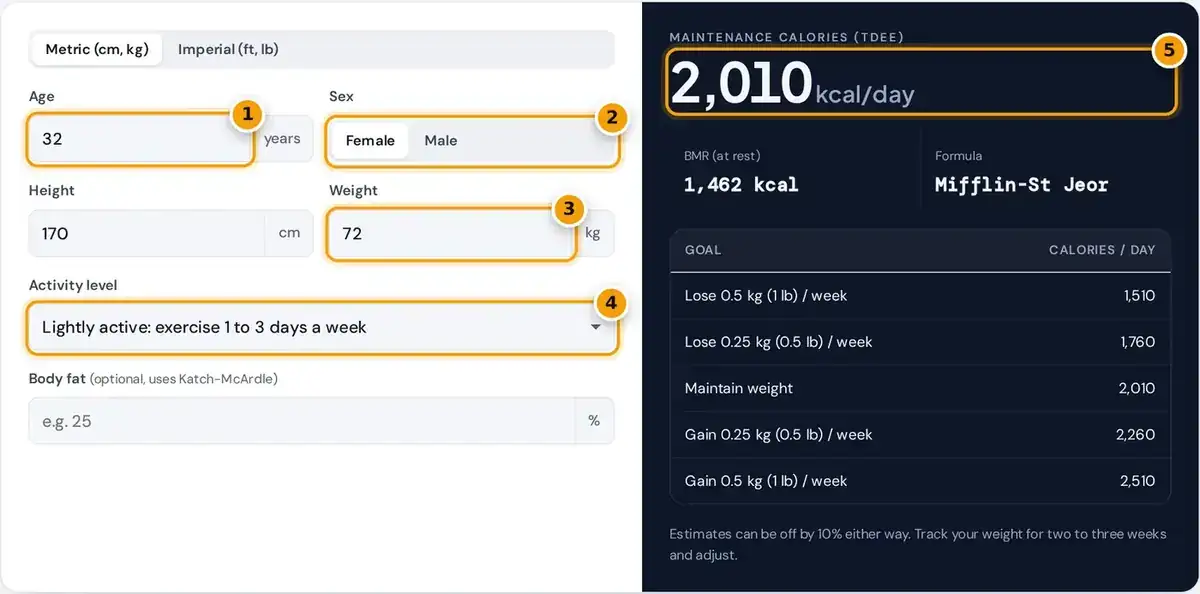
- Enter your age in years.
- Select female or male for the Mifflin-St Jeor equation.
- Enter height and weight in your chosen units.
- Pick the activity level that matches a typical week.
- Read your maintenance calories, then use the goal table to lose, maintain or gain.
Choose metric or imperial units first, then enter your age, sex, height and weight. The calculator updates as you type, so there is no button to press and nothing you enter ever leaves your browser.
Pick the activity level that matches a normal week, not your best week. If you know your body fat percentage, add it in the optional field to switch the estimate to a lean mass formula.
The result shows your maintenance calories in kcal per day, your BMR and the formula used, plus a goal table with daily calorie targets for losing, keeping or gaining weight at a steady, realistic pace.
What TDEE Means
Total daily energy expenditure is the total number of calories burned by your body across 24 hours. Eating that amount keeps you in energy balance, which is why TDEE is also called your maintenance calories.
The largest single part is your basal metabolic rate, usually around 60 to 70 percent of the daily total. The thermic effect of food, the energy used to digest meals, adds roughly another 10 percent.
The rest comes from physical activity: planned exercise plus non-exercise activity such as walking, standing and fidgeting. Researchers call that second part NEAT, and it can differ by several hundred calories between otherwise similar people.
How TDEE Is Calculated
The calculator first estimates your BMR with the Mifflin-St Jeor equation, published in 1990 and found in later reviews to predict resting needs more closely than the older Harris-Benedict equation for most healthy, nonobese adults.
Women: BMR = 10W + 6.25H − 5A − 161
Katch-McArdle: BMR = 370 + 21.6 × lean body mass (kg)
TDEE = BMR × activity factor
In the formula, W is weight in kilograms, H is height in centimeters and A is age in years. The original Mifflin-St Jeor study abstract is available on PubMed, the National Library of Medicine index.
When you enter a body fat figure, the tool switches to the Katch-McArdle formula, which uses lean body mass instead of total weight. It suits lean or muscular people whose weight alone misleads the equation.
Worked Example
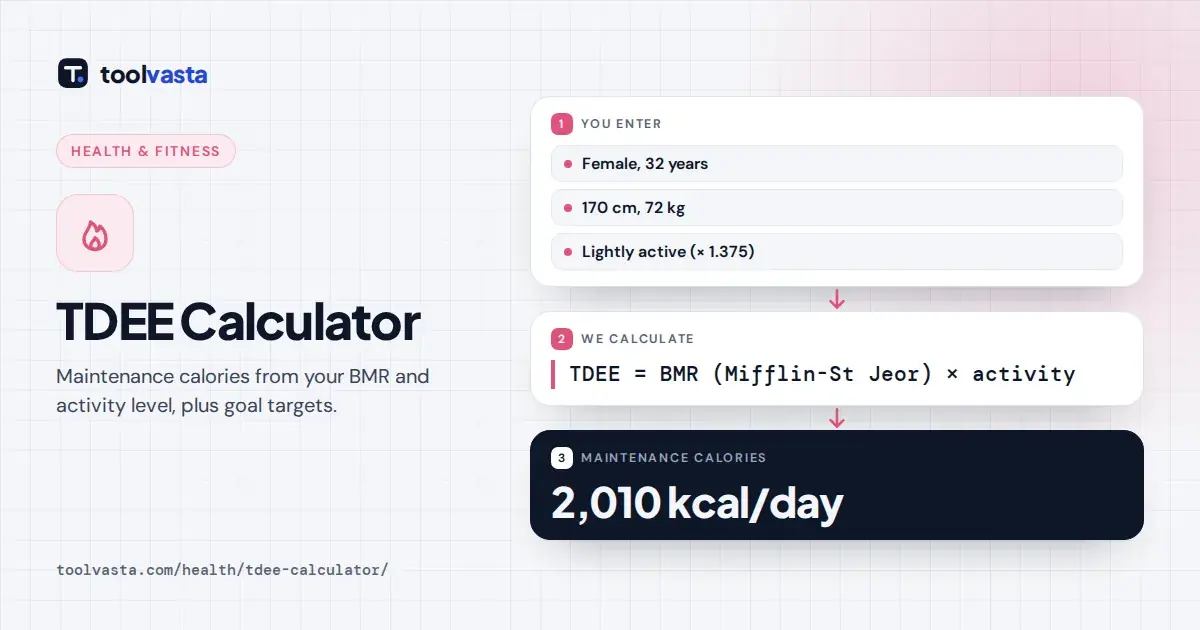
Take the tool's default inputs: a woman aged 32 who is 170 cm tall and who weighs 72 kg. Her BMR is 10 × 72 + 6.25 × 170 − 5 × 32 − 161, which equals 1,461.5 kcal a day.
She is lightly active, so the tool multiplies 1,461.5 by 1.375 and rounds to the nearest 10. Her maintenance calories come out at about 2,010 kcal a day, the figure shown on the results page.
Switch sex to male with the same inputs and BMR rises to 1,628 kcal because the constant changes from minus 161 to plus 5. A 500 kcal deficit then gives a calorie target near 1,740.
Activity Multipliers Explained
| Activity level | Typical week | Multiplier |
|---|---|---|
| Sedentary | Desk job, little exercise | 1.2 |
| Lightly active | Exercise 1 to 3 days a week | 1.375 |
| Moderately active | Exercise 3 to 5 days a week | 1.55 |
| Very active | Hard exercise 6 to 7 days a week | 1.725 |
| Extra active | Physical job plus daily training | 1.9 |
The activity factor scales BMR up to cover movement. Sedentary means a desk job and little exercise, while extra active describes a physical job plus daily training. Most people sit somewhere between those two ends.
People tend to overestimate how active they are. A one hour workout on a desk job day still leaves the other fifteen waking hours mostly seated, so the lightly active or moderately active rows fit.
If you are unsure between two levels, choose the lower one and let your scale decide. Moving from very active to moderately active lowers the estimate by about 10 percent for exactly the same body.
TDEE vs BMR
BMR is the energy your body needs at rest to keep vital organs working: breathing, circulation, brain activity, cell repair. It assumes you lie still all day in a comfortable room with no digestion happening.
TDEE starts from that resting metabolism and adds everything else you do, from digestion to walking to lifting weights. Because it includes movement and food processing, your TDEE is always higher than your BMR figure.
Eating at BMR level is a common mistake. It creates a deficit far larger than most plans intend, which can leave you tired, hungry and less able to train, and the diet harder to sustain.
Using TDEE to Lose, Maintain or Gain Weight
| Goal | Daily change from TDEE | Expected pace |
|---|---|---|
| Lose weight | −500 kcal | About 0.5 kg (1 lb) a week |
| Lose slowly | −250 kcal | About 0.25 kg (0.5 lb) a week |
| Maintain | 0 | Stable weight |
| Gain slowly | +250 kcal | About 0.25 kg (0.5 lb) a week |
| Gain weight | +500 kcal | About 0.5 kg (1 lb) a week |
To lose weight, eat below your TDEE. A calorie deficit near 500 kcal a day brings roughly 0.5 kg of fat loss per week, while 250 kcal gives a much gentler pace, easier to hold.
To gain weight, eat above it. A calorie surplus of 250 to 500 kcal supports muscle gain when paired with strength training, and the smaller surplus keeps unwanted extra fat gain lower for most people.
The tool flags any target below 1,200 kcal for women or 1,500 kcal for men, since intakes that low need medical supervision. If you are pregnant or managing a condition, ask a registered dietitian first.
How Accurate Is a TDEE Estimate?
Equations like Mifflin-St Jeor are usually within about 10 percent of measured values, so treat the number as a starting point. That margin of error can mean 200 kcal or more either way each day.
Weigh yourself at the same time several mornings a week and compare the weekly average across two to three weeks. If weight is not moving as planned, adjust intake by 100 to 200 kcal daily.
Recalculate after a large weight change, which the NIH Body Weight Planner can model. Long diets cause metabolic adaptation, and many people underreport what they eat, so careful food logging makes estimates far more useful.
Frequently asked questions
What is the difference between BMR and TDEE?
BMR is the energy your body uses at complete rest to keep you alive. TDEE adds the calories you burn through daily movement, exercise and digesting food, so it is always higher than your BMR.
How accurate is a TDEE calculator?
The Mifflin-St Jeor equation is usually within about 10 percent of measured values for most adults. Treat the result as a starting point and adjust it based on how your weight changes over two to three weeks.
Should I eat my TDEE to lose weight?
No. Your TDEE is your maintenance level, so eating it keeps your weight stable. To lose weight, eat around 250 to 500 kcal below it, which typically means 0.25 to 0.5 kg of loss per week.
How many calories should I eat to build muscle?
Aim for a surplus of about 250 to 500 kcal above your TDEE and combine it with regular strength training. Check your weekly average weight and adjust if you gain faster than about 0.5 kg a week.
Are maintenance calories the same as TDEE?
Yes. Maintenance calories are the calories you need to keep your current weight, which equals your total daily energy expenditure. If you eat that amount on average, your body weight should stay roughly stable over time.
How often should I recalculate my TDEE?
Recalculate whenever your weight changes by around 4 to 5 kg, or when your activity level changes a lot. Your BMR falls as you get lighter and older, so an old figure slowly becomes too high.