How to Use the Running Pace Calculator
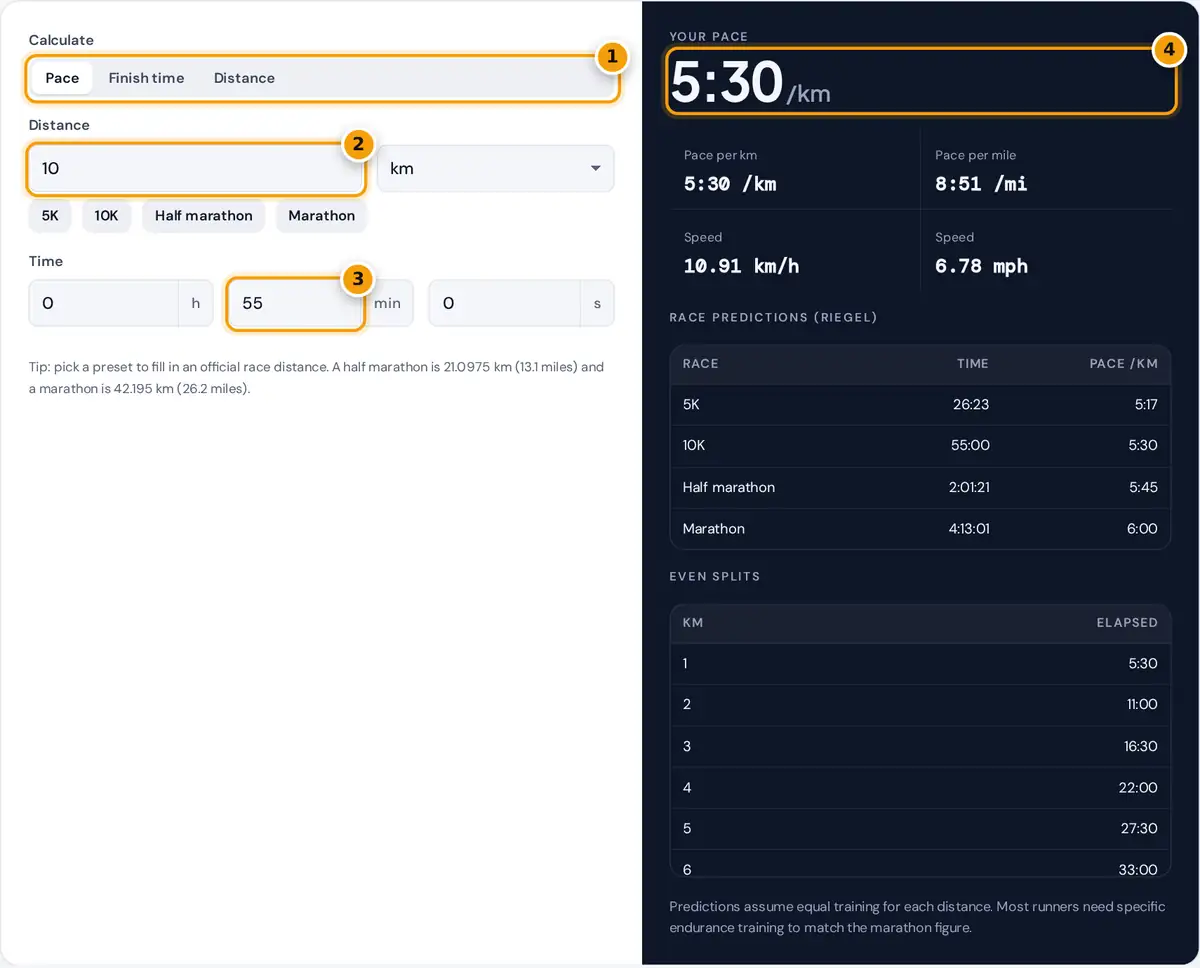
- Choose what to calculate: pace, finish time or distance.
- Enter the distance and pick km or miles, or tap a 5K to marathon preset.
- Enter your time in hours, minutes and seconds.
- Read your pace, then check speed, race predictions and even splits.
Choose what to work out. Pace needs a distance and a time, Finish time needs a distance and a pace, and Distance needs a time and a pace. The field being solved is hidden automatically.
Distances can be in kilometers or miles, and pace can be per kilometer or per mile, in any combination. The race buttons fill in the official 5K, 10K, half marathon and marathon distances for you.
The result panel shows both pace units and your speed in km/h and mph. Below it are even splits for every kilometer or mile, plus predicted times for four race distances based on your run.
Pace, Speed and Time Formulas
Pace is time divided by distance, finish time is pace multiplied by distance, and distance is time divided by pace. Converting everything to seconds first keeps the arithmetic simple and helps avoid small rounding errors.
time = pace × distance
distance = time ÷ pace
speed (km/h) = 60 ÷ pace in minutes per km
1 mile = 1.609344 km
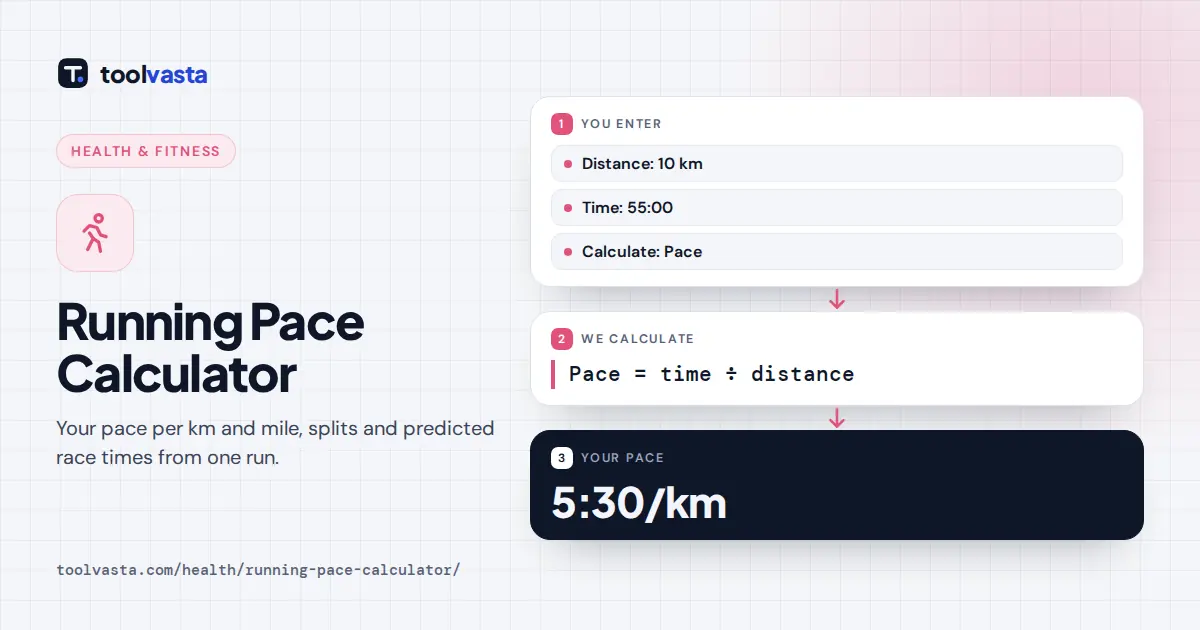
A 10 km run in 55 minutes is 3,300 seconds ÷ 10 = 330 seconds per km, which is a pace of 5:30 per km. Multiply by 1.609344 to get 531.1 seconds, or about 8:51 per mile.
The mile factor comes from the international definition of the mile, exactly 1,609.344 meters, as listed in NIST length references. That precision keeps long-distance conversions accurate, even over a marathon where errors would add up.
Converting Pace to Speed
Pace and speed are two views of the same effort. Pace is time per distance, while speed is distance per hour, so a faster runner always has a lower pace number but a higher speed.
To convert pace to speed, divide 60 by your pace in minutes per km. The 5:30 per km example equals 60 ÷ 5.5 = 10.91 km/h, or 6.78 mph, exactly as the results panel shows for it.
That makes this tool a handy pace calculator km/h converter for treadmill sessions, where machines display speed rather than pace. A treadmill set to 10 km/h means 6:00 per km, and 12 km/h means 5:00.
Half Marathon Time Calculator
Pick the half marathon button, which enters 21.0975 km, switch to Finish time and type your goal pace. At 6:00 per km, the result is 2:06:35, and the splits show every kilometer along the way.
Breaking two hours needs about 5:41 per km or 9:09 per mile. Holding exactly 5:41 per km finishes in 1:59:54, leaving only six seconds of margin, so most runners aim slightly faster on race day.
The same 5:41 pace over the full 42.195 km gives 3:59:48, which is why it is also the classic four-hour marathon target. Choose Pace mode instead to find the pace for any other goal time.
How Race Predictions Work
Predictions use the endurance formula published by Peter Riegel in American Scientist in 1981. It scales a known performance to a new distance, allowing for the way pace slows as longer races take more time.
The exponent 1.06 is slightly above one, so doubling the distance more than doubles the time. From the 10 km in 55:00 example, the formula predicts 26:23 for 5K and 2:01:21 for a half marathon.
For a full marathon, the same 10 km run predicts 4:13:01. Riegel predictions work best between similar distances, and they assume you have trained properly for the longer event rather than relying on speed alone.
Common Paces and Finish Times
This pace chart shows finish times for an even pace across the four standard race distances. Find the row closest to your current pace to see what each distance would take at that steady effort.
| Pace per km | Pace per mile | 5K | 10K | Half marathon | Marathon |
|---|---|---|---|---|---|
| 4:00 | 6:26 | 20:00 | 40:00 | 1:24:23 | 2:48:47 |
| 5:00 | 8:03 | 25:00 | 50:00 | 1:45:29 | 3:30:59 |
| 6:00 | 9:39 | 30:00 | 1:00:00 | 2:06:35 | 4:13:10 |
| 7:00 | 11:16 | 35:00 | 1:10:00 | 2:27:41 | 4:55:22 |
Each step of one minute per km adds five minutes to a 5K, ten minutes to a 10K and about 42 minutes to a marathon. Small pace gains therefore matter most in the longest races.
Many experienced runners aim for negative splits, running the second half slightly faster than the first half. Even splits from the calculator give a sensible baseline before you plan any deliberate change in race pace.
Limits and Tips
Pace math assumes an even effort. Hills, wind, heat and crowded starts all slow real races, so add a buffer to any goal time set from runs on a flat course in cool, calm weather.
GPS watch readings often show a race as slightly longer than its officially certified distance, so watch pace may look faster than official pace. Trust the course markers when the two disagree during the event.
Most training should happen at an easy pace where you can still talk. Save hard race-pace efforts for a few key sessions. The American Heart Association heart rate guide explains moderate and vigorous effort zones.
Frequently asked questions
How do I calculate my running pace?
Divide your total time by the distance. For example, 50 minutes for 10 km is 5 minutes per km. Enter your distance and time above and the calculator converts it to minutes per km and minutes per mile.
How do I convert pace to km/h?
Divide 60 by your pace in minutes per km. A 6:00 per km pace is 60 divided by 6, which equals 10 km/h. The calculator shows speed in km/h and mph for every result.
What pace do I need for a 2 hour half marathon?
About 5:41 per km or 9:09 per mile. Holding exactly that pace for 21.0975 km finishes in 1:59:54, a few seconds under two hours, so aim a little faster for safety.
How accurate are race time predictions?
The Riegel formula is a good guide between similar distances, such as 10K to half marathon. Marathon predictions from short races are often optimistic unless your weekly mileage is high.
What is a good running pace for beginners?
Most beginners run comfortably at 6:30 to 8:00 per km, or about 10:30 to 13:00 per mile. An easy pace is one where you can still speak in full sentences.
What pace is a 4 hour marathon?
A four-hour marathon needs about 5:41 per km or 9:09 per mile. Holding 5:41 per km for 42.195 km finishes in 3:59:48, so build a small buffer for water stations.