How to Use the VDOT Calculator
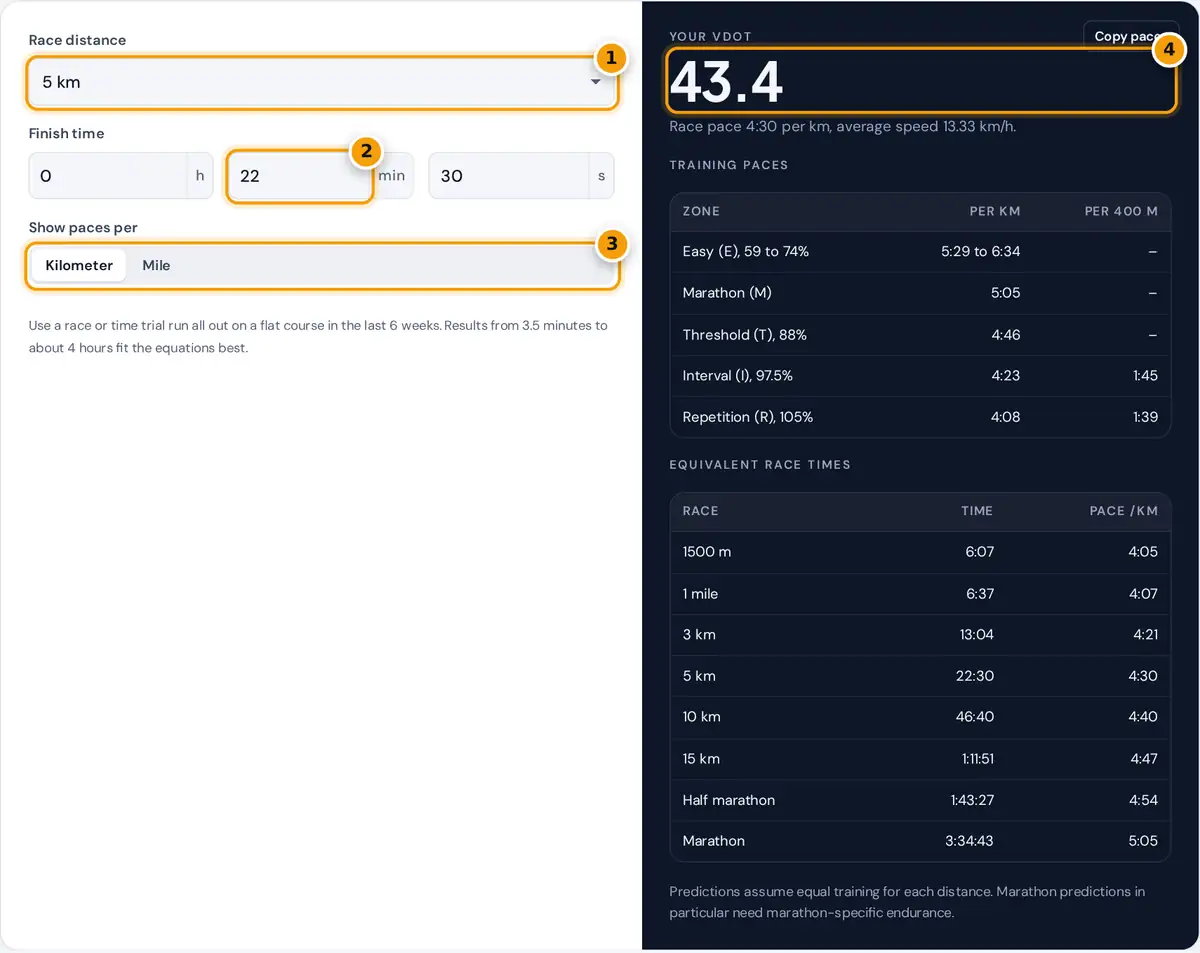
- Choose the distance of a recent race or time trial, or pick a custom distance.
- Enter your finish time in hours, minutes and seconds.
- Show training paces per kilometer or per mile.
- Read your VDOT, then use the training pace and equivalent race time tables.
Choose the distance of a recent race or time trial, or pick Custom distance and type it in kilometers or miles. Enter your finish time in hours, minutes and seconds. The best input is an all out effort on a flat course within the last six weeks, because VDOT describes your current fitness, not your best ever race.
The result shows your VDOT, your race pace and two tables. Training paces cover the five Daniels zones: easy, marathon, threshold, interval and repetition, with 400 m splits for the fast zones. Equivalent race times show what the same fitness predicts from 1500 m to the marathon. Switch between paces per kilometer and per mile at any time, and copy the paces for your training log.
The VDOT Formula
VDOT comes from equations published by coach Jack Daniels and physiologist Jimmy Gilbert. The first gives the oxygen cost of running at a given speed. The second gives the share of VO2 max a runner can sustain for a race of a given duration.
VO2 = −4.60 + 0.182258 × v + 0.000104 × v²
%max = 0.8 + 0.1894393 × e−0.012778 t + 0.2989558 × e−0.1932605 t
VDOT = VO2 ÷ %max
Race predictions solve the same equations for the time that gives your VDOT at another distance. Training paces find the speed whose oxygen cost equals a set share of VDOT: 59 to 74% for easy running, 88% for threshold, 97.5% for interval and 105% for repetition. Marathon pace is your predicted marathon race pace.
Worked Example
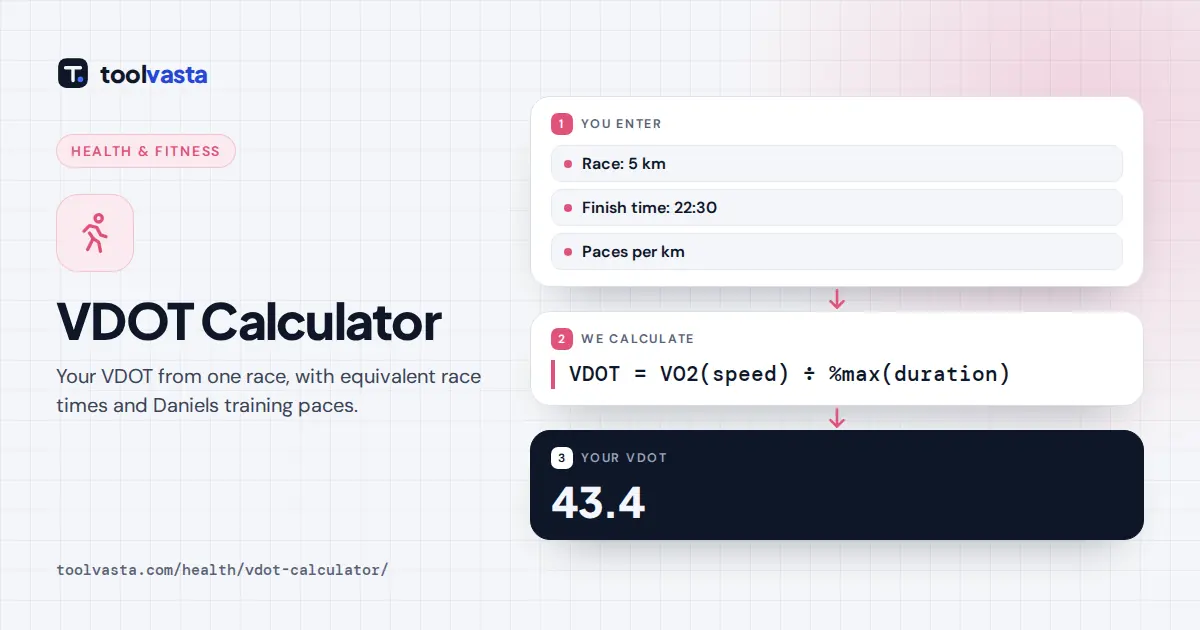
A 5 km in 22:30 is 1,350 seconds, so v = 5,000 ÷ 22.5 = 222.2 m per minute. The oxygen cost is 41.04 ml per kg per minute, and a 22.5 minute race can be held at 94.6% of maximum. That gives a VDOT of 43.4. The same fitness predicts 46:40 for 10 km, 1:43:27 for a half marathon and 3:34:43 for a marathon. Threshold pace is 4:46 per km (7:41 per mile) and interval pace is 4:23 per km.
Daniels Training Zones
| Zone | Purpose | Typical use |
|---|---|---|
| Easy (E) | Aerobic base, recovery | Most weekly running, long runs |
| Marathon (M) | Race pace practice | Steady segments in marathon training |
| Threshold (T) | Lactate clearance, comfortably hard | 20 minute tempo or cruise intervals |
| Interval (I) | VO2 max stimulus | 3 to 5 minute repeats with jog recovery |
| Repetition (R) | Speed and economy | 200 to 400 m repeats with full recovery |
Using VDOT in Training
Train at the paces for your current VDOT, not the VDOT you hope to reach. When a new race or time trial shows a higher number, move up. Daniels suggests that without a race, runners can raise VDOT by about one point after several weeks of consistent training if workouts feel easier. Heat, hills, wind and altitude all make a given pace harder, so run by effort on those days.
Which Race to Enter
Races between 5 km and the half marathon usually give the most useful VDOT, because they are long enough to be aerobic and short enough to run all out. A mile or 1500 m depends more on speed, and a marathon depends on fueling and pacing, so both can understate or overstate fitness. If you have several recent races, enter each one and train from the highest reliable result.
Limits of the Predictions
- Equivalent times assume you train properly for each distance. A fast 5 km runner without long runs will not reach the predicted marathon time.
- The equations were fitted to trained runners. Beginners often run long races slower than predicted.
- VDOT is a performance score, not a lab VO2 max. Two runners with the same lab result can have different VDOTs because of running economy.
Results are estimates for general information, not medical advice. Talk with a doctor or registered dietitian before big changes to diet, exercise or sleep, especially if you are pregnant, under 18 or managing a health condition.
Frequently asked questions
What is VDOT in running?
VDOT is a running fitness score developed by Jack Daniels. It is the VO2 max that matches your race performance in the Daniels and Gilbert equations, and it is used to set training paces and predict race times.
How is VDOT calculated?
The calculator converts your race into speed in meters per minute, finds the oxygen cost of that speed, then divides by the share of VO2 max a runner can hold for that race duration. The result is VDOT.
Is VDOT the same as VO2 max?
No. VDOT is calculated from race results, so it includes running economy. A lab VO2 max measures oxygen uptake directly. Two runners with the same lab VO2 max can have quite different VDOT scores.
What is a good VDOT score?
There is no single good value. A 5 km in 25 minutes is about VDOT 38, 22:30 is about 43, and 20 minutes is about 50. Compare your number with your own past results, not with other runners.
How accurate are VDOT race predictions?
They are accurate for well trained runners who prepare for each distance. Predictions from short races to the marathon are often optimistic for newer runners or anyone without enough long runs.
How often should I update my VDOT?
Update it after each race or time trial, usually every 4 to 8 weeks. Training at paces from an old or overly hopeful VDOT is a common cause of overtraining.