How to Use the Resting Metabolic Rate Calculator
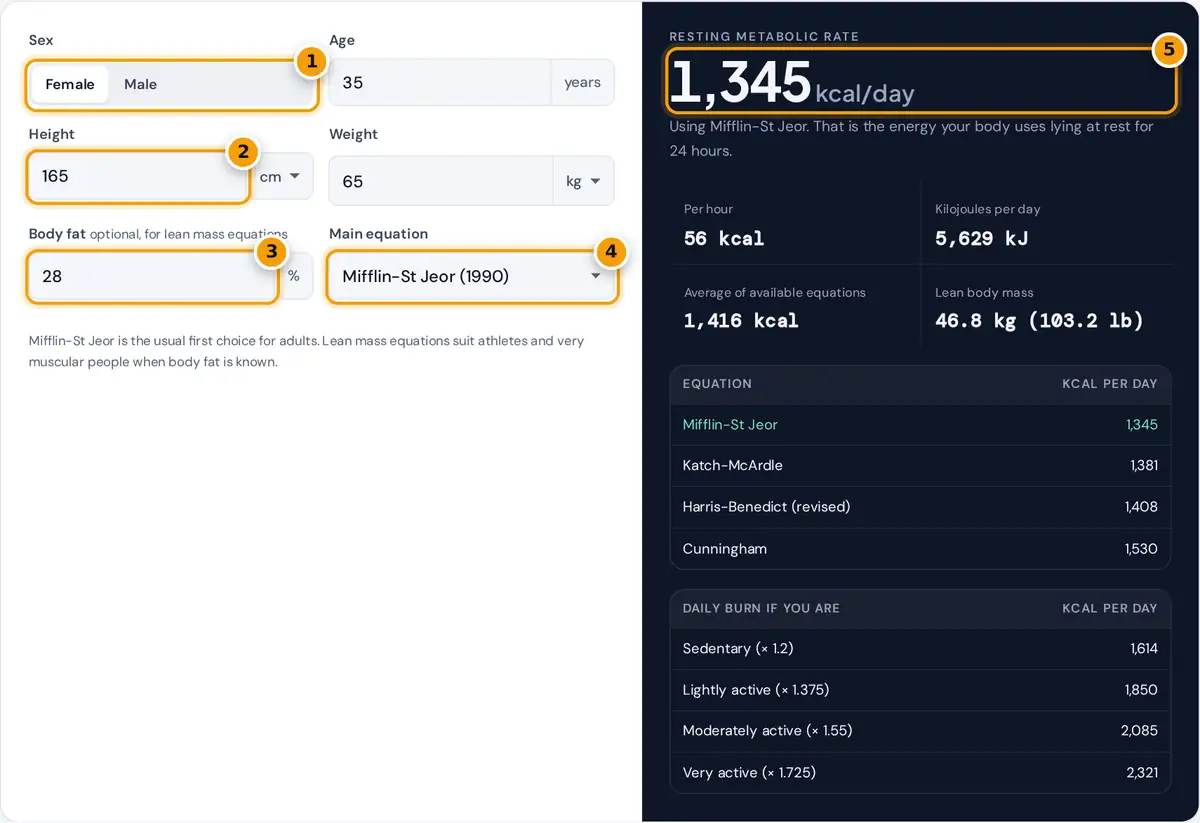
- Select your sex and enter your age.
- Enter height and weight in metric or imperial units.
- Add body fat to unlock the Katch-McArdle and Cunningham equations.
- Choose which equation to feature.
- Read your resting metabolic rate, then compare all equations and activity levels.
Select your sex and enter your age, height and weight. Height can be in centimeters or inches and weight in kilograms or pounds; switching the unit converts the number you typed. If you know your body fat percentage, add it to unlock the two lean mass equations. Then choose which equation to feature in the large result.
The result shows your resting metabolic rate (RMR) per day and per hour, the same value in kilojoules, the average of every equation that has enough data, and your lean body mass. A table lists all four equations side by side, and a second table multiplies your RMR by standard activity factors to estimate total daily burn.
RMR Equations Used
Harris-Benedict, revised: men 88.362 + 13.397 × kg + 4.799 × cm − 5.677 × age; women 447.593 + 9.247 × kg + 3.098 × cm − 4.330 × age
Katch-McArdle: 370 + 21.6 × lean mass (kg)
Cunningham: 500 + 22 × lean mass (kg)
lean mass = weight × (1 − body fat % ÷ 100)
Mifflin-St Jeor was published in 1990 and is widely recommended for adults because it predicted measured resting energy well in validation studies. The Harris-Benedict equation dates from 1919; the version here is the 1984 revision by Roza and Shizgal. Katch-McArdle and Cunningham use lean mass only, which helps people whose weight is mostly muscle.
Worked Example
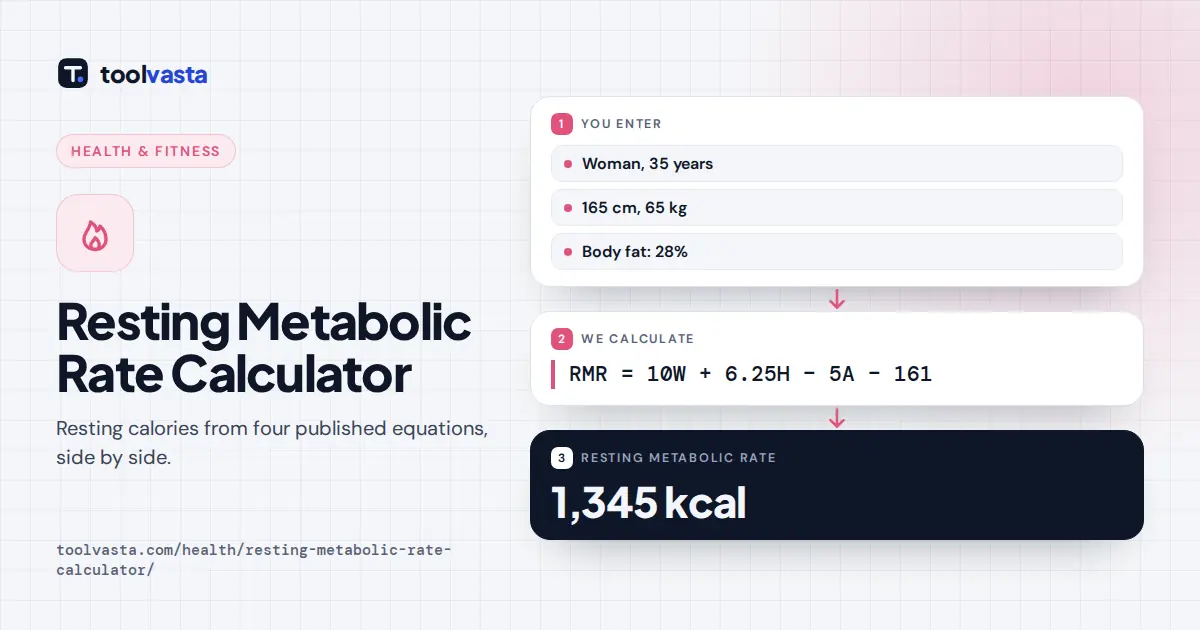
A 35 year old woman who is 165 cm tall and weighs 65 kg has a Mifflin-St Jeor RMR of 650 + 1,031.25 − 175 − 161 = 1,345 kcal per day, or about 56 kcal per hour and 5,629 kJ. With 28% body fat her lean mass is 46.8 kg, so Katch-McArdle gives 1,381 kcal and Cunningham 1,530 kcal. The revised Harris-Benedict equation gives 1,408 kcal, and the average of all four is 1,416 kcal.
RMR Equations Compared
| Equation | Inputs | Best suited to |
|---|---|---|
| Mifflin-St Jeor | Sex, age, height, weight | Most adults, the common default |
| Harris-Benedict (revised) | Sex, age, height, weight | Comparison with older references |
| Katch-McArdle | Lean mass | Lean or muscular people with a body fat estimate |
| Cunningham | Lean mass | Athletes with high training volume |
RMR Versus BMR
Basal metabolic rate (BMR) is measured under strict conditions: after a full night of sleep, 12 hours of fasting and complete rest in a warm room. Resting metabolic rate is measured under looser conditions and is usually slightly higher. In everyday use the two terms are often swapped, and both describe the calories you would burn if you rested all day. Neither includes the energy used to digest food, walk around or exercise.
What Changes Resting Metabolic Rate
Body size is the biggest factor: larger bodies have more tissue to keep running. Lean mass burns more energy than fat at rest, which is why two people of the same weight can differ. RMR also tends to decline slowly with age, mainly as lean mass falls. Long or large calorie deficits can lower it further, while illness, fever and some thyroid conditions raise or lower it. These are reasons to treat any equation as a starting point.
Tips and Limits
- Equations predict averages. Individual RMR often differs from the estimate by around 10%, more for people at the extremes of body size.
- Body fat estimates from scales and calipers can be off by several percentage points, which shifts the lean mass equations.
- Indirect calorimetry, a breath test done in clinics and labs, measures RMR directly if you need a precise value.
- To plan daily intake, multiply RMR by an activity factor or use our TDEE calculator.
Research summaries on energy needs are available from the National Institutes of Health.
Results are estimates for general information, not medical advice. Talk with a doctor or registered dietitian before big changes to diet, exercise or sleep, especially if you are pregnant, under 18 or managing a health condition.
Frequently asked questions
What is a normal resting metabolic rate?
It depends on body size, sex and age. Many adult women fall around 1,200 to 1,500 kcal per day and many men around 1,500 to 1,900 kcal, with larger and more muscular people higher.
Which RMR equation is most accurate?
For most adults, Mifflin-St Jeor is the usual first choice because it matched measured values best in comparison studies. If you are lean or muscular and know your body fat, Katch-McArdle can fit better.
Is RMR the same as BMR?
They are very close. BMR is measured under strict fasting and rest conditions, while RMR uses relaxed conditions and is usually a little higher. Calculators often use the terms interchangeably.
How can I increase my resting metabolic rate?
Building lean mass through strength training raises RMR modestly, because muscle uses more energy at rest than fat. Eating enough protein and avoiding very large calorie deficits also help keep it from dropping.
Why do the four equations give different results?
Each was fitted to a different group of people and uses different inputs. Two use height, weight and age, while two use lean mass only. The spread shows the normal uncertainty of any estimate.
How many calories should I eat if I know my RMR?
Eating only your RMR would put most people in a deficit, because daily activity adds more burn. Multiply RMR by an activity factor of about 1.2 to 1.9 to estimate maintenance calories.