How to Use the Ape Index Calculator
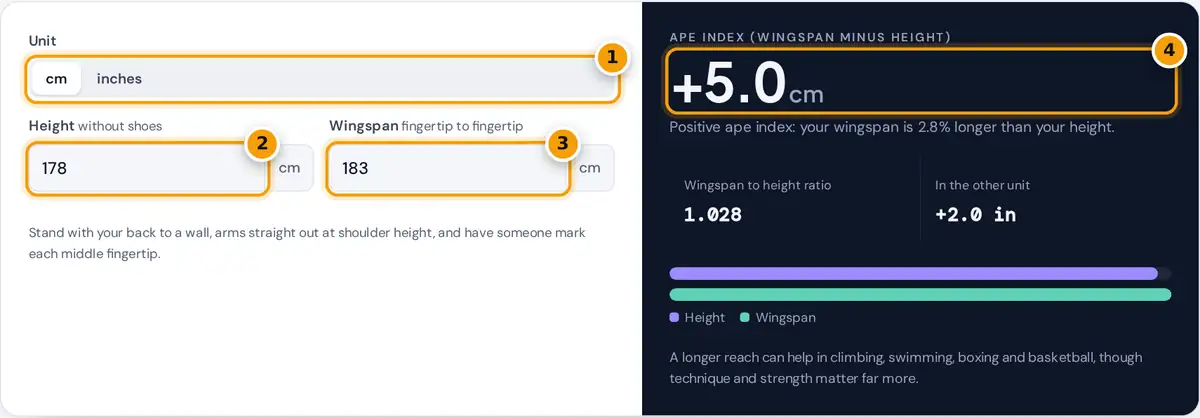
- Choose centimeters or inches.
- Enter your height without shoes.
- Enter your wingspan from fingertip to fingertip.
- Read your ape index, the ratio and the value in the other unit.
Choose centimeters or inches, then enter your height and your wingspan. Height is measured standing straight without shoes. Wingspan, also called arm span, is the distance from one middle fingertip to the other with both arms stretched out sideways at shoulder height. If you switch units, the numbers you typed are converted for you.
The result gives your ape index as a difference, the most common way climbers quote it, and as a ratio, the form often used in research and sports scouting. You also see the difference in the other unit and a simple bar comparing the two lengths.
Ape Index Formula
ape index (ratio) = wingspan ÷ height
A positive difference, or a ratio above 1, means your arms reach further than you are tall. A negative difference, or a ratio below 1, means the opposite. Climbers usually say "plus 5" or "minus 2" in centimeters or inches, so always note the unit.
Worked Example
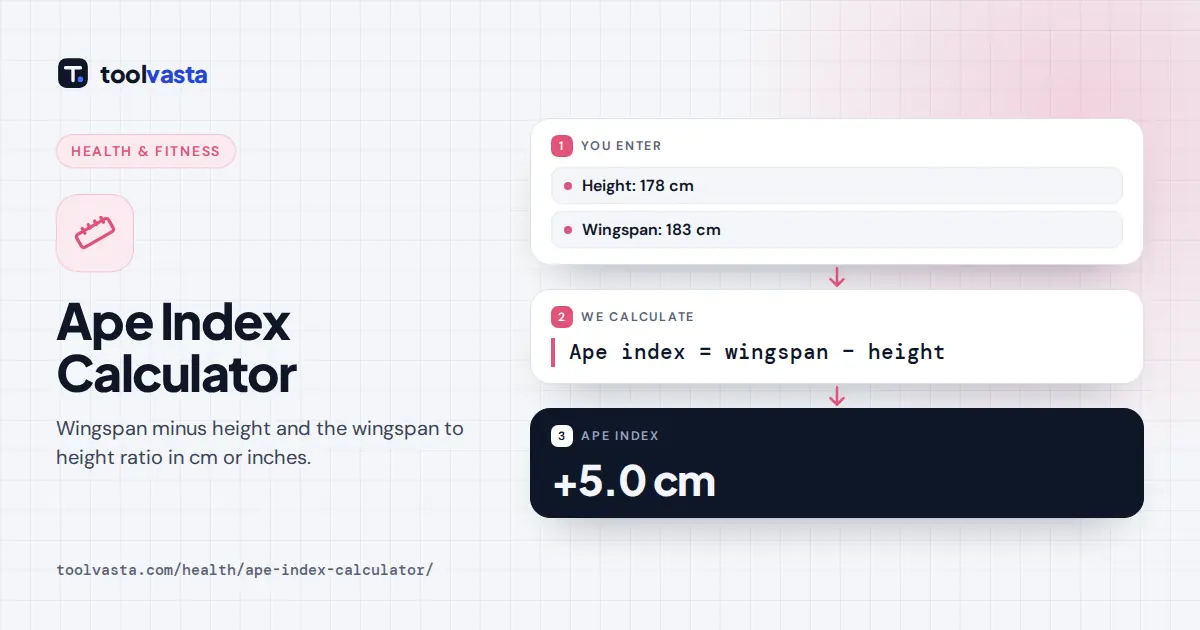
A climber who is 178 cm tall with a 183 cm wingspan has an ape index of 183 − 178 = +5.0 cm, or about +2.0 in. The ratio is 183 ÷ 178 = 1.028, so the wingspan is 2.8% longer than height. Someone who is 72 in tall with a 70 in wingspan has an index of −2.0 in and a ratio of 0.972.
Ape Index Examples
| Height | Wingspan | Difference | Ratio |
|---|---|---|---|
| 165 cm | 162 cm | −3 cm | 0.982 |
| 170 cm | 170 cm | 0 cm | 1.000 |
| 175 cm | 180 cm | +5 cm | 1.029 |
| 180 cm | 190 cm | +10 cm | 1.056 |
| 6 ft (72 in) | 75 in | +3 in | 1.042 |
Why Wingspan Matters in Sport
In climbing, a longer reach can make the distance between holds feel shorter. In swimming, long arms give a longer pull each stroke. Boxers with a long reach can strike from further away, and basketball scouts record wingspan because it helps with blocking and rebounding. None of these advantages replace skill. Plenty of elite climbers have a neutral or negative ape index and make up for it with technique, flexibility and finger strength.
Difference or Ratio: Which to Use
The difference is easy to picture: plus 5 cm means your fingertips reach 5 cm wider than you are tall. Its weakness is that it depends on body size, because 5 cm means more for a short person than for a tall one. The ratio removes that effect, which is why researchers and scouts often prefer it. A ratio of 1.03 means the same proportion for everyone. This calculator gives both, so you can use whichever your sport or community quotes.
In casual climbing talk the difference is still the norm, and most people quote it in the unit they grew up with. If you share your ape index online, include the unit or the ratio so others can compare fairly.
Ape index does not change much with training, but flexibility in the shoulders and chest can add a centimeter or so to a measured wingspan, so measure relaxed and the same way each time.
How to Measure Wingspan Accurately
- Stand with your back flat against a wall, feet together, and raise both arms straight out to the sides at shoulder height.
- Spread your fingers and keep your palms facing forward. Do not shrug or lean.
- Have a helper mark the tip of each middle finger on the wall, then measure between the marks with a tape.
- Measure twice and use the average. A difference of 1 to 2 cm between attempts is normal.
Limits
Ape index is a body proportion, not a measure of ability. Small measuring errors of a centimeter or two change the result noticeably, so compare numbers measured the same way. For general information on healthy body measurements, see the National Institutes of Health.
Frequently asked questions
What is the ape index?
The ape index compares arm span with height. As a difference it is wingspan minus height, and as a ratio it is wingspan divided by height. A positive value means your arms reach further than you are tall.
How do I calculate my ape index?
Measure your height and your wingspan from fingertip to fingertip with arms out at shoulder height. Subtract height from wingspan for the difference, or divide wingspan by height for the ratio.
What is a good ape index for climbing?
A positive ape index can help with reach, but it is not required. Many top climbers have a neutral or negative index and rely on technique, footwork and finger strength instead of long arms.
Is a wingspan to height ratio of 1 normal?
Yes. A ratio near 1.0 means wingspan and height are about equal, which is common. Many people fall within a few centimeters either side, giving ratios of roughly 0.97 to 1.05.
Does ape index change as you grow?
Proportions change during childhood and the teenage growth spurt, so a child's ape index can shift. In adults it stays mostly stable, apart from small losses in height with age.
Should I quote ape index in cm or inches?
Either works, but always say which unit you used. A plus 5 in centimeters is only about plus 2 in inches. The ratio has no unit, which makes it easier to compare.