How to Use the Grade Adjusted Pace Calculator
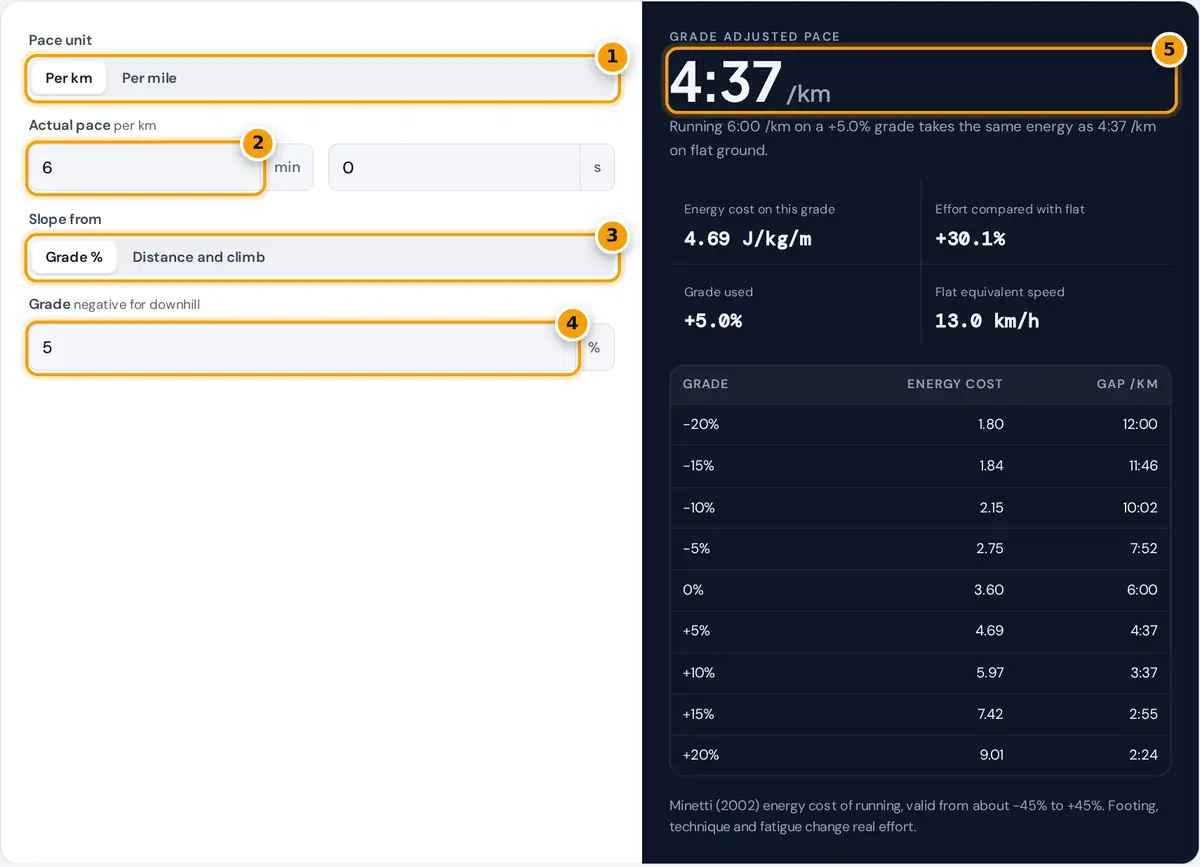
- Choose pace per km or per mile.
- Enter your actual running pace.
- Describe the slope as a grade or as distance and climb.
- Enter the grade, negative for downhill.
- Read the grade adjusted pace and the table for other grades.
Choose whether you think in pace per kilometer or per mile, then enter the pace you actually ran or plan to run. Describe the slope in one of two ways: type the grade as a percentage, using a minus sign for downhill, or switch to Distance and climb and enter the length of the section with its net elevation change in meters or feet.
The result is your grade adjusted pace (GAP), the flat ground pace that would cost the same energy. You also see the energy cost of running on that grade, how much harder or easier it is than flat running, and a table of the same pace across grades from −20% to +20%. Switching pace units converts the pace you typed.
The Minetti Energy Cost Formula
The calculator uses the polynomial published by Alberto Minetti and colleagues in 2002 from treadmill measurements of runners on slopes from −45% to +45%. It gives the energy cost of running per kilogram per meter at gradient i, written as a decimal.
effort ratio = Cr(i) ÷ Cr(0), where Cr(0) = 3.6
grade adjusted pace = actual pace ÷ effort ratio
grade (%) = elevation change ÷ distance × 100
Worked Example
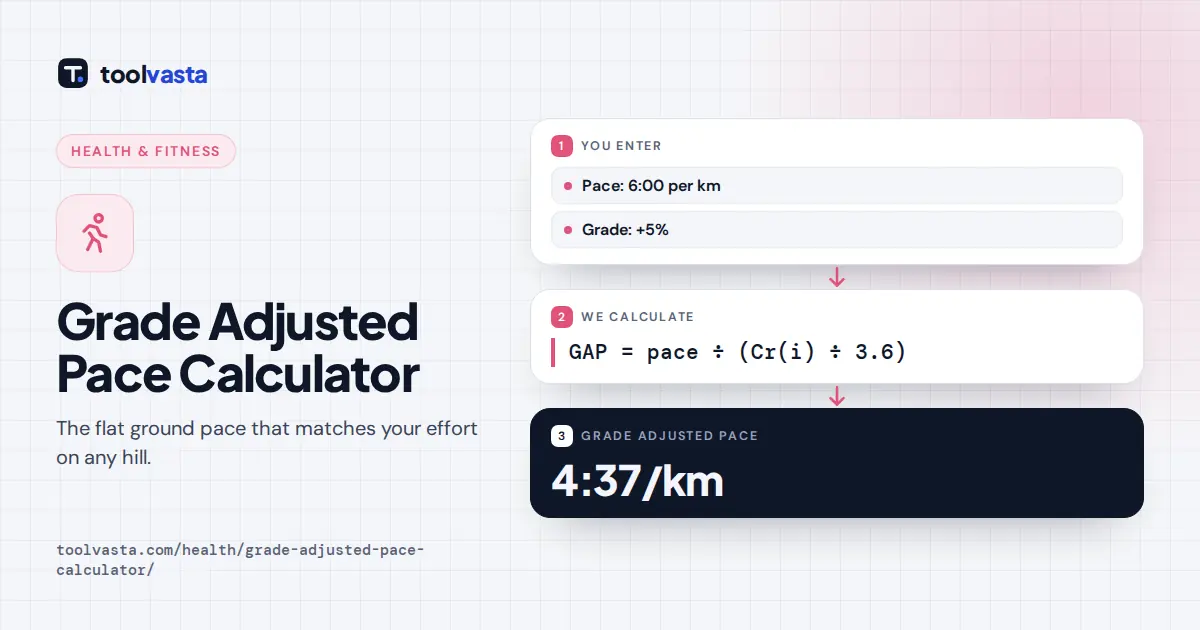
You run 6:00 per km up a 5% grade. With i = 0.05, Cr = 4.685 J/kg/m, so the effort ratio is 4.685 ÷ 3.6 = 1.301, about 30% harder than flat. The grade adjusted pace is 360 s ÷ 1.301 = 276.6 s, which is 4:37 per km. Running the same 6:00 per km down a 5% grade costs only 2.75 J/kg/m, so its flat equivalent is a gentle 7:52 per km. An 8 km section with 400 m of climbing is also a 5% grade.
Energy Cost by Grade
| Grade | Cost (J/kg/m) | Effort vs flat | 6:00 /km becomes |
|---|---|---|---|
| −10% | 2.15 | −40.2% | 10:02 |
| −5% | 2.75 | −23.7% | 7:52 |
| 0% | 3.60 | 0% | 6:00 |
| +5% | 4.69 | +30.1% | 4:37 |
| +10% | 5.97 | +65.8% | 3:37 |
| +15% | 7.42 | +106.0% | 2:55 |
Energy cost is lowest at a downhill grade of around −20%. Beyond that, running downhill gets more costly again because you have to brake.
Using GAP in Training and Racing
GAP lets you compare a hilly run with a flat one. If your easy runs on rolling routes show a GAP close to your usual easy pace, the effort was right even if the watch shows slower splits. On race day, planning by GAP helps you hold an even effort on climbs instead of chasing a flat pace and paying for it later. Many training platforms show their own grade adjusted pace, built on similar research but tuned with their own data, so their numbers can differ slightly from this model.
Planning a Hilly Race
Split the course into sections using the elevation profile, then enter each section's distance and climb to see its flat equivalent effort. If you aim for an even effort, your target pace on each climb is the pace whose GAP equals your planned flat pace. Expect to lose time on climbs and win back only part of it on descents, especially on steep or technical ground.
Limits
- The model measures metabolic cost on smooth treadmills. Rough trails, mud, snow and technical descents cost more.
- Steep descents are limited by leg strength and safety, not energy. Few runners can run as fast downhill as the model allows.
- Average grade over a long section hides steeper parts. Split long climbs into shorter sections for better estimates.
- Very steep climbs are often faster and cheaper to power hike than to run.
Results are estimates for general information, not medical advice. Talk with a doctor or registered dietitian before big changes to diet, exercise or sleep, especially if you are pregnant, under 18 or managing a health condition.
Frequently asked questions
What is grade adjusted pace?
Grade adjusted pace is the pace on flat ground that would take the same effort as your pace on a hill. Uphill, it is faster than your actual pace; on gentle downhills, it is slower.
How is grade adjusted pace calculated?
This tool uses the Minetti energy cost equation. It finds the energy cost of running at your grade, divides it by the flat cost of 3.6 J/kg/m, then divides your pace by that ratio.
How much slower should I run uphill?
On a 5% grade, the same effort is about 30% harder, so 4:37 per km of flat effort becomes about 6:00 per km uphill. Run by effort and breathing rather than forcing your flat pace.
Why is my downhill GAP slower than my actual pace?
Gentle downhills need less energy than flat running, so the flat equivalent effort is a slower pace. Down to about minus 20%, running downhill keeps getting cheaper in the model.
How do I calculate the grade of a hill?
Divide the elevation change by the horizontal distance and multiply by 100. A climb of 400 m over 8 km is 400 ÷ 8,000 × 100 = 5%.
Is this the same GAP as my running app?
Not exactly. Apps build their own grade models from research and their users' data, so numbers can differ by a few seconds per km. The Minetti model is a published laboratory reference.