How to Use the Saddle Height Calculator
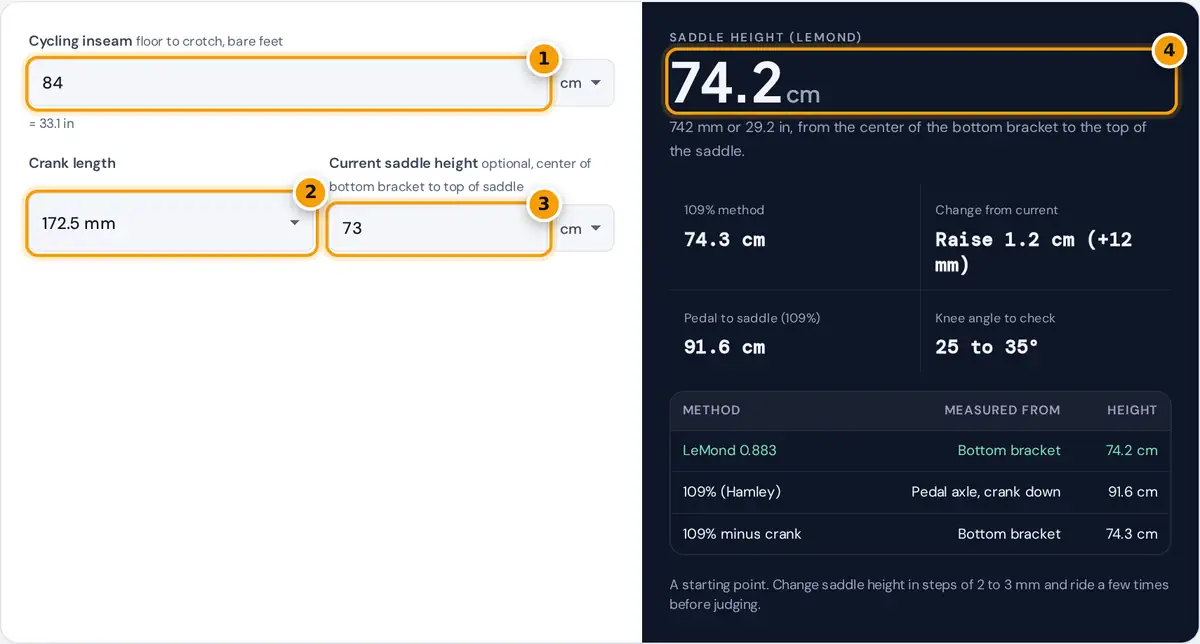
- Enter your cycling inseam in cm or inches.
- Choose your crank length.
- Optionally enter your current saddle height to see the change.
- Read the LeMond height, then compare the 109% method and the change.
Measure your cycling inseam and enter it in centimeters or inches. Choose your crank length, which is usually stamped on the inside of the crank arm. If you want to compare with your bike, measure the current saddle height from the center of the bottom bracket, along the seat tube, to the top of the saddle where your sit bones rest, and enter it.
The large result is the LeMond saddle height. The panel also shows the 109% method in two forms, the change from your current setting in centimeters and millimeters, and the knee angle range many fitters use to check the result on the bike.
Saddle Height Formulas
109% method: pedal axle to saddle = inseam × 1.09 (crank at the bottom)
109% from the bottom bracket = inseam × 1.09 − crank length
The 0.883 multiplier was popularized by road racer Greg LeMond and his coach Cyrille Guimard in the 1980s. The 109% method comes from a 1967 study by Hamley and Thomas, who found that cycling efficiency was best around 109% of inseam measured to the pedal. Both are starting points that most riders fine tune.
Worked Example
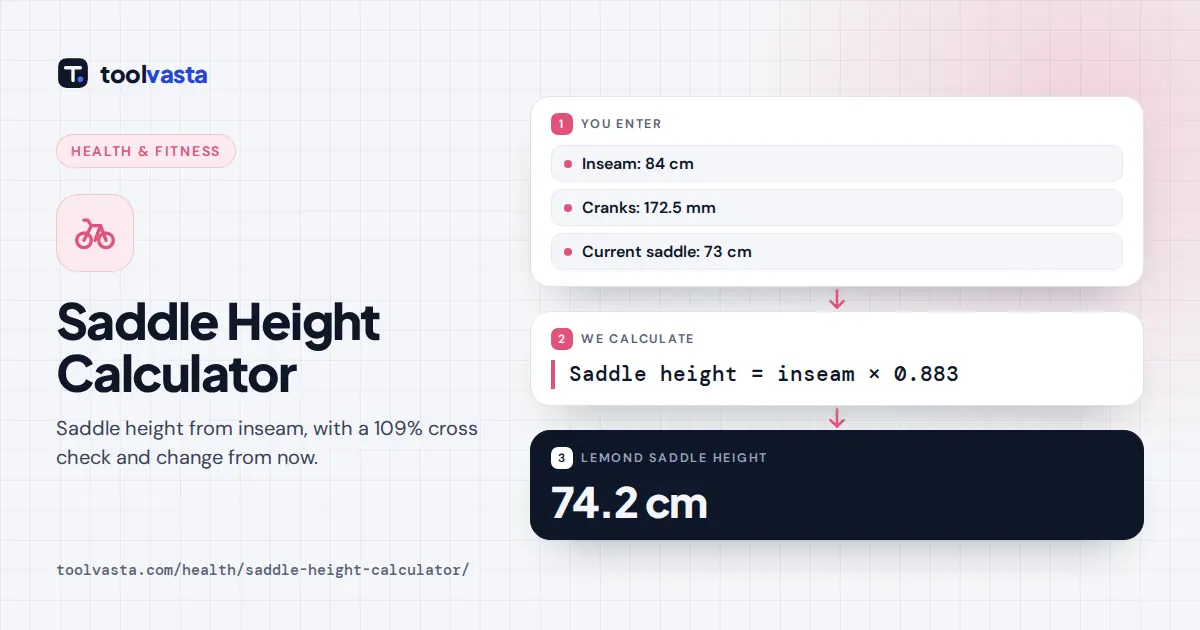
A rider with an 84 cm inseam gets a LeMond saddle height of 84 × 0.883 = 74.2 cm (742 mm, 29.2 in). The 109% method gives 91.6 cm from the pedal axle; with 172.5 mm cranks that is 91.56 − 17.25 = 74.3 cm from the bottom bracket, almost the same. If the saddle is currently at 73.0 cm, raise it by about 1.2 cm, ideally in two or three small steps.
How to Measure Cycling Inseam
- Stand barefoot with your back to a wall and feet about 15 to 20 cm apart, roughly as on the pedals.
- Pull a hardcover book up firmly between your legs, spine vertical, as a saddle would press.
- Mark the top of the spine on the wall and measure from the floor to the mark.
- Measure three times and use the average. Trouser inseam sizes are not accurate enough.
Saddle Height by Inseam
| Inseam | LeMond height | Inches |
|---|---|---|
| 76 cm | 67.1 cm | 26.4 in |
| 80 cm | 70.6 cm | 27.8 in |
| 84 cm | 74.2 cm | 29.2 in |
| 88 cm | 77.7 cm | 30.6 in |
| 92 cm | 81.2 cm | 32.0 in |
Making Changes Safely
Mark your current seat post position with tape before you move anything, so you can always go back. Change the height by 2 to 3 mm at a time and ride at least two or three times before judging. Large single changes often cause new aches because muscles and tendons need time to adapt. If you also change shoes, pedals or cleats, recheck the saddle height, because the stack height between foot and pedal axle changes the effective leg extension.
Record the final height in millimeters once you are happy with it. That number makes it easy to set up a new bike, travel bike or indoor trainer the same way.
Checking the Fit on the Bike
With the crank at the bottom of the stroke and your foot level, many fitters look for a knee bend of about 25 to 35 degrees. Signs the saddle is too high include hips rocking side to side and toes reaching for the pedal. Too low often shows as pressure at the front of the knee and a cramped feeling. Thick soled shoes, pedal systems and saddle shape all shift the ideal height by a few millimeters.
Limits
Formulas do not see flexibility, foot length, ankle style or old injuries. If you feel knee, hip or back pain, lower the height slightly and consider a professional bike fit. Make one change at a time and give each a few rides. For general physical activity guidance, see the World Health Organization.
Frequently asked questions
How do I calculate my saddle height?
Multiply your cycling inseam by 0.883. The result is the distance from the center of the bottom bracket to the top of the saddle. An 84 cm inseam gives about 74.2 cm.
What is the 109% saddle height method?
Multiply inseam by 1.09 to get the distance from the pedal axle, with the crank at the bottom, to the top of the saddle. Subtract crank length for a bottom bracket measurement.
Does crank length affect saddle height?
It does for the 109% method measured from the bottom bracket, because longer cranks bring the pedal lower. The LeMond formula ignores crank length, which is one reason fitters cross check both.
How do I know if my saddle is too high?
Common signs are hips rocking on the saddle, toes pointing down to reach the bottom of the stroke and pain behind the knee. Lower the saddle by 2 to 3 mm and test again.
How do I measure saddle height on my bike?
Measure from the center of the crank axle along the seat tube line to the top of the saddle, at the point where your sit bones rest. Use the same method every time.
Is the same saddle height right for road and mountain bikes?
It is a good starting point for both. Mountain bikers often lower the saddle on descents with a dropper post, and different shoes or pedals can shift the ideal height slightly.