How to Use the Caloric Deficit Calculator
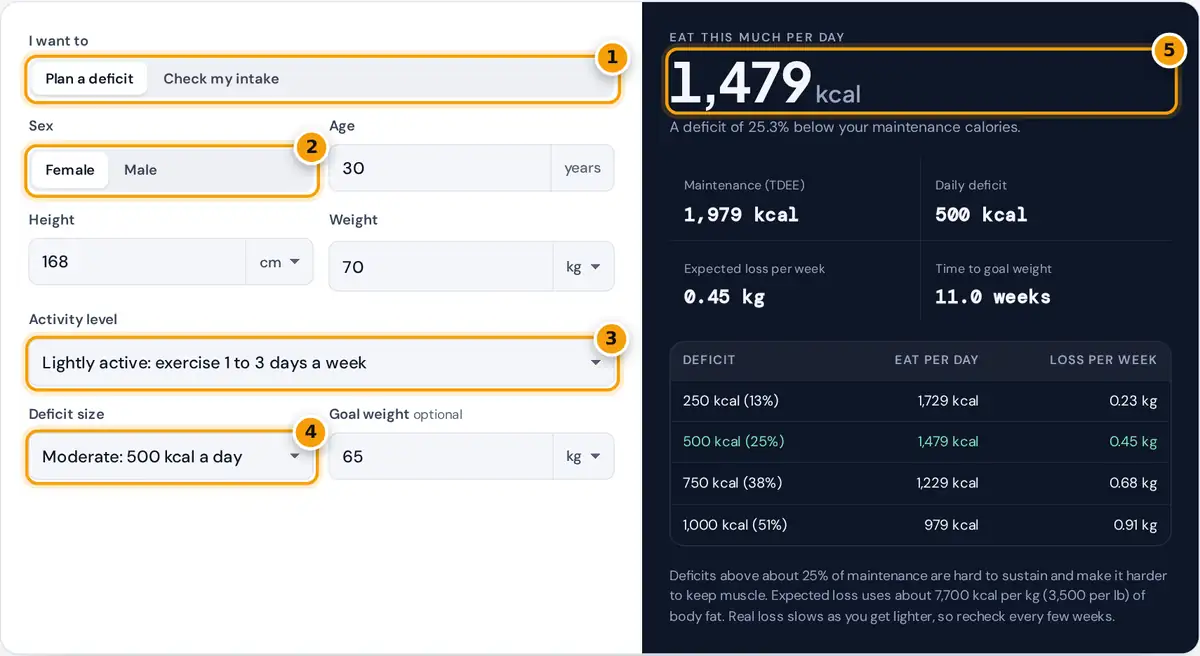
- Choose Plan a deficit, or Check my intake to test what you already eat.
- Enter sex, age, height and weight.
- Pick your activity level.
- Choose a fixed or percentage deficit and add a goal weight if you like.
- Read your daily calories, then check weekly loss and weeks to goal.
Choose a mode. Plan a deficit gives you a daily calorie target for a deficit you pick, either a fixed number of calories or a percentage of maintenance. Check my intake works the other way: enter what you currently eat and see how large your deficit is and what weight change to expect.
In both modes, enter your sex, age, height, weight and activity level so the tool can estimate maintenance calories. Add a goal weight to see roughly how many weeks it would take. The table compares the four most common deficit sizes for your body, so you can see the trade off between speed and how much food you get to eat.
How the Deficit Is Calculated
maintenance (TDEE) = RMR × activity factor
daily target = TDEE − deficit
weekly loss (kg) = deficit × 7 ÷ 7,700
The 7,700 kcal per kilogram figure (about 3,500 kcal per pound) is the common rule of thumb for the energy stored in body fat. It works for short term planning but overstates long term loss, because maintenance calories fall as body weight drops.
Worked Example
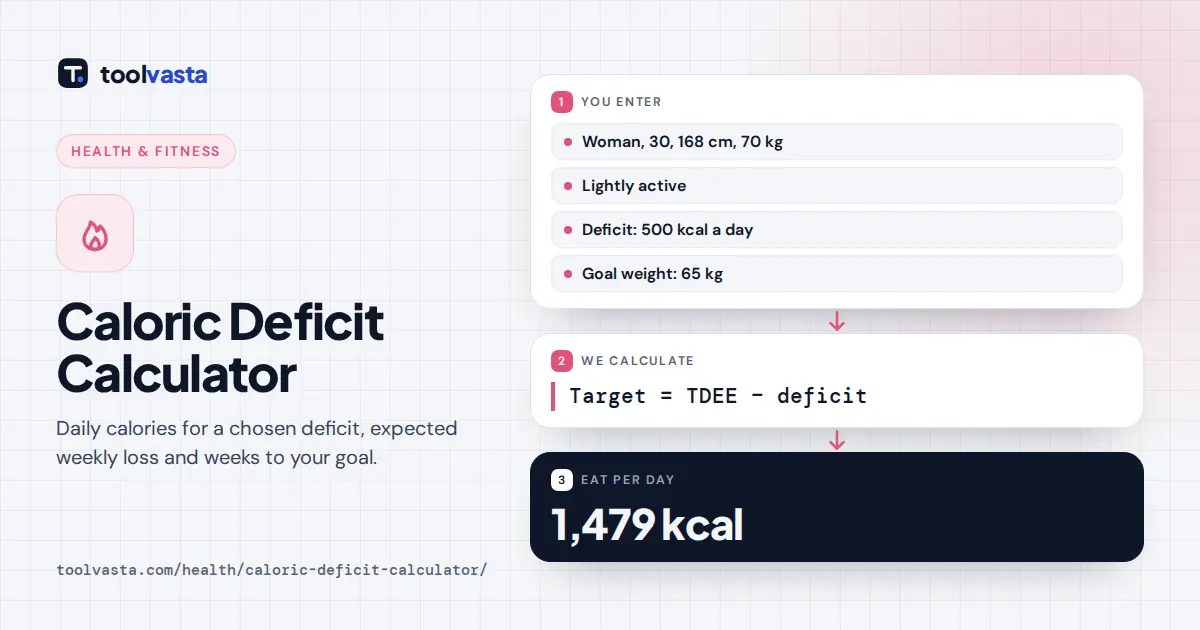
A 30 year old woman, 168 cm and 70 kg, has a Mifflin-St Jeor RMR of 1,439 kcal. Lightly active (× 1.375), her maintenance is 1,979 kcal. A 500 kcal deficit means eating 1,479 kcal a day, which is 25.3% below maintenance and predicts about 0.45 kg (1.0 lb) of loss per week. Reaching a 65 kg goal would take about 11 weeks. If she instead eats 1,800 kcal, her deficit is only 179 kcal, about 0.16 kg a week.
Choosing a Deficit Size
| Daily deficit | Weekly loss | What to expect |
|---|---|---|
| 250 kcal | About 0.23 kg (0.5 lb) | Easy to sustain, slow progress |
| 500 kcal | About 0.45 kg (1 lb) | The classic starting point |
| 750 kcal | About 0.68 kg (1.5 lb) | Noticeable hunger for smaller people |
| 1,000 kcal | About 0.91 kg (2 lb) | Usually only suitable for larger bodies |
A percentage deficit scales with your size, which is fairer: 20% of maintenance is a moderate cut for most adults, while 500 kcal can be a small cut for a tall, active man and a steep one for a petite woman.
Checking Your Current Intake
Check my intake mode is useful when you already track food and want to know whether your numbers add up. Log everything for at least a week, including drinks and cooking oils, and enter the daily average. If the calculator says you are in a deficit but your weight has not changed in a month, the estimate of maintenance or the food log is probably off, and the real result is the better guide.
Tips for a Sustainable Deficit
- Keep protein high and keep strength training so more of the loss comes from fat rather than muscle.
- Weigh yourself several times a week and look at the weekly average. Daily weight swings from water and salt hide fat loss.
- If the scale has not moved for three to four weeks, recheck your intake and recalculate with your new weight before cutting further.
- Plan diet breaks or maintenance weeks on long diets. They make adherence easier for many people.
Limits and Safety
Activity multipliers and RMR equations are estimates, often off by 10% or so for an individual. Treat the target as a starting point and adjust by results. Many health services advise against eating below roughly 1,200 kcal a day for women or 1,500 kcal for men without medical supervision. Large deficits are not advised during pregnancy, while breastfeeding, for teenagers or for anyone with a history of eating disorders. Public guidance on healthy weight is available from Health Canada.
Results are estimates for general information, not medical advice. Talk with a doctor or registered dietitian before big changes to diet, exercise or sleep, especially if you are pregnant, under 18 or managing a health condition.
Frequently asked questions
What is a good calorie deficit to lose weight?
A deficit of about 500 kcal a day, or 15 to 25% below maintenance, is a common starting point. It predicts roughly 0.45 kg (1 lb) of loss per week and is manageable for most adults.
How do I calculate my calorie deficit?
Estimate maintenance calories with an equation such as Mifflin-St Jeor multiplied by an activity factor, then subtract what you eat. The difference is your daily deficit. The Check my intake mode does this for you.
How much weight will I lose with a 500 calorie deficit?
About 0.45 kg (1 lb) per week at first, using 7,700 kcal per kg of fat. Loss usually slows over time because a lighter body burns fewer calories, so recalculate every few weeks.
Is a 1,000 calorie deficit safe?
It can be reasonable for people with high maintenance calories, but for smaller adults it may push intake too low. Many health services advise medical supervision below about 1,200 kcal for women or 1,500 for men.
Why am I not losing weight in a calorie deficit?
Common reasons are underestimating portions, overestimating activity, and water retention hiding fat loss. Track carefully for two to four weeks and look at average weight trends before changing your plan.
Should I use a percentage or a fixed calorie deficit?
A percentage scales with your body, so it is fairer across sizes. A fixed deficit is simpler to understand. For most people, 15 to 25% below maintenance is a sensible range.