How to Use the Cycling Speed Calculator
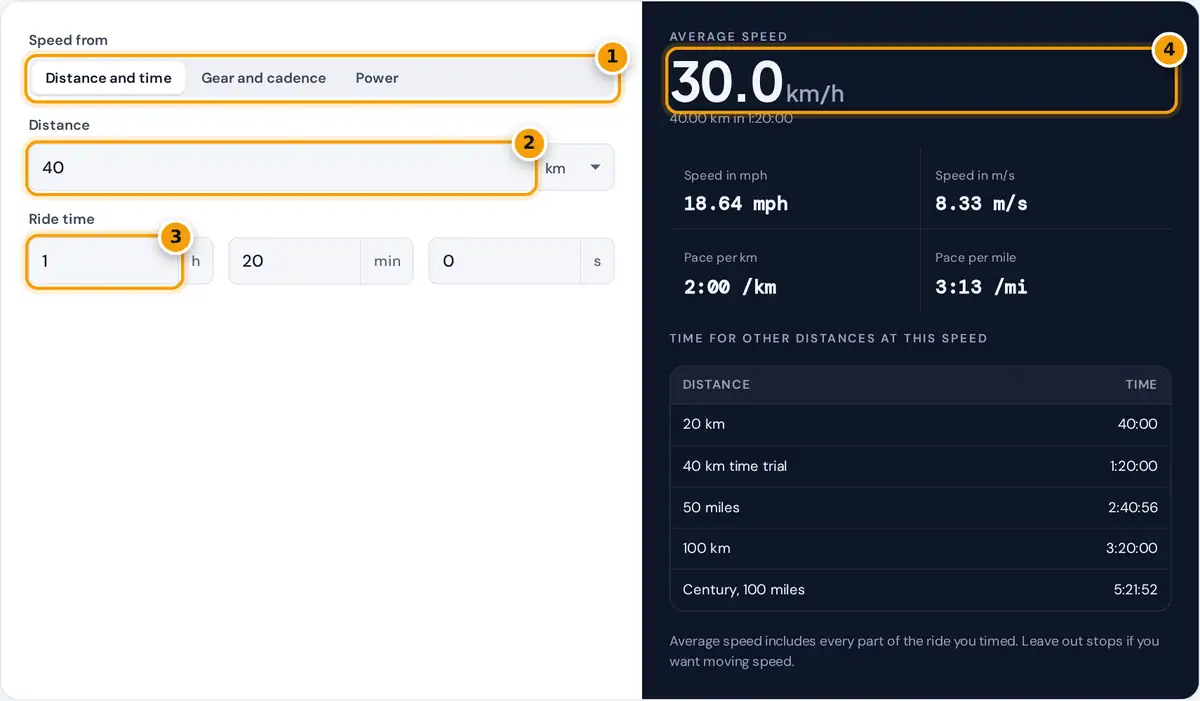
- Pick how to find speed: distance and time, gear and cadence, or power.
- Enter the ride distance in km or miles.
- Enter the ride time in hours, minutes and seconds.
- Read your speed in km/h, then mph, pace and finish times for common distances.
Pick how you want to find your speed. Distance and time gives the average speed of a ride you have already done. Gear and cadence shows how fast you travel in a chosen gear at a given pedaling rate, which helps when choosing a cassette or chainring. Power estimates the steady speed you can hold with a given number of watts on flat roads or hills.
Each mode shows the result in km/h and mph, plus extra detail: pace and finish times for the average speed, gear ratio, gear inches and development for gearing, and a breakdown of where your watts go for power.
Cycling Speed Formulas
gear speed (km/h) = cadence × (chainring ÷ cog) × circumference (m) × 60 ÷ 1,000
wheel circumference = π × (bead seat diameter + 2 × tire width)
power × 0.975 = (Crrmg cosθ + mg sinθ + ½ρCdA v²) × v
The power equation balances your power at the wheel against rolling resistance, gravity on the slope and air drag. The calculator solves it for the speed v. Air drag grows with the cube of speed in watts, which is why going a little faster on the flat takes a lot more power.
Worked Examples
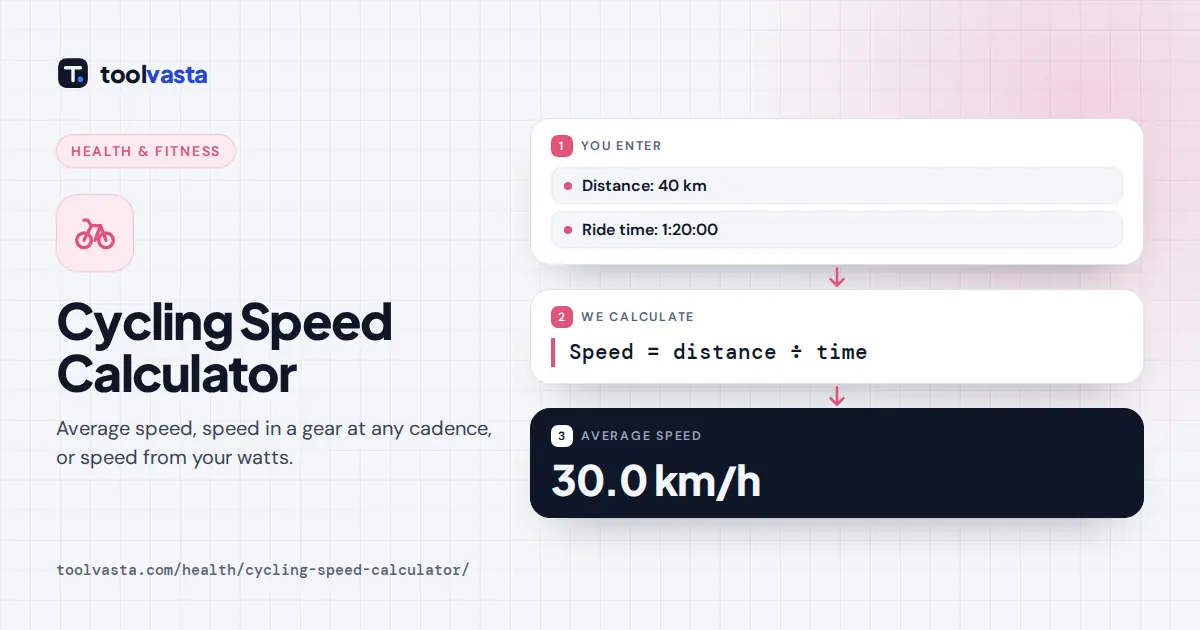
Average speed: 40 km in 1 hour 20 minutes is 40 ÷ 1.333 = 30.0 km/h, or 18.64 mph. At that speed a 100 mile century takes 5:21:52.
Gear and cadence: a 700 × 25c wheel has a circumference of π × (622 + 50) = 2,111 mm. In a 50 × 17 gear the ratio is 2.94, so each crank turn moves the bike 6.21 m. At 90 rpm that is 90 × 6.21 × 60 ÷ 1,000 = 33.5 km/h, and the gear measures 77.8 gear inches.
Power: a 75 kg rider on a 9 kg bike, hands on the hoods (drag area 0.32 m²) on a smooth flat road, holds about 33.9 km/h at 200 W. On a 5% climb, 250 W gives about 17.8 km/h.
Gear Inches and Cadence Table
| Gear, 700 × 25c | Gear inches | 80 rpm | 90 rpm | 100 rpm |
|---|---|---|---|---|
| 34 × 28 | 32.0 | 12.1 km/h | 13.6 km/h | 15.1 km/h |
| 50 × 17 | 77.8 | 29.8 km/h | 33.5 km/h | 37.3 km/h |
| 50 × 11 | 120.3 | 46.1 km/h | 51.8 km/h | 57.6 km/h |
Gear inches is the diameter of a penny-farthing wheel that would travel the same distance per pedal turn. Lower numbers are easier for climbing, and higher numbers are faster on descents.
Use the cadence table to choose gears. Many experienced road riders settle between 80 and 100 rpm on the flat. If your target speed needs a cadence above about 110 rpm, you need a bigger gear. If a climb drops you below about 60 rpm, a larger rear cog or a smaller chainring will help you keep spinning.
How Position and Hills Change Speed at 200 W
| Position | Flat | 3% climb | 6% climb |
|---|---|---|---|
| Upright, hands on tops | 31.6 km/h | 19.8 km/h | 12.6 km/h |
| Hands on hoods | 33.9 km/h | 20.5 km/h | 12.7 km/h |
| Hands in drops | 35.4 km/h | 20.8 km/h | 12.8 km/h |
| Aero bars | 37.1 km/h | 21.2 km/h | 12.9 km/h |
All rows use a 75 kg rider, a 9 kg bike and a smooth road, worked out with the power mode above. On the flat, position changes speed by more than 5 km/h because air drag dominates. On a 6% climb the difference shrinks to a fraction of a km/h, because almost all of your power goes into lifting your weight. Loose gravel on the flat at the same 200 W drops the hoods speed to about 29.9 km/h.
Assumptions and Limits
- The power mode assumes still air at sea level and typical drag and rolling values. A headwind of 10 km/h can cut flat speed by several km/h.
- Drag area depends on your body size, clothing and position. The presets are reasonable averages, not measurements.
- Gear speeds assume no slipping and a constant cadence. Real roll-out also depends on tire pressure and load.
Frequently asked questions
How do I calculate my average cycling speed?
Divide the distance by the ride time in hours. Riding 40 km in 1 hour 20 minutes gives 40 ÷ 1.333 = 30 km/h. Include only moving time if you want moving average speed.
How do I work out speed from gear and cadence?
Multiply cadence by the gear ratio (chainring ÷ cog) and by the wheel circumference. At 90 rpm in a 50 × 17 gear on a 700 × 25c wheel, that gives about 33.5 km/h.
What is a good average speed on a road bike?
Many recreational riders average 20 to 25 km/h on mixed roads. Regular club riders often hold 25 to 30 km/h in a group, and strong riders exceed 30 km/h on flat routes.
How fast will I go at 200 watts?
On flat roads in still air, a 75 kg rider on a road bike with hands on the hoods goes about 34 km/h. Wind, position, tire choice and gradient change this a lot.
What are gear inches?
Gear inches are the gear ratio multiplied by the wheel diameter in inches. They let you compare gears across bikes with different wheel sizes. Around 70 to 90 suits fast flat riding.
How do I find my wheel circumference?
Use pi times the rim bead seat diameter plus twice the tire width, which the calculator does for common sizes. For best accuracy, mark the tire and measure one full roll on the ground.