How to Use the Body Recomposition Calculator
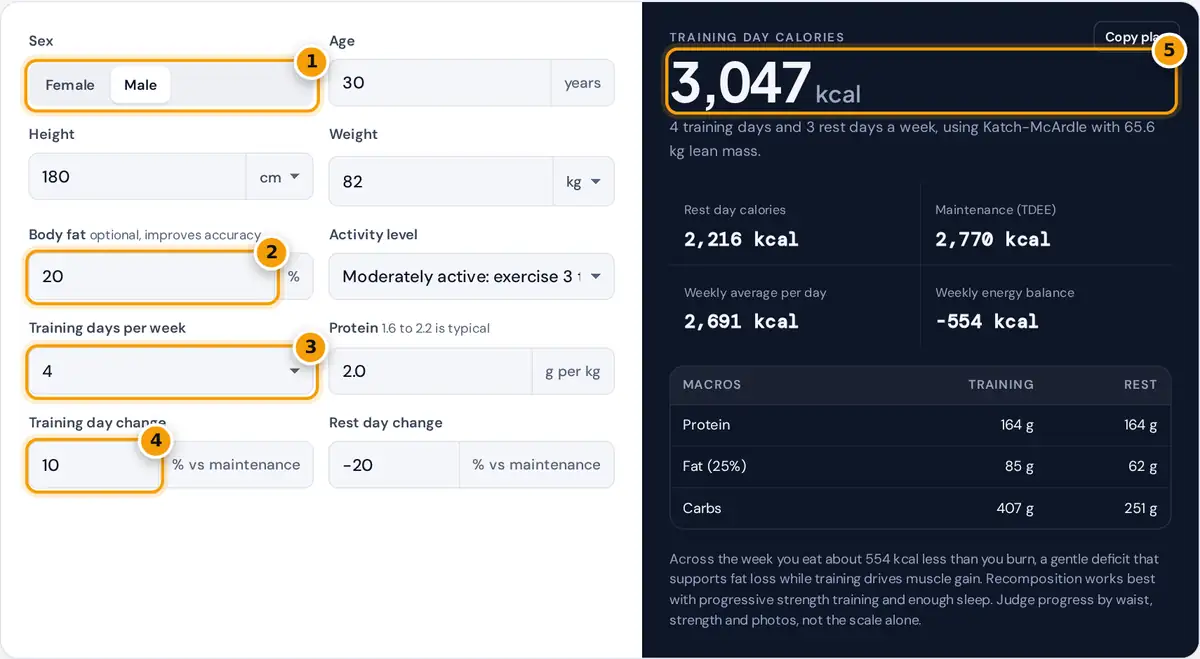
- Choose your sex, then enter age, height and weight in metric or imperial units.
- Add body fat if you know it to use the lean mass based Katch-McArdle equation.
- Pick how many days a week you lift weights.
- Set the training day and rest day calorie changes. +10% and -20% is a classic recomp.
- Read training day calories, then check rest day calories, macros and the weekly balance.
Choose your sex, then enter your age, height and weight in metric or imperial units. If you know your body fat percentage from a scan, calipers or a smart scale, type it in: the calculator then uses lean body mass, which suits muscular people better. Leave the field blank to use height, weight and age instead.
Pick the activity level that describes your normal week including workouts, then set how many days you lift. The training day and rest day fields control calorie cycling. The defaults, 10% above maintenance on training days and 20% below on rest days, are a common starting point. The result shows calories and macros for both day types, your maintenance calories and the balance across the whole week.
How the Recomp Numbers Are Calculated
Maintenance calories (TDEE) start from resting metabolic rate. With a body fat entry the tool uses the Katch-McArdle equation; without it, Mifflin-St Jeor. RMR is multiplied by the activity factor to get TDEE.
Mifflin-St Jeor RMR = 10 × kg + 6.25 × cm − 5 × age + 5 (men) or − 161 (women)
TDEE = RMR × activity factor
training day = TDEE × (1 + training change)
rest day = TDEE × (1 + rest change)
Protein is set per kilogram of body weight. Fat is 25% of each day's calories, and carbohydrates fill the remaining calories at 4 kcal per gram (protein 4, fat 9).
Worked Example
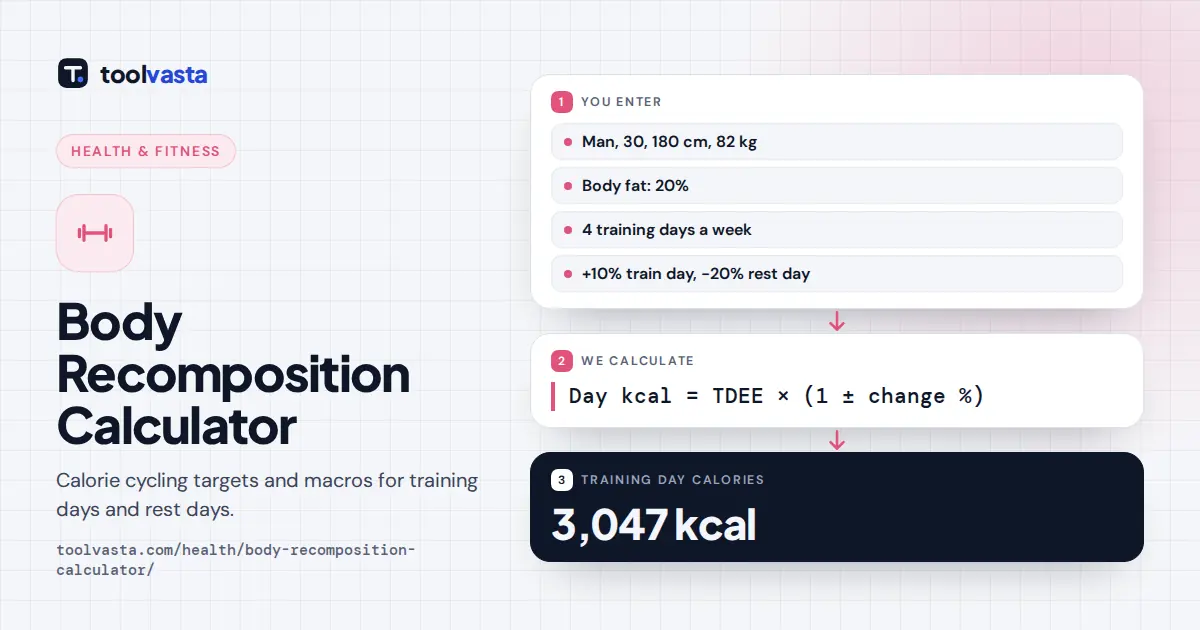
A 30 year old man, 180 cm and 82 kg with 20% body fat, has 65.6 kg of lean mass. Katch-McArdle gives 370 + 21.6 × 65.6 = 1,787 kcal, and the moderately active factor of 1.55 gives a TDEE of 2,770 kcal. Training days at +10% are 3,047 kcal and rest days at −20% are 2,216 kcal. With 4 training days, the week totals 18,835 kcal against 19,389 burned, a balance of about −554 kcal. At 2.0 g per kg, protein is 164 g every day; training day fat is 85 g and carbs 407 g, while rest day fat is 62 g and carbs 251 g.
Calorie Cycling Options
| Setup | Training day | Rest day | Best for |
|---|---|---|---|
| Fat loss lean | +0 to +5% | −20 to −25% | Higher body fat, newer lifters |
| Classic recomp | +10% | −20% | Most people starting a recomp |
| Maintenance recomp | +10% | −10% | Lean lifters who want to stay near maintenance |
| Flat | −10% | −10% | People who prefer the same intake every day |
The percentages in the table are coaching conventions, not fixed rules. The weekly balance matters most: a small overall deficit with high protein and hard training is the usual recipe.
Who Can Recomp Successfully
Recomposition, losing fat and gaining muscle at the same time, is most realistic for people new to lifting, people returning after a break, and people with more body fat to lose. Very lean, experienced lifters usually make faster progress with separate bulking and cutting phases. Progress is slow, so expect the scale to move little while your waist shrinks and your lifts climb.
Tips and Limits
- Equations estimate TDEE within roughly 10% for most people. Track your weight and waist for three to four weeks and adjust by 100 to 200 kcal if needed.
- Pick the activity level honestly. Overestimating it is the most common reason a plan stalls.
- Protein of 1.6 to 2.2 g per kg is the range most sports nutrition reviews discuss for people trying to build or keep muscle.
- The plan assumes regular resistance training. Without it, a deficit tends to cost muscle as well as fat.
For general nutrition research summaries, see the National Institutes of Health.
Results are estimates for general information, not medical advice. Talk with a doctor or registered dietitian before big changes to diet, exercise or sleep, especially if you are pregnant, under 18 or managing a health condition.
Frequently asked questions
How many calories should I eat for body recomposition?
Most plans keep the weekly average a little below maintenance. A common setup is about 10% above maintenance on training days and 20% below on rest days, which creates a gentle weekly deficit while fueling workouts.
How much protein do I need to recomp?
Many sports nutrition reviews suggest 1.6 to 2.2 g of protein per kg of body weight a day for people building or keeping muscle. The calculator defaults to 2.0 g per kg and lets you change it.
Is body recomposition possible for everyone?
It works best for beginners, people returning to training and people with more body fat. Lean, experienced lifters usually gain muscle faster with a separate bulk and cut, because their recomp progress is very slow.
Why does the calculator ask for body fat percentage?
With body fat it can use the Katch-McArdle equation, which is based on lean mass and suits muscular people better. Without it, the Mifflin-St Jeor equation uses height, weight, age and sex instead.
How long does a body recomposition take?
Visible change usually takes at least 8 to 12 weeks of consistent training and eating. Because fat loss and muscle gain happen together, the scale may barely move, so track waist size and strength too.
Should I eat more carbs on training days?
Yes, that is the idea of calorie cycling. Protein stays the same every day, fat is a fixed share of calories, and most of the extra training day energy comes from carbohydrates to support your workouts.