How to Use the Golf Handicap Calculator
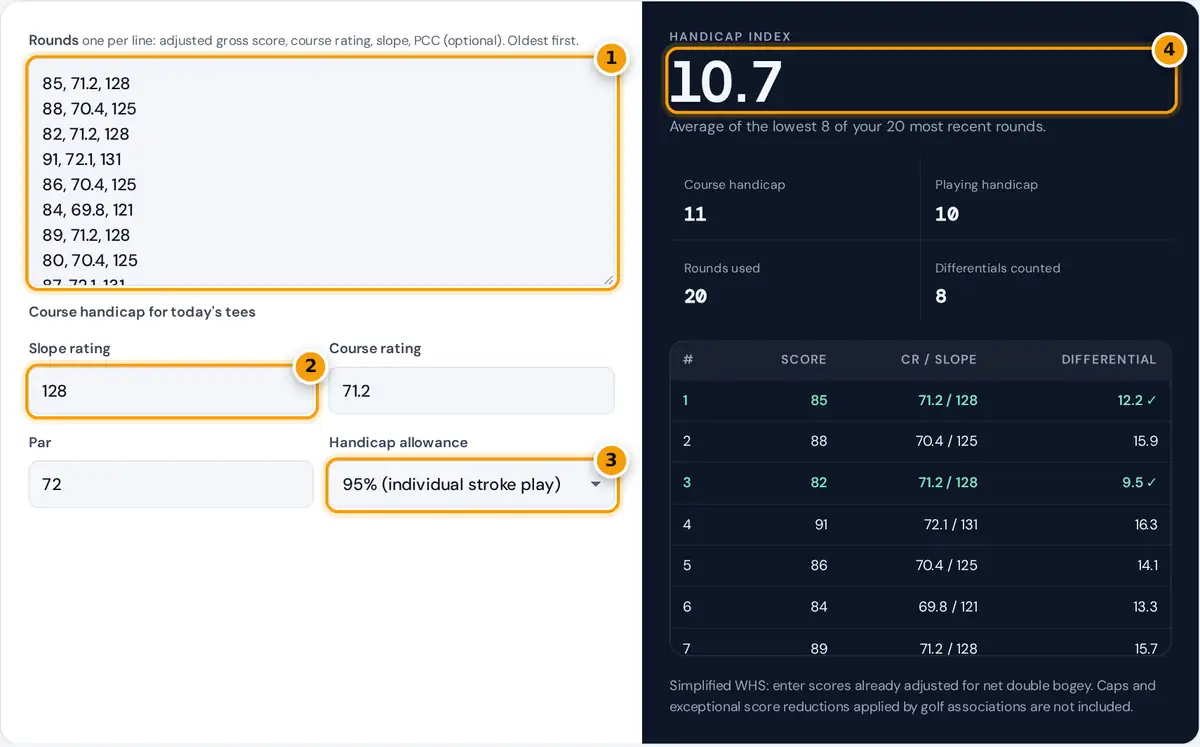
- Enter one round per line: adjusted gross score, course rating, slope and optional PCC.
- Enter today's slope rating and course rating.
- Choose the handicap allowance for the format.
- Read your handicap index, course handicap and which rounds counted.
Enter one round per line: adjusted gross score, course rating and slope rating, separated by commas or spaces. Add the playing conditions calculation (PCC) as a fourth number if your association published one for that day; otherwise it is zero. List rounds from oldest to newest. If you enter more than 20, only the latest 20 count.
The handicap index updates as you type. Counted rounds are highlighted with a check mark in the table. Below the rounds, enter the slope rating, course rating and par of the tees you are about to play to get your course handicap, then choose the handicap allowance for the format to see your playing handicap.
World Handicap System Formulas
handicap index = average of the lowest differentials (8 of the latest 20)
course handicap = index × (slope ÷ 113) + (course rating − par)
playing handicap = course handicap × allowance
113 is the slope rating of a course of standard difficulty. Differentials are rounded to one decimal, the index is rounded to one decimal and capped at 54.0, and course and playing handicaps are rounded to whole strokes.
Worked Example
A score of 85 on a course rated 71.2 with slope 128 gives (113 ÷ 128) × (85 − 71.2) = 12.2. Across the 20 sample rounds, the eight lowest differentials are 8.6, 8.7, 9.5, 10.5, 11.4, 12.2, 12.3 and 12.3. Their average is 10.69, so the handicap index is 10.7. On tees with slope 128, rating 71.2 and par 72, the course handicap is 10.7 × 128 ÷ 113 + (71.2 − 72) = 11.32, rounded to 11. At a 95% allowance, the playing handicap is 10.
Fewer Than 20 Rounds
| Rounds | Differentials used | Adjustment |
|---|---|---|
| 3 | Lowest 1 | −2.0 |
| 4 | Lowest 1 | −1.0 |
| 5 | Lowest 1 | 0 |
| 6 | Average of lowest 2 | −1.0 |
| 7 to 8 | Average of lowest 2 | 0 |
| 9 to 11 | Average of lowest 3 | 0 |
| 12 to 14 | Average of lowest 4 | 0 |
| 15 to 16 | Average of lowest 5 | 0 |
| 17 to 18 | Average of lowest 6 | 0 |
| 19 | Average of lowest 7 | 0 |
| 20 | Average of lowest 8 | 0 |
With the first five sample rounds only, the lowest differential of 9.5 is the index. With three rounds the lowest differential is reduced by 2.0, so the same first three rounds give 7.5.
What Adjusted Gross Score Means
Under the World Handicap System, a bad hole is capped before the score is used for handicap purposes. The usual maximum is net double bogey: par plus two strokes plus any handicap strokes received on that hole. Enter the adjusted score, not the raw total, so one disaster hole does not inflate your index.
Slope and Course Rating Explained
Course rating is the score a scratch golfer is expected to shoot from a set of tees, such as 71.2. Slope rating measures how much harder the course plays for a bogey golfer compared with a scratch golfer, on a scale from 55 to 155 with 113 as standard. A higher slope gives higher handicap golfers more strokes. Both numbers are printed on the scorecard or published by the club for every set of tees.
Keep a record of every acceptable round with its rating and slope. Pasting that list into this calculator after each round shows how your index will move before the official revision is published.
Limits
- Official indexes include a soft cap and hard cap that limit how fast an index can rise against your low index of the past year. This tool does not apply them.
- Exceptional score reductions after a very low round are not applied.
- Nine hole scores need to be combined or expanded under your association's rules before entry.
- Your official index comes from your national golf association. Use this calculator to check and plan.
Frequently asked questions
How is a golf handicap index calculated?
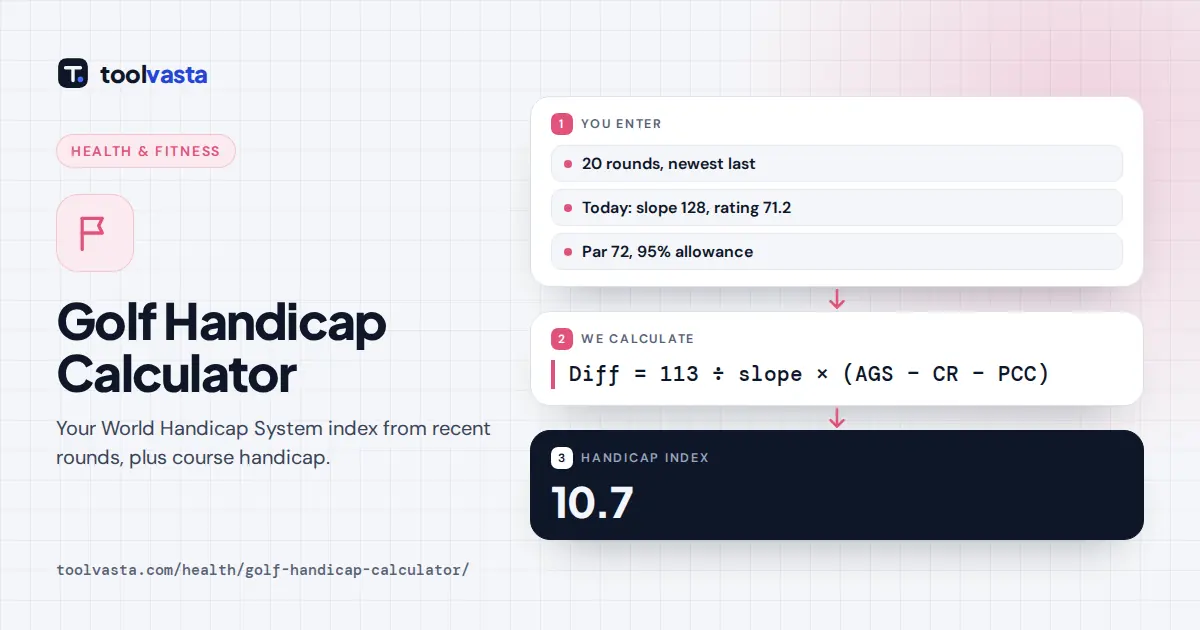
Each round becomes a score differential: 113 divided by slope, times adjusted gross score minus course rating minus PCC. With 20 rounds, the index is the average of the lowest 8 differentials, rounded to one decimal.
What is a score differential?
It is your score adjusted for course difficulty. The formula is (113 ÷ slope) × (adjusted gross score − course rating − PCC). Lower differentials mean better rounds relative to the course.
How do I calculate my course handicap?
Multiply your handicap index by the slope rating of the tees, divide by 113, then add the course rating minus par. Round to a whole number. An index of 10.7 on slope 128, rating 71.2, par 72 gives 11.
How many rounds do I need for a handicap?
Under the World Handicap System you need scores from at least 54 holes, such as three 18 hole rounds. With fewer than 20 rounds, a smaller number of the lowest differentials is used with set adjustments.
What is the difference between course and playing handicap?
Course handicap is the strokes you receive from a set of tees. Playing handicap applies the allowance for the format, such as 95% for individual stroke play, and is the number used in that competition.
Is this my official handicap?
No. Official indexes are kept by national golf associations and include caps and exceptional score rules. This calculator uses the core WHS formulas so you can estimate and check your index.