How to use the FFMI calculator
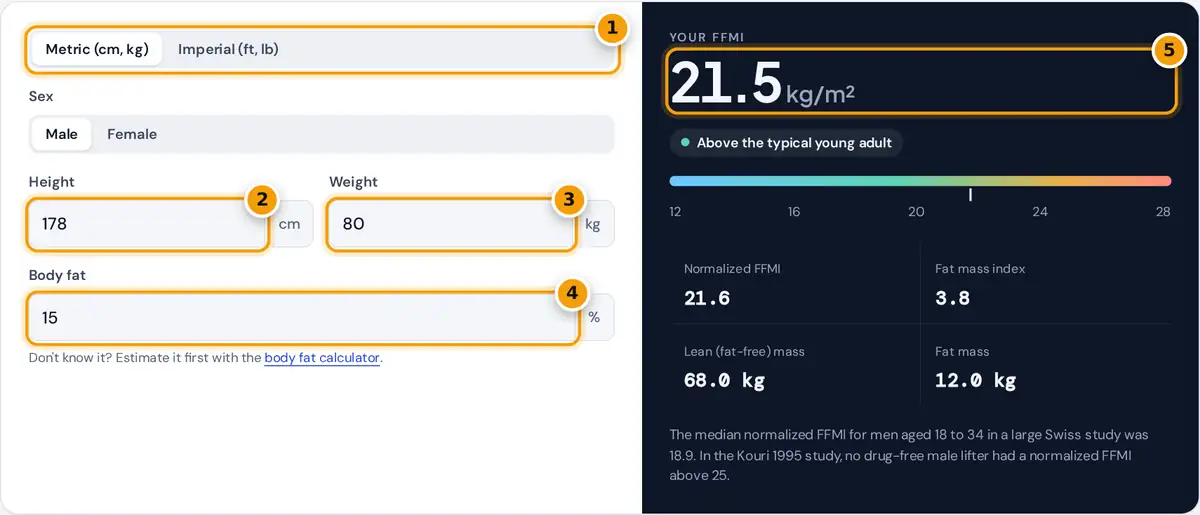
- Choose metric (cm, kg) or imperial (ft, lb).
- Enter your height.
- Enter your body weight.
- Enter your body fat percentage, or estimate it first with the body fat calculator.
- Read your FFMI, then your normalized FFMI, lean mass and fat mass.
Choose metric or imperial units, then enter your sex, height, weight and body fat percentage. The calculator works out your lean mass (everything that is not fat: muscle, bone, organs and water), divides it by your height squared and shows your fat-free mass index. It also gives the normalized FFMI, which adjusts for height, plus your fat mass index and the weight of your lean and fat mass.
FFMI is only as good as the body fat figure you enter. A DEXA scan or a careful skinfold measurement is best. Estimates from bathroom scales or tape measures can be several points off.
FFMI formula
FFMI = lean mass ÷ height (m)2
normalized FFMI = FFMI + 6.1 × (1.8 − height in m)
The normalization comes from Kouri and colleagues (Clinical Journal of Sport Medicine, 1995). Taller people tend to have a slightly lower FFMI for the same build, so the correction adjusts every result to a height of 1.80 m.
Worked example
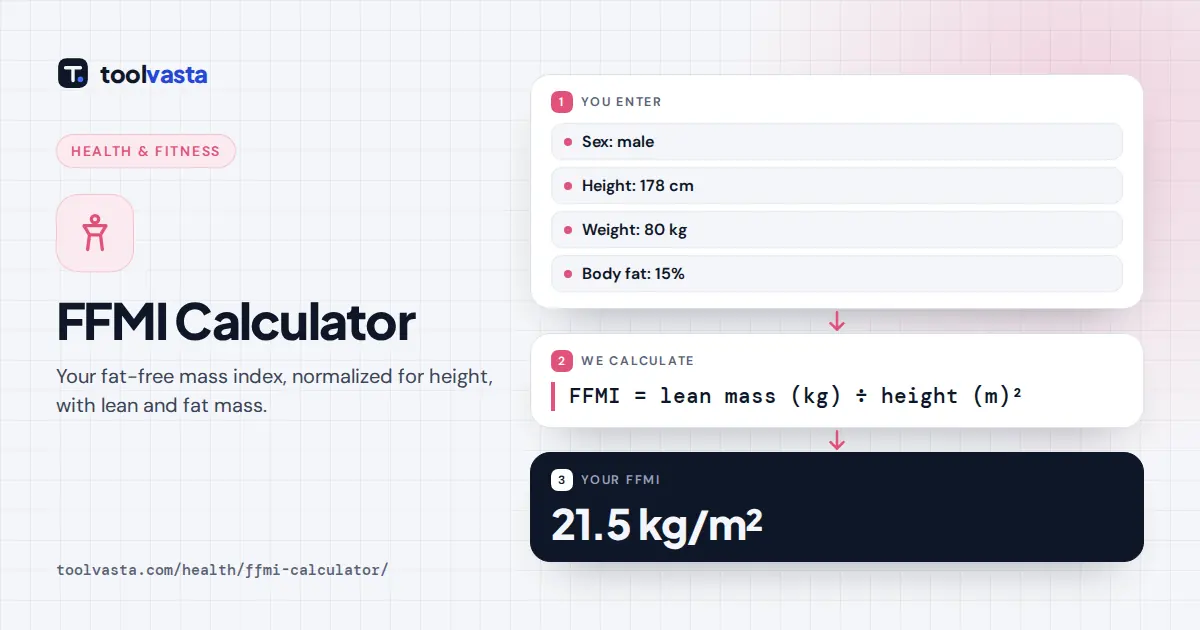
A man who is 178 cm tall, weighs 80 kg and has 15% body fat carries 80 × 0.85 = 68 kg of lean mass and 12 kg of fat. His FFMI is 68 ÷ 1.782 = 68 ÷ 3.1684 = 21.5. The height correction adds 6.1 × 0.02 = 0.12, giving a normalized FFMI of 21.6. His fat mass index is 12 ÷ 3.1684 = 3.8.
How to read your result
Two research findings give useful reference points:
- Typical adults: in a study of more than 5,000 healthy Swiss adults (Schutz, Kyle and Pichard, International Journal of Obesity, 2002), the median FFMI for people aged 18 to 34 was 18.9 for men and 15.4 for women. The badge in the result compares your normalized value with these medians.
- Trained men: Kouri's team measured 157 male athletes. After height normalization, none of the 74 who had never used anabolic steroids scored above 25, while many users did. This is why 25 is often called the natural limit. It is a finding from one sample, not a hard rule, and a few drug-free athletes have been measured above it.
| Normalized FFMI vs typical median | Badge |
|---|---|
| More than 1 point below | Below the typical young adult |
| Within 1 point | Close to the typical young adult |
| 1 to 3 points above | Above the typical young adult |
| 3 or more points above | Well above the typical young adult |
FFMI vs BMI
BMI divides total weight by height squared, so it cannot tell muscle from fat. A muscular person and a person with high body fat can share the same BMI. FFMI removes the fat first, which makes it far more useful for athletes and anyone tracking muscle gain. Pair it with the fat mass index to see both sides of your body composition.
Limits
- A body fat error of 3 percentage points changes FFMI by roughly 0.8 for the example above.
- Hydration, glycogen and recent meals change lean mass readings from day to day.
- Reference data come mostly from white European and North American adults, so they may not fit everyone.
Results are estimates for general information, not medical advice. Talk with a doctor or registered dietitian before making big changes, especially if you are pregnant, breastfeeding, under 18 or managing a health condition.
Frequently asked questions
What is a good FFMI?
For context, the median normalized FFMI for adults aged 18 to 34 was 18.9 for men and 15.4 for women in a large Swiss study. Regular strength trainees are often 2 to 4 points above those medians.
What is the FFMI natural limit?
In a 1995 study of 157 male athletes, none of the drug-free lifters had a normalized FFMI above 25. That figure is widely used as a rough natural ceiling, though it is not an absolute rule.
What is the difference between FFMI and normalized FFMI?
Normalized FFMI adds 6.1 × (1.8 − your height in meters) to adjust the result to a height of 1.80 m, so tall and short people can be compared fairly.
Do I need my body fat percentage?
Yes. FFMI is based on lean mass, which needs a body fat estimate. Use a DEXA scan, skinfold calipers or the body fat calculator on this site.
Is FFMI useful for women?
Yes, the same formula works for women. Typical values are lower than for men, and there is less research on upper limits for trained women.