How to use the implantation calculator
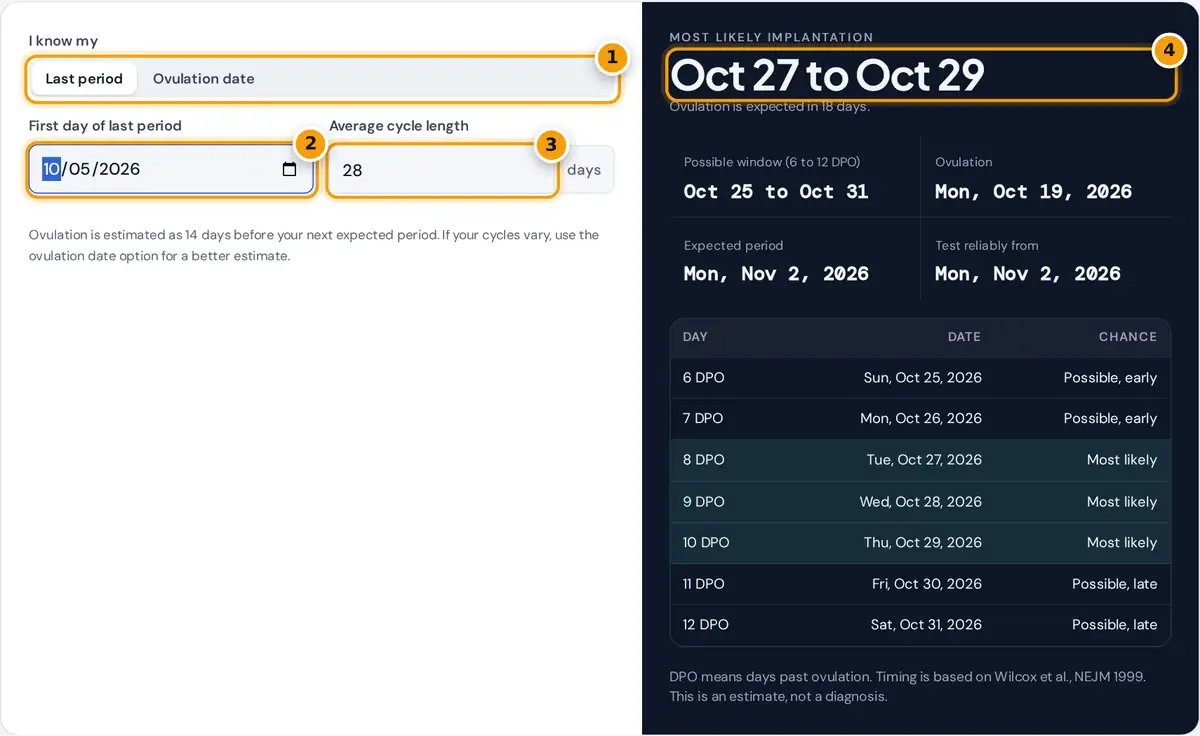
- Choose whether you know your last period or your ovulation date.
- Enter the first day of your last period.
- Enter your average cycle length in days.
- Read the most likely implantation days, then check the full window and test date.
Choose Last period and enter the first day of your most recent period and your usual cycle length, or choose Ovulation date if you tracked ovulation with test strips, basal body temperature or a fertility monitor. The calculator shows the three most likely implantation days, the full window in which implantation can happen, a day by day table and the date your period is due.
When does implantation happen?
After an egg is fertilized it travels down the fallopian tube for several days while it divides. It reaches the uterus as a blastocyst and then attaches to the uterine lining. That attachment is implantation, and it is when the body starts making the pregnancy hormone hCG.
The best data come from a study by Allen Wilcox and colleagues in the New England Journal of Medicine (1999), which tracked daily urine samples from 221 women trying to conceive. In pregnancies that lasted beyond six weeks, hCG first appeared 6 to 12 days after ovulation, and 84% implanted on day 8, 9 or 10. Later implantation was linked with a higher chance of early pregnancy loss.
How the dates are calculated
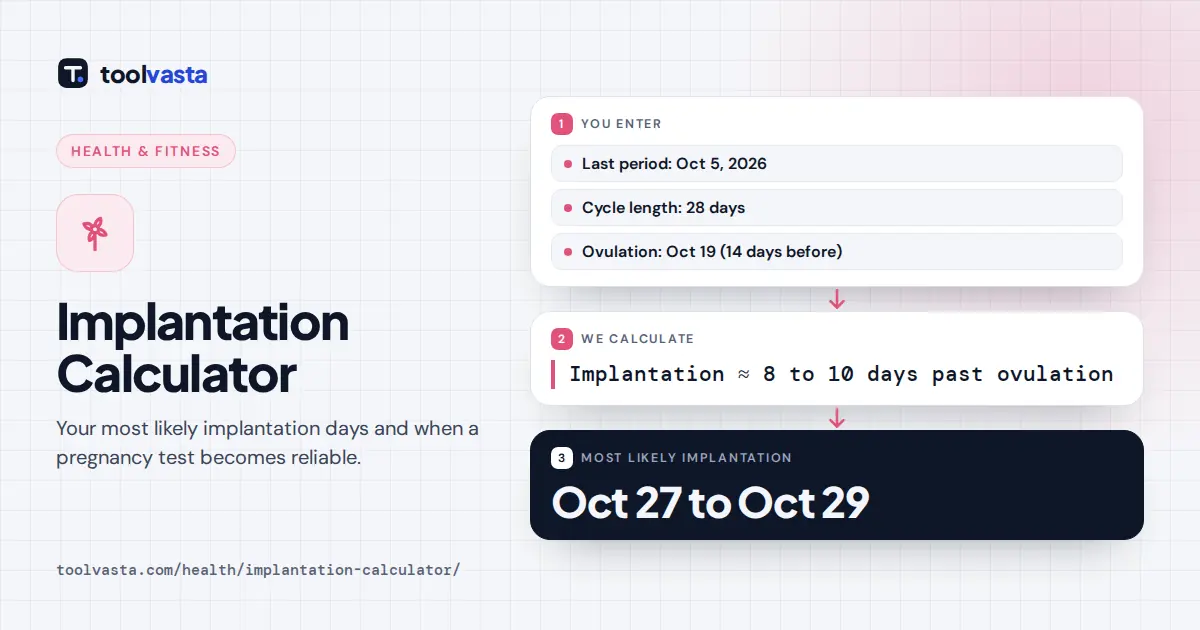
most likely implantation = ovulation + 8 to 10 days
possible window = ovulation + 6 to 12 days
expected period = ovulation + 14 days
Worked example
Your last period started on March 1, 2026, and your cycles are 28 days long. Ovulation is estimated at March 1 + 28 − 14 = March 15. Implantation is most likely from March 23 to March 25, with a possible window from March 21 to March 27. Your next period is due on Sunday, March 29, and that is the first day a home test is reliable. With a 32-day cycle, every date moves four days later: ovulation on March 19 and likely implantation from March 27 to March 29.
When to take a pregnancy test
Home tests detect hCG in urine. Levels start low after implantation and roughly double every two to three days, so testing too early can give a negative result even if you are pregnant. Most tests are reliable from the first day of a missed period, which is why the calculator shows the expected period date. If a test is negative and your period still has not arrived, test again in two or three days.
Implantation bleeding and other signs
Some people notice light spotting or mild cramps around the time of implantation. Spotting is usually pink or brown, light, and lasts a few hours to two days. Many people have no signs at all, and spotting can have other causes, so these signs cannot confirm a pregnancy. Heavy bleeding, severe pain or one-sided pain needs prompt medical advice.
Limits
- The period method assumes ovulation 14 days before your next period. The real luteal phase ranges from about 10 to 16 days.
- Irregular cycles, recent hormonal contraception and breastfeeding make the estimate less reliable.
- For IVF, implantation timing depends on the embryo age at transfer. Follow the blood test date your clinic gives you.
Source: Wilcox AJ, Baird DD, Weinberg CR. Time of implantation of the conceptus and loss of pregnancy. N Engl J Med 1999;340:1796-1799.
This calculator gives an estimate for general information. Every pregnancy is different, and only your doctor, midwife or care provider can confirm dates for you. If anything feels wrong, contact them or call your local health line.
Frequently asked questions
How many days after ovulation does implantation occur?
Usually 6 to 12 days after ovulation. In the largest daily hormone study, 84% of pregnancies implanted on day 8, 9 or 10.
Can I take a pregnancy test right after implantation?
It is usually too early. hCG needs a few days to build up after implantation. Home tests are most reliable from the first day of your missed period.
What does implantation bleeding look like?
It is typically light pink or brown spotting that lasts from a few hours to two days. It is much lighter than a period, and many people never notice it.
How do I calculate my implantation date?
Find your ovulation date, which is about 14 days before your next period, then add 8 to 10 days for the most likely implantation days. The calculator does this for you.
Does late implantation mean something is wrong?
Not necessarily. Implantation on days 11 or 12 still leads to many healthy pregnancies, although research found a higher rate of early loss with later implantation.