How to Use the BAC Calculator
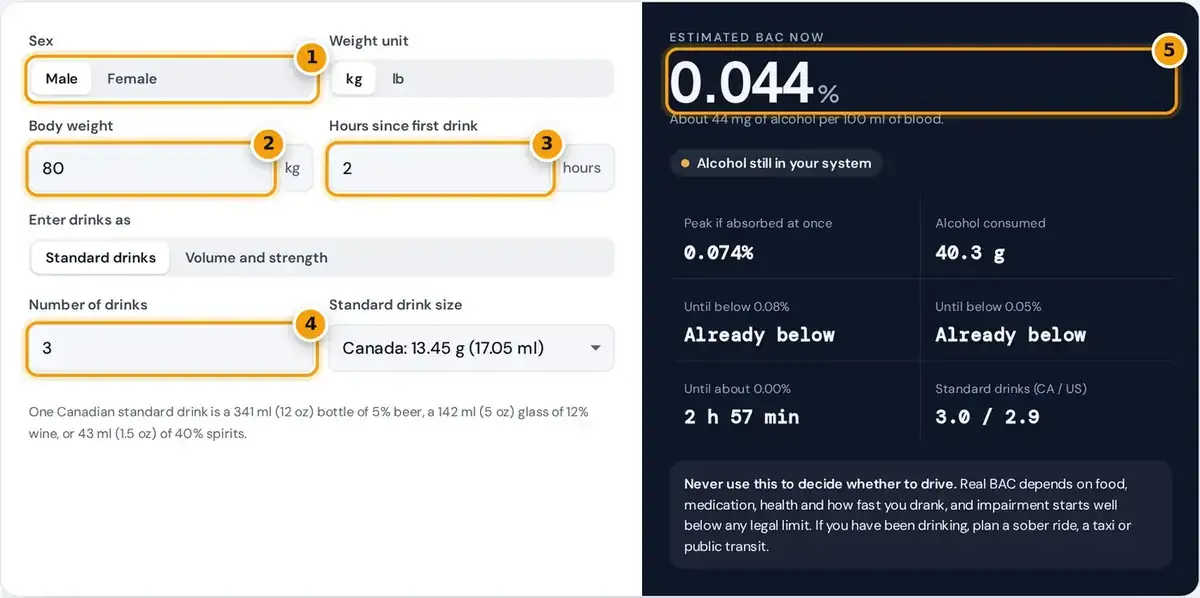
- Select male or female; body water differs between them.
- Enter your body weight in kg or lb.
- Enter the hours since your first drink.
- Enter the number of standard drinks and choose the Canadian or US size.
- Read your estimated BAC and the time until it falls below 0.08%, 0.05% and zero.
Choose your sex, pick kg or lb, and enter your body weight and the hours since your first drink. The calculator accepts any body weight from 30 to 300 kg, or 66 to 660 lb.
Count all your drinks as standard drinks, using the Canadian or US size, or switch to volume and strength to enter the drink size in ml, its ABV and how many of them you had.
The result shows your estimated BAC now, the peak it would reach if all alcohol were absorbed at once, the grams of alcohol, and how long it takes to fall below 0.08%, 0.05% and zero.
What BAC Means
Blood alcohol concentration is the amount of alcohol in your blood, written as a percentage. A BAC of 0.08% means 80 mg of alcohol per 100 ml of blood, the unit used in Canadian law.
The calculator shows both forms, so 0.044% also appears as about 44 mg per 100 ml. The small colored status badge marks results at or above 0.08%, at or above 0.05%, or still above zero.
Impairment starts well before any legal limit. Judgment, reaction time and coordination begin to suffer at fairly low levels, and people often feel more sober than they are, especially while their BAC is still rising.
The Widmark Formula
Swedish scientist Erik Widmark described how alcohol spreads evenly through body water back in the 1930s. His simple equation is still the basis of most modern BAC estimates, including the one used by this calculator.
r = 0.68 for men, 0.55 for women
alcohol (g) = volume (ml) × ABV × 0.789
The factor r reflects the share of body weight that is water: 0.68 for men and 0.55 for women. Alcohol has a density of 0.789 g per ml, which turns volume into grams of alcohol.
For elimination, the body clears about 0.015% BAC per hour, a widely used average. Real rates vary from roughly 0.010% to 0.025% per hour between people, and even for the same person on different days.
Worked Examples
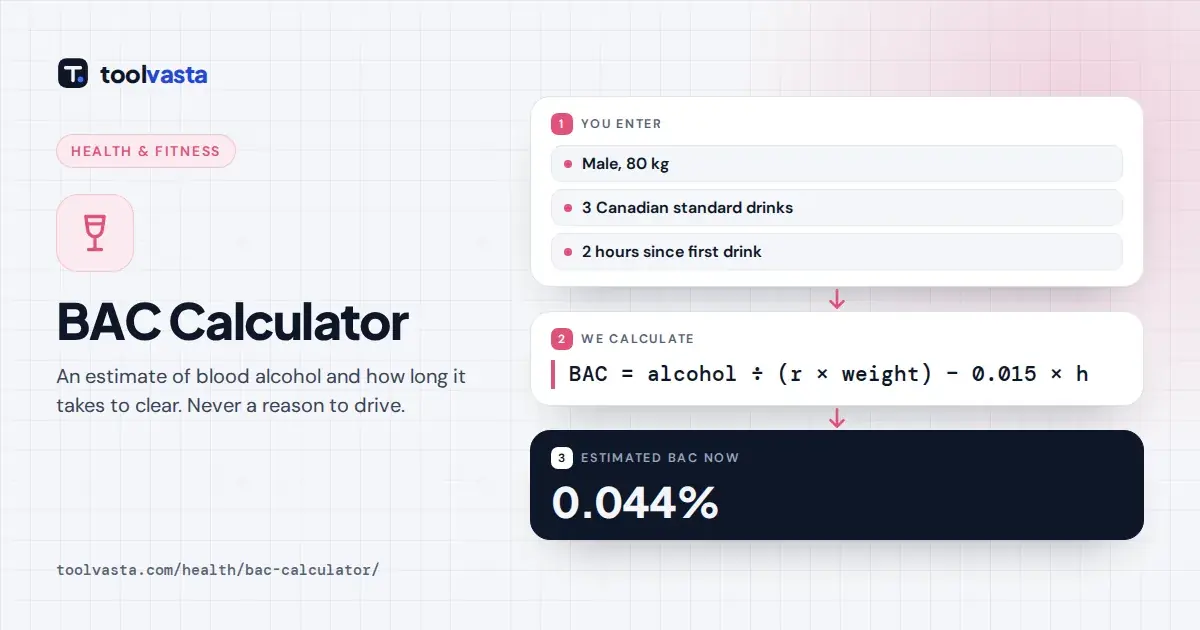
In a worked example, a man who weighs 80 kg drinks three Canadian standard drinks, or 40.35 g of alcohol. His estimated peak is 40.35 divided by 80,000 times 0.68, times 100, which is 0.074%.
After 2 hours of elimination, he subtracts 0.030, leaving an estimated 0.044%. It would take about another 2 hours 57 minutes for his BAC to reach zero, and nothing he can do speeds that up.
A 60 kg woman who has four Canadian standard drinks in 1 hour reaches an estimated 0.148%. She would need about 4 hours 32 minutes to drop below 0.08%, and much longer to reach zero.
Standard Drinks in Canada and the US
Canada defines a standard drink as 17.05 ml or 13.45 g of pure alcohol, as used in Canada's Guidance on Alcohol and Health. The US standard drink is slightly larger, at 14 g of alcohol.
| Drink | Canada (13.45 g) | US (14 g) |
|---|---|---|
| Beer, 5% | 341 ml (12 oz) | 12 fl oz (355 ml) |
| Wine, 12% | 142 ml (5 oz) | 5 fl oz (148 ml) |
| Spirits, 40% | 43 ml (1.5 oz) | 1.5 fl oz (44 ml) |
| Pure alcohol | 17.05 ml | 0.6 fl oz (17.7 ml) |
The US figure comes from the NIAAA, the National Institute on Alcohol Abuse and Alcoholism. The result panel converts your total into both Canadian and US standard drinks, so you can compare the two easily.
Many craft beers, large pours of wine and mixed drinks contain two or more standard drinks. Two 473 ml cans of 6% beer hold about 44.8 g of alcohol, or roughly 3.3 Canadian standard drinks.
What Affects Your BAC
The formula uses only weight, sex, alcohol and time, but many other things change how high your BAC climbs and how impaired you feel. These are the most important factors the simple estimate cannot see.
- Food in the stomach slows absorption and lowers the peak.
- Drinking speed matters: the same drinks taken quickly produce a higher peak.
- Medications, health conditions, fatigue and genetics change how alcohol affects you.
- BAC can keep rising for 30 to 90 minutes after your last drink.
Body composition also matters, not just total weight. Two people of the same weight can have different amounts of body water, so the average factors of 0.68 and 0.55 fit some people better than others.
Because of these factors, two people drinking the same amount can end up with quite different results. Treat the number as a rough average for learning, not as a real measurement of your own blood.
BAC Limits in Canada
Under the Criminal Code, it is an offence to have a BAC of 80 mg of alcohol per 100 ml of blood, or more, within two hours of driving. That equals the calculator's 0.08% line.
Most provinces also impose administrative penalties, such as license suspensions, starting at a lower 50 mg, or 0.05%. Many also require zero alcohol for new drivers and for young drivers, regardless of how they feel.
You can also be charged with impaired driving at any BAC if alcohol affects your ability to drive. A result below a legal limit never means it is safe or legal for you to drive.
How Long Alcohol Takes to Leave Your Body
The liver mainly removes alcohol at a roughly steady, slow rate, so only time lowers BAC. At the average rate of 0.015% per hour, a BAC of 0.06% takes about four hours to clear completely.
Nothing speeds up elimination. Coffee, water, cold showers, exercise and sleep may help you feel better or more awake, but they do not reduce the alcohol in your blood or restore your normal reaction time.
This matters the morning after a late night. If you drank heavily, your BAC may still be above zero when you wake up, so allow extra time before driving or doing anything needing full attention.
Why This Is Only an Estimate
This tool is for education only. It cannot tell you whether you are safe to drive, operate machinery or care for others, and it cannot measure your real BAC or your actual level of impairment.
Real BAC depends on food, medication, health and how fast you drank, and breath or blood tests are the only real way to measure it. Individual results can differ widely from the average shown here.
If you have been drinking, do not drive. Plan a sober ride, a taxi or public transit home before you start drinking, and if someone may have alcohol poisoning, call local emergency services right away.
Frequently asked questions
How is BAC calculated?
The Widmark formula divides grams of alcohol by body weight times a body water factor, 0.68 for men and 0.55 for women, then subtracts about 0.015% for each hour since drinking began.
How long does it take to get to 0.00 BAC?
On average the body removes about 0.015% BAC per hour, so a BAC of 0.06% takes roughly 4 hours to clear. Nothing, including coffee, water or sleep, speeds this up.
What is a standard drink in Canada?
A Canadian standard drink contains 17.05 ml or 13.45 g of pure alcohol: a 341 ml bottle of 5% beer, a 142 ml glass of 12% wine or 43 ml of 40% spirits.
What is the legal BAC limit in Canada?
The Criminal Code limit is 80 mg per 100 ml of blood, or 0.08%, within two hours of driving. Most provinces impose penalties from 0.05%, and many require zero alcohol for new drivers.
Can I use this calculator to know if I can drive?
No. It gives a rough average and cannot measure your real BAC or impairment. If you have had any alcohol, the safest choice is not to drive at all.
What factors affect BAC the most?
The amount of alcohol, your body weight, your sex and the time since you started drinking matter most. Food, drinking speed, medications and health can also change your real BAC considerably.