How to Use the Pregnancy Due Date Calculator
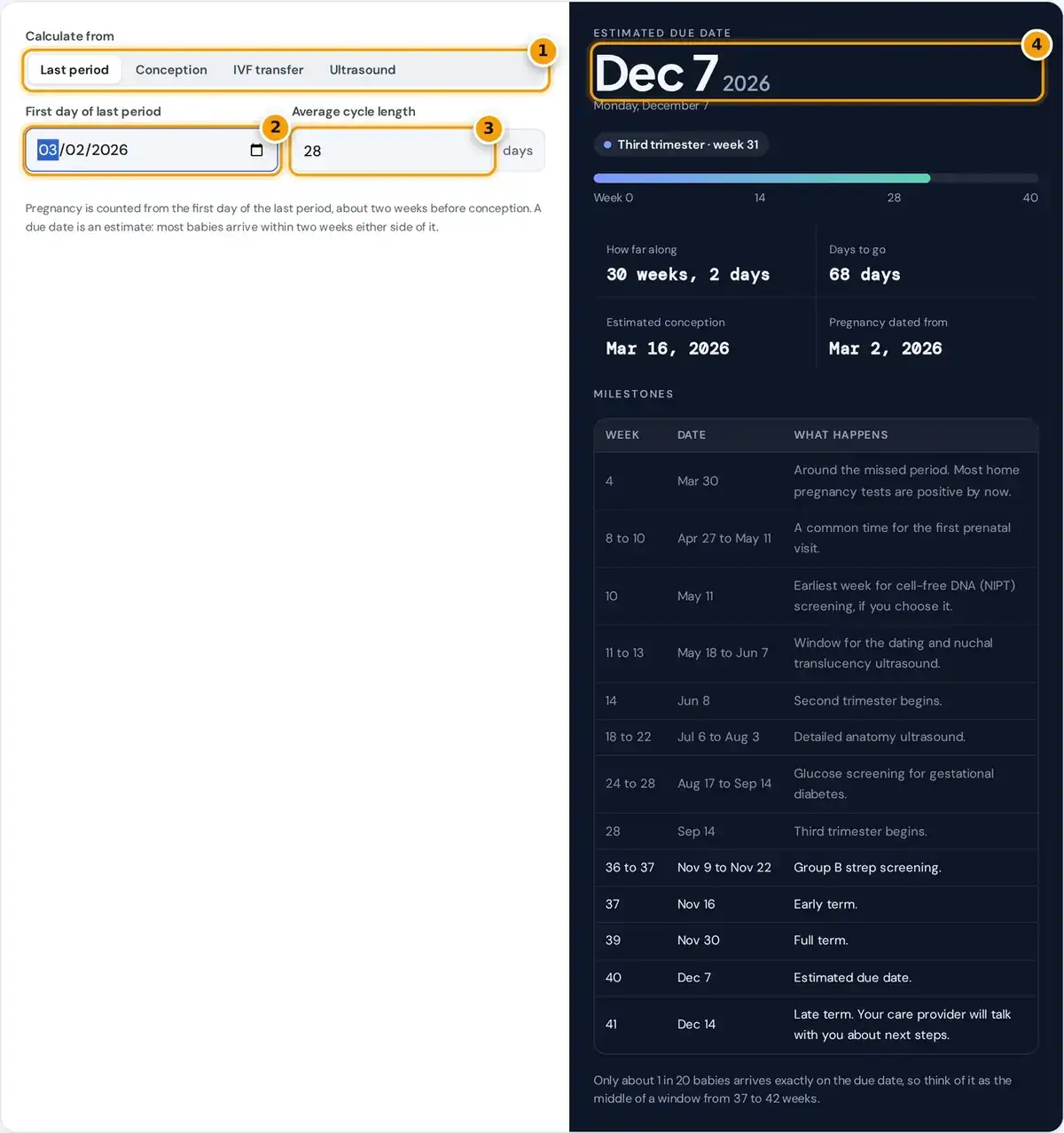
- Choose what you know: last period, conception date, IVF transfer or ultrasound.
- Enter the first day of your last menstrual period.
- Enter your average cycle length; the date shifts if it is not 28 days.
- Read your estimated due date, then check weeks pregnant and the milestone table.
Choose the method that matches what you know. Most people start with the first day of their last menstrual period, called the LMP, and enter their usual cycle length if it differs from 28 days.
If you know your conception date, had an IVF transfer, or have a dating ultrasound, pick that tab. The IVF option asks for embryo age, and the ultrasound option asks for gestational age on scan.
The result shows your estimated due date, how many weeks pregnant you are, your trimester and a week by week list of common milestones. Everything updates instantly and nothing you enter ever leaves your browser.
The Due Date Formulas
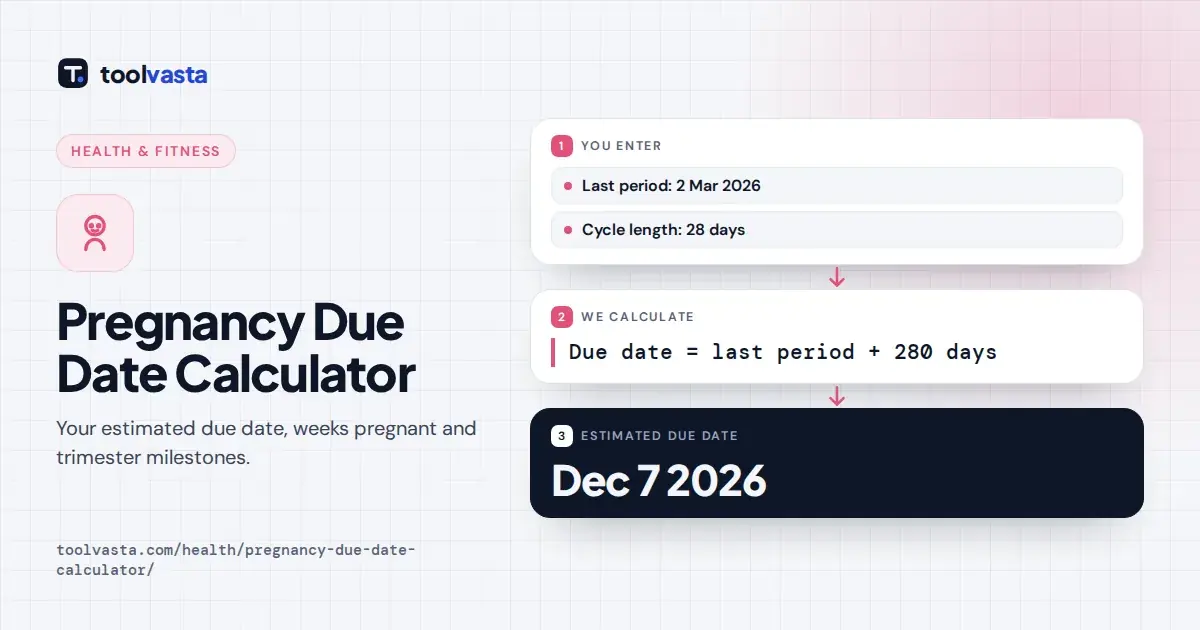
A full-term pregnancy is counted as 280 days, or 40 weeks, from the first day of the last period. This is Naegele's rule, the method most doctors and midwives still use at the first appointment.
From conception: due date = conception date + 266 days
IVF: due date = transfer date + 266 − embryo age in days
Ultrasound: due date = scan date + 280 − gestational age on scan (days)
Ovulation and conception usually happen about two weeks after the period starts, so the time from conception to birth is 266 days. Longer cycles move ovulation later, and the formula shifts the date to match.
For IVF, a day 5 blastocyst transfer adds 261 days and a day 3 embryo adds 263 days. For ultrasound, 8 weeks and 2 days equals 58 days, so the scan date gains 222 days.
Worked Examples
Your last period started on January 5, 2026, and you have a 28-day cycle. Adding 280 days gives an estimated due date of Monday, October 12, 2026, and a likely conception date around January 19.
With a longer cycle of 32 days, ovulation probably happened four days later. The cycle adjustment moves the due date to Friday, October 16, 2026, which is why the cycle length field matters for dating.
With a day 5 embryo transfer on April 10, 2026, the due date is April 10 plus 261 days, which is Sunday, December 27, 2026. A day 3 embryo on that date gives December 29.
Which Method Is Most Accurate?
A first trimester ultrasound is the most reliable way to date a pregnancy conceived naturally. Measuring the baby's crown-rump length before 14 weeks gives a date that is usually more precise than the LMP alone.
The SOGC guideline on determining gestational age by ultrasound recommends using that early scan to confirm or correct the LMP date. Care teams then usually keep the chosen date for the rest of the pregnancy.
For IVF pregnancies the transfer date is known, so it sets the due date. The LMP method works less well with irregular periods, when the date of ovulation is harder to predict from the calendar.
Gestational Age vs Fetal Age
Gestational age is counted from the first day of the last period, which is how pregnancy weeks are described. Fetal age is counted from conception, so it is about two weeks less than gestational age.
That difference explains a common question: a baby is typically born about 38 weeks after conception, yet pregnancy is described as lasting 40 weeks, because the count starts before conception actually happens in the cycle.
The calculator reports gestational age, since that is what doctors, midwives and ultrasound reports use. When a scan report says 8 weeks and 2 days, it means gestational age, not the actual time since conception.
Pregnancy Weeks and Trimesters
| Stage | Weeks |
|---|---|
| First trimester | 0 to 13 weeks, 6 days |
| Second trimester | 14 weeks to 27 weeks, 6 days |
| Third trimester | 28 weeks until birth |
| Early term | 37 weeks to 38 weeks, 6 days |
| Full term | 39 weeks to 40 weeks, 6 days |
| Late term | 41 weeks to 41 weeks, 6 days |
| Post-term | 42 weeks and beyond |
The first trimester runs to 13 weeks and 6 days, the second trimester to 27 weeks and 6 days, and the third trimester from 28 weeks until birth. The calculator shows which one applies today.
Early term starts at 37 weeks, full term covers 39 weeks to 40 weeks and 6 days, late term is week 41, and post-term begins at 42 weeks. These labels help care teams plan monitoring.
The term definitions follow the ACOG guidance on estimating the due date and are used widely in Canada. Screening test timing in the milestone list reflects common practice and may differ slightly where you live.
Things to Keep in Mind
Only about 1 in 20 babies is born on the exact due date. Most arrive between 37 and 42 weeks, so treat the date as the middle of a window rather than a fixed appointment.
The LMP method simply assumes ovulation around day 14 of a 28-day cycle. Irregular cycles, recent hormonal birth control or breastfeeding can make it less accurate, and an early dating scan then matters even more.
This calculator gives an estimate for general information only. Every pregnancy is different, so your doctor, midwife or other care provider confirms your dates. If anything feels wrong, contact them or your local health line.
Frequently asked questions
How is a due date calculated from the last period?
Add 280 days, or 40 weeks, to the first day of your last period. If your cycle is longer or shorter than 28 days, add or subtract the difference. A 30-day cycle adds two days.
How many weeks pregnant am I?
Count the days from the first day of your last period to today and divide by 7. The calculator does this for you and shows weeks and days, for example 10 weeks, 0 days.
How accurate is a due date calculator?
It gives a good estimate, but only about 1 in 20 babies arrives on the exact day. An early ultrasound is the most accurate way to confirm dates for a natural pregnancy.
How do I calculate an IVF due date?
Add 261 days to the transfer date for a day 5 blastocyst, or 263 days for a day 3 embryo. This is the same as counting 266 days from the equivalent conception date.
Why is pregnancy counted from the last period and not conception?
The first day of the last period is usually easier to know than the day of conception. Counting from it adds about two weeks, which is why pregnancy lasts 40 weeks rather than 38.
What if I do not know the date of my last period?
Use the conception, IVF or ultrasound method if you have that information. Otherwise your doctor or midwife can arrange a dating ultrasound, which estimates gestational age from the baby's size.