How to Use the BC Income Tax Calculator
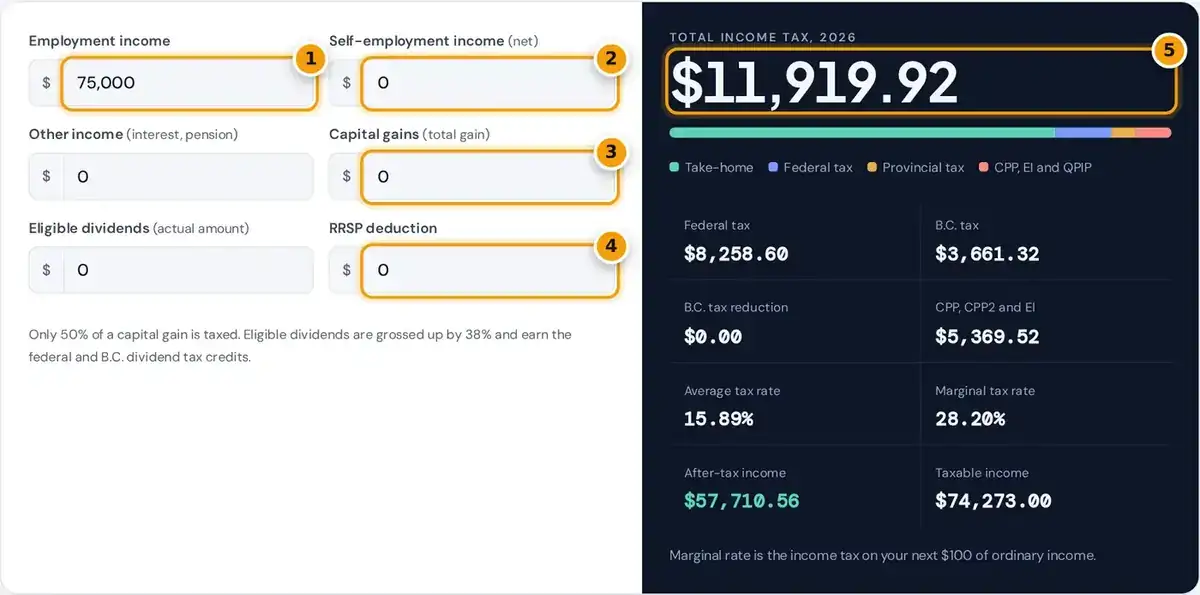
- Enter your 2026 employment income.
- Add net self-employment income, if any.
- Enter capital gains; only 50% of the gain is taxed.
- Enter your RRSP deduction to see the tax it saves.
- Read total tax, the B.C. part, after-tax income and your marginal rate.
Enter your expected 2026 income by type: employment income, net self-employment income, other income such as interest or pension, total capital gains and the actual amount of eligible dividends you received during this tax year.
Add an RRSP deduction if you plan to contribute. The bc income tax calculator then updates instantly, showing total income tax, the federal and B.C. parts, the B.C. tax reduction and your CPP and EI.
You also see your average and marginal rates, after-tax income and a colour bar of take-home pay against taxes. Two tables underneath split your taxable income across every federal and B.C. bracket, step by step.
2026 B.C. and Federal Tax Brackets
B.C. Budget 2026 raised the lowest rate from 5.06% to 5.60% for the 2026 tax year. Several other online calculators still show the old rate, which clearly understates provincial tax for almost every B.C. resident.
| B.C. taxable income | B.C. rate | Federal taxable income | Federal rate |
|---|---|---|---|
| $0 to $50,363 | 5.60% | $0 to $58,523 | 14% |
| $50,363 to $100,728 | 7.70% | $58,523 to $117,045 | 20.5% |
| $100,728 to $115,648 | 10.50% | $117,045 to $181,440 | 26% |
| $115,648 to $140,430 | 12.29% | $181,440 to $258,482 | 29% |
| $140,430 to $190,405 | 14.70% | Over $258,482 | 33% |
| $190,405 to $265,545 | 16.80% | ||
| Over $265,545 | 20.50% |
The B.C. top rate of 20.50% applies above $265,545. Bracket indexation is paused at 2026 levels until 2031, so these thresholds will not rise with inflation for several more years under the current provincial budget.
The federal brackets start at 14% and reach 33% above $258,482. All rates here match the CRA current year tax rates and income brackets for 2026. Federal thresholds are still indexed, unlike the B.C. ones.
How B.C. Income Tax Is Calculated
Canada uses a progressive system: each rate applies only to the slice of taxable income inside its bracket. Moving into a higher bracket never raises the tax on the income below that particular bracket threshold.
Tax reduction = $690 − 3.56% × (net income − $25,570), not below $0
Non-refundable credits then reduce the resulting bracket tax. In B.C. these credits include the $13,216 basic personal amount, the base part of CPP contributions and EI premiums, all multiplied by the lowest rate of 5.60%.
Federal tax works the same way with a 14% credit rate, the $16,452 basic personal amount and the $1,501 Canada employment amount. The two separate results are added together to give your total income tax.
Worked Example: $75,000 Salary in B.C.
In 2026, a $75,000 employment salary pays $4,230.45 of CPP contributions, $16 of CPP2 and $1,123.07 of EI. The enhanced CPP portion and CPP2, $727 in total, are deductible, so taxable income falls to $74,273.
Using the federal brackets and credits, federal tax comes to $8,258.60. B.C. tax before credits is $4,661.40, and credits worth 5.60% of $17,858.52 equal $1,000.08, so B.C. tax is $3,661.32 after credits for the year.
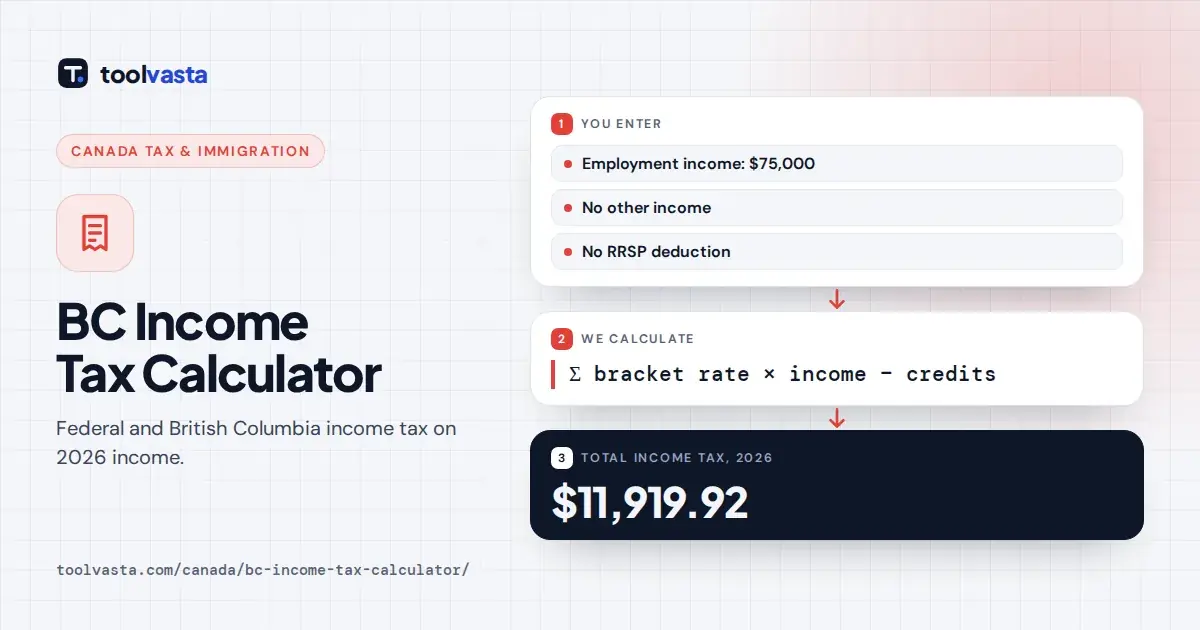
Total income tax is $11,919.92, an average tax rate of 15.89%. After subtracting CPP, CPP2 and EI as well, after-tax income is $57,710.56, and the combined marginal rate on the next dollar earned is 28.20%.
The B.C. Tax Reduction
The B.C. tax reduction is a credit of up to $690 for 2026 that lowers provincial tax for people living on a low income. The full amount applies when net income is $25,570 or less.
Above that level, the credit shrinks by 3.56% of net income over $25,570, and it is completely phased out at $44,952. It can reduce B.C. tax to zero but it can never create a refund.
For example, a $40,000 salary in 2026 still receives a B.C. tax reduction of $189.29. Because the credit shrinks as income rises, the phase-out adds 3.56 points to the marginal rate between $25,570 and $44,952.
Marginal and Average Tax Rates
Your marginal tax rate is the combined federal and B.C. income tax on your next dollar of ordinary income. It guides choices about RRSP contributions, raises and overtime by showing how much extra you keep.
| Taxable income | Combined marginal rate |
|---|---|
| $44,952 to $50,363 | 19.60% |
| $50,363 to $58,523 | 21.70% |
| $58,523 to $100,728 | 28.20% |
| $100,728 to $115,648 | 31.00% |
| $115,648 to $117,045 | 32.79% |
| $117,045 to $140,430 | 38.29% |
| $140,430 to $181,440 | 40.70% |
| $181,440 to $190,405 | 43.99% |
| $190,405 to $258,482 | 46.09% |
| $258,482 to $265,545 | 49.80% |
| Over $265,545 | 53.50% |
Your average tax rate, sometimes called the effective tax rate, is total income tax divided by your total income. It is always lower than the marginal rate, because the first dollars fall into lower brackets.
Between $181,440 and $258,482 the federal basic personal amount shrinks, which adds about 0.29 points to the combined rate. That small effect is why the table above shows 43.99% and 46.09% rather than rounder numbers.
Capital Gains, Dividends and RRSP Deductions
The calculator taxes capital gains at a 50% inclusion rate, so only half of the total gain you enter becomes taxable income. At a 28.20% marginal rate, a capital gain is effectively taxed at 14.10%.
Eligible dividends receive a 38% gross-up, then earn the federal dividend tax credit of 15.0198% and a B.C. dividend tax credit of 12% of the grossed-up amount, which lowers their tax compared with interest income.
An RRSP deduction lowers your taxable income directly, dollar for dollar. On a $75,000 salary, a $5,000 deduction cuts income tax from $11,919.92 to $10,509.92, tax savings of $1,410 or exactly the 28.20% marginal rate.
Why Your Paycheque Uses 6.14%
The higher 5.60% rate was announced after payroll tables for January had been issued, so employers kept deducting at 5.06% for the first half of 2026. That left slightly too little tax withheld early on.
To collect the right amount for the full year, the CRA told employers to use a prorated 6.14% rate and an $805 reduction for all remaining pay periods from July 1, 2026 to December 31.
Your annual tax on your return still uses 5.60%, exactly as this calculator does. If your paycheque deductions run slightly high or low overall, the difference shows up as a tax refund or balance owing.
Assumptions and Limits
The calculator assumes you are single, lived in B.C. on December 31, 2026 and claim only basic credits. Self-employed CPP includes both the employee and employer shares, while EI applies only to your employment income.
It does not include tuition, medical, donation or pension credits, the B.C. climate action or family benefits, or the federal Canada Workers Benefit. Check the B.C. personal income tax rates page for any later updates.
This is an estimate for planning, not tax, legal or financial advice. Your actual tax depends on your full return, including all credits, so confirm important numbers with the CRA or a qualified tax professional.
Frequently asked questions
How much tax do I pay on $75,000 in B.C.?
For 2026, a $75,000 salary pays about $8,258.60 in federal tax and $3,661.32 in B.C. tax, for $11,919.92 in total. After CPP and EI, take-home pay is about $57,710.56.
Did B.C. raise income tax in 2026?
Yes. B.C. Budget 2026 increased the lowest provincial rate from 5.06% to 5.60% for 2026 and later years, and it paused bracket indexation, so the 2026 thresholds stay in place until 2031.
What is the B.C. tax reduction?
It is a credit of up to $690 for 2026 that reduces B.C. tax for low incomes. It shrinks by 3.56% of net income above $25,570 and is fully phased out at $44,952.
What is the top marginal tax rate in B.C.?
The top combined federal and B.C. rate in 2026 is 53.50% on taxable income over $265,545. That combines the 33% top federal rate with the 20.50% top provincial rate.
What is the difference between marginal and average tax rate?
The marginal rate is the tax on your next dollar of income. The average rate is total income tax divided by total income. On a $75,000 salary they are 28.20% and 15.89%.
Why does my paycheque deduct more B.C. tax than this calculator?
From July 1, 2026, payroll uses a prorated 6.14% rate to catch up the rate increase for the whole year. The annual tax on your return is calculated at 5.60%, as this calculator shows.