How to Use the Compound Interest Calculator
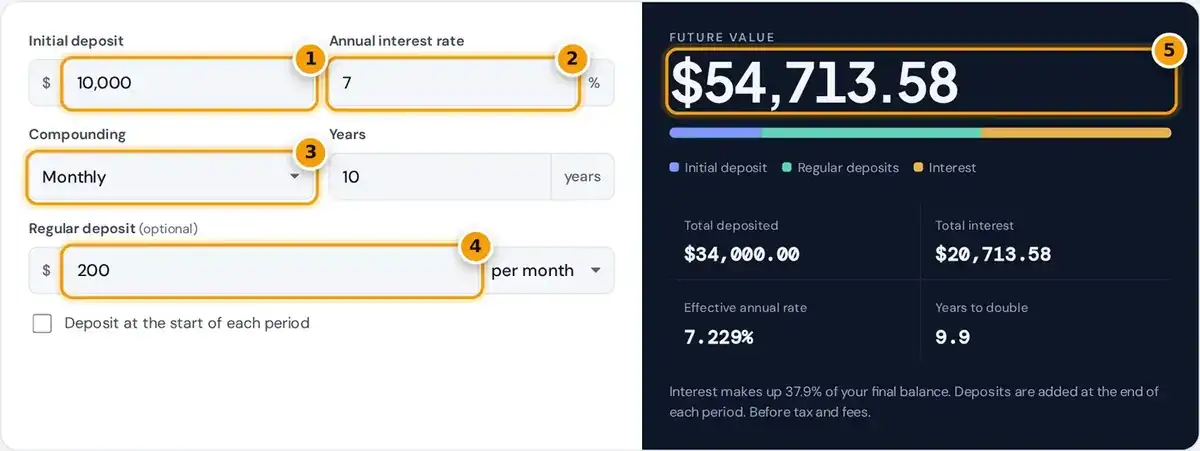
- Enter your initial deposit.
- Enter the annual interest rate.
- Choose how often interest compounds, from annually to continuously.
- Add an optional regular deposit and how often you make it.
- Read the future value, total interest, effective annual rate and years to double.
Enter an initial deposit, the annual interest rate and the number of years, a whole number from 1 to 100. Then simply choose the compounding frequency: annually, semi-annually, quarterly, monthly, weekly, daily or continuously compounded.
If you plan to save regularly, add a regular deposit and pick how often you make it, from weekly to yearly. Tick deposit at the start if you contribute at the beginning of each period.
The compound interest calculator shows the future value, the total you deposited, the interest earned, the effective annual rate and the years to double. The growth table lists deposits, interest and balance for every year.
What Is Compound Interest?
Compound interest is interest on interest. Each period, interest is added to the balance, and the next period's interest is calculated on that larger amount, so growth speeds up the longer you leave it alone.
Simple interest pays only on the original principal. On $100 at 10% for two years, simple interest earns $20, while annual compounding earns $21, because the second year also earns interest on the first $10.
Over short periods the gap is small, but over decades it becomes the main driver of wealth. The curve bends upward, which is why compounding is often described as exponential growth rather than straight-line growth.
Compound Interest Formulas
The compound interest formula for a single deposit raises one plus the periodic rate to the number of compounding periods. Continuous compounding replaces that with the exponential constant e, the limit of compounding infinitely often.
Continuous: A = P × er × t
With deposits: FV = A + D × ((1 + i)k − 1) / i
P is the initial deposit, r the annual rate, n the periods per year and t the years. D is the regular deposit, k the number of deposits and i the rate per deposit period.
The deposit part is an annuity. When deposits and compounding differ in frequency, the calculator converts the rate so each deposit earns correctly. For deposits at the start, that part is multiplied by (1 + i).
Worked Example: $10,000 at 7% Compounded Monthly
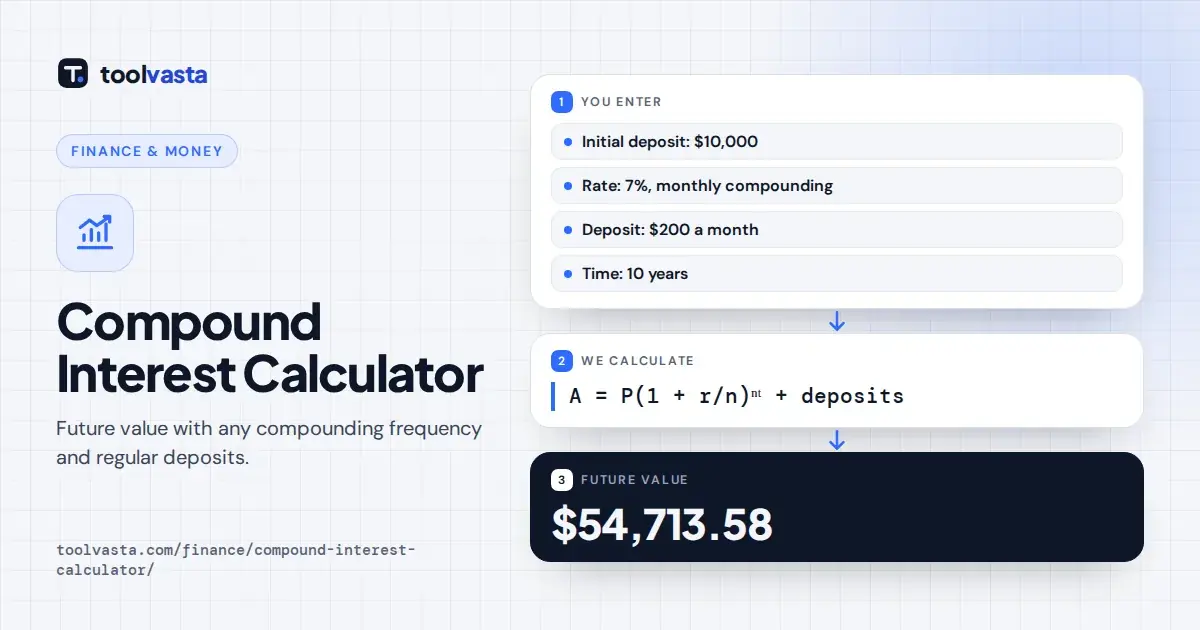
Here is a worked example. You invest $10,000 at 7% compounded monthly and add $200 at the end of every month for 10 years. The initial deposit alone grows to $20,096.61 over that whole period.
The 120 monthly deposits of $200 grow to $34,616.96. The total is $54,713.58, of which $34,000 is your own money and $20,713.58 is compound interest. The effective annual rate shown for this plan is 7.229%.
Tick deposit at the start and the same plan reaches $54,915.51, about $202 more, because each deposit earns one extra month of interest. Extend the plan to 20 years and the final balance becomes $144,572.72.
Daily, Monthly and Continuous Compounding Compared
More frequent compounding raises the effective annual rate, also called APY, above the nominal rate. The table shows what $10,000 grows to at 7% over 10 years with no deposits, for four common compounding frequencies.
| Compounding | Future value | Effective annual rate |
|---|---|---|
| Annually | $19,671.51 | 7.000% |
| Monthly | $20,096.61 | 7.229% |
| Daily | $20,136.18 | 7.250% |
| Continuously | $20,137.53 | 7.251% |
Moving from annually to monthly adds about $425 here, but moving from daily to continuous adds only $1.35. Semi-annually and quarterly sit between annual and monthly results, so the frequency matters less than people think.
When comparing savings accounts or GICs, always compare the APY rather than the nominal rate. Two accounts quoting 7% can pay different amounts if one compounds annually and the other compounds daily or monthly instead.
The Rule of 72 and Doubling Time
The rule of 72 is a quick way to estimate doubling time. Simply divide 72 by the annual rate in percent. At 7%, 72 divided by 7 is about 10.3 years to double your money.
The calculator gives the exact answer using ln(2) divided by ln(1 + APY). For 7% compounded monthly that is 9.9 years, a little shorter than the rule of 72 estimate suggests at this particular interest rate.
The rule works best for rates between about 6% and 10%. It also works in reverse: at 3% inflation, prices double in roughly 24 years, which is why cash left idle loses purchasing power steadily.
Getting the Most From Compounding
Start early. Time is the single biggest driver, because each year's interest earns interest in every later year. $10,000 at 7% compounded monthly grows to $20,096.61 in 10 years but reaches $81,164.97 after 30 years.
Contribute regularly, even in quite small amounts. In the worked example, $200 a month adds more to the final balance than the initial $10,000 does, and setting up automatic transfers makes the habit almost effortless.
Use tax-sheltered accounts so growth is not taxed each year. In Canada, the TFSA and the RRSP both allow exactly this. Watch fees too, because a yearly fee compounds against you just as returns do.
Assumptions and Limits
The calculator assumes a fixed rate for the whole period, with no withdrawals, taxes or fees. Real returns on investments vary from year to year, so treat the result as an illustration, not a promise.
A savings account or GIC usually pays a known rate, which fits this calculator well. Stock returns are uncertain, so test a cautious rate and a hopeful rate to see a sensible range of outcomes.
Results here are not adjusted for inflation. For a second opinion on the same inputs, the SEC's Investor.gov calculator uses a similar method, while the investment calculator on this site adjusts your results for inflation.
Frequently asked questions
How do I calculate compound interest monthly?
Divide the annual rate by 12, add 1, raise it to the power of 12 times the number of years, and multiply by the principal. $10,000 at 7% compounded monthly for 10 years grows to $20,096.61.
What is continuous compounding?
It is the limit of compounding infinitely often, calculated with A = Pe^(rt). At 7% over 10 years, $10,000 grows to $20,137.53, only $1.35 more than daily compounding produces.
Is daily compounding better than monthly?
Yes, but by very little. At 7% the effective annual rate is 7.229% with monthly compounding and 7.250% with daily compounding, a difference of about $40 on $10,000 over 10 years.
How long does it take to double money at 7%?
About 10 years. The rule of 72 gives 72 divided by 7, or 10.3 years. With monthly compounding the exact answer from the calculator is 9.9 years.
Does it matter if I deposit at the start or end of the month?
Yes, slightly. Deposits at the start of each period earn one extra period of interest. In the worked example, starting deposits add about $202 over 10 years compared with end-of-month deposits.
What is the difference between simple and compound interest?
Simple interest is paid only on the original principal, while compound interest is also paid on interest already earned. On $100 at 10% for two years, simple interest gives $20 and annual compounding gives $21.