How to Use the Amortization Calculator
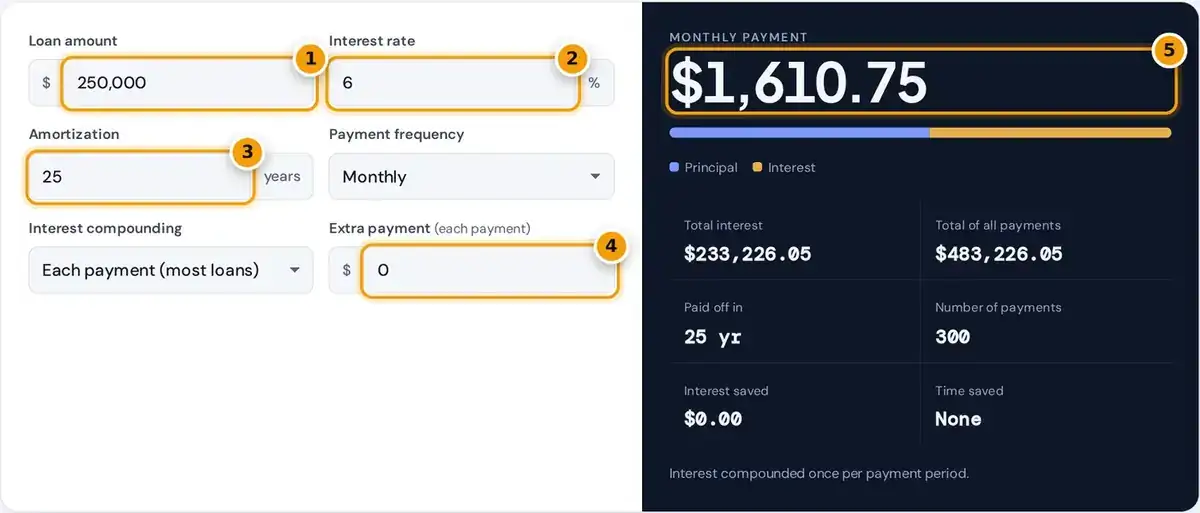
- Enter the loan or mortgage amount.
- Enter the annual interest rate.
- Set the amortization period in years.
- Add an optional extra payment to see interest and time saved.
- Read your payment and totals, then scroll to the schedule and CSV download.
Enter the loan amount, the annual interest rate and the amortization period, which is the total time needed to repay the loan. Then choose a payment frequency and how often interest compounds on the balance.
Each payment compounding suits car loans, personal loans and US-style mortgages. Semi-annual compounding is required for Canadian fixed-rate mortgages. Add an optional extra payment to see how much sooner the whole loan is paid off.
The schedule below the calculator shows every payment or a yearly summary. Download CSV saves the full payment-by-payment schedule, which opens directly in Excel, Numbers or Google Sheets for your own budgeting, notes and comparisons.
The Amortization Formula
Interest in period = balance × i
Principal in period = payment − interest
A fixed payment is set so that the loan reaches zero after the final payment. Each payment first covers interest on the remaining balance, and whatever is left over then reduces the principal you owe.
L is the loan amount, N is the number of payments and i is the rate per payment. With per-payment compounding, i simply equals the annual rate divided by the number of payments per year.
With semi-annual compounding, i = (1 + rate / 2)2 / n − 1, where n is payments per year. Spreadsheet users get the same payment from the PMT function when they enter the matching periodic rate and count.
Worked Example: $250,000 at 6% Over 25 Years
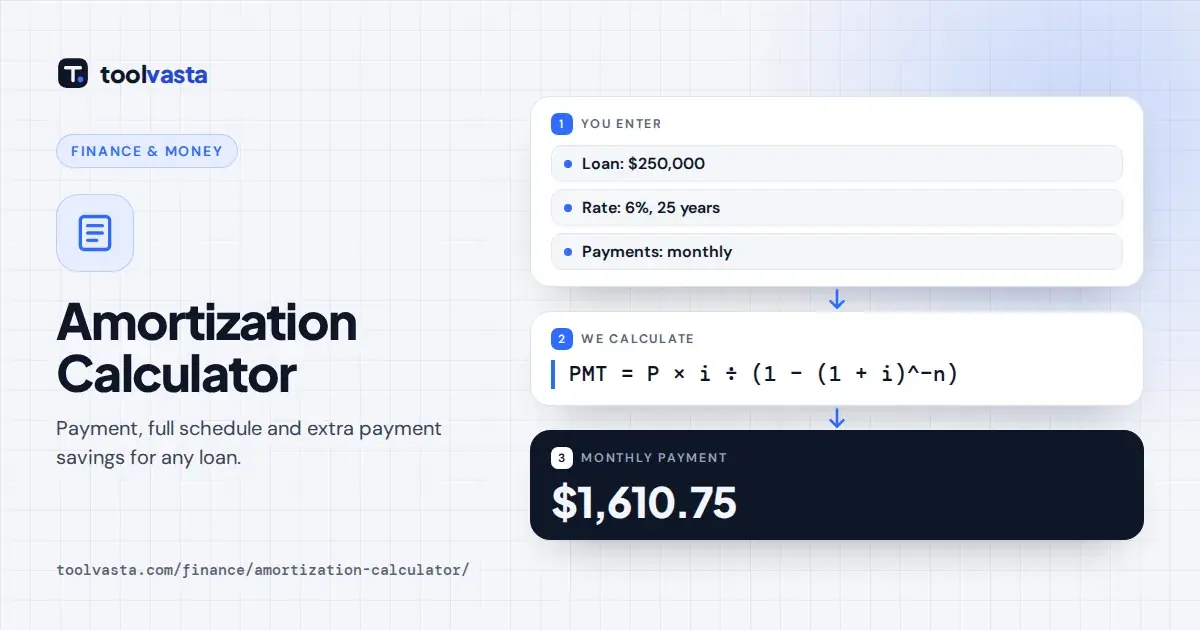
A $250,000 loan at 6% over 25 years, with monthly payments and monthly compounding, has a periodic rate of 0.5% per month and 300 payments. The monthly payment is $1,610.75, and total interest reaches $233,226.05.
In the very first payment, $1,250.00 goes to interest and only $360.75 goes to principal. After the first full year of payments the balance is still $245,549.90, even though $19,329 has been paid by then.
The same loan with semi-annual compounding, as a Canadian fixed-rate mortgage, costs $1,599.52 a month. The slightly lower payment comes from the way the quoted rate converts into an effective monthly rate under semi-annual compounding.
How to Read an Amortization Schedule
Each row of an amortization schedule lists the payment, the interest part, the principal part and the balance left afterwards. The yearly summary adds up twelve months at a time so long loans stay readable.
Early payments are mostly interest because the balance is at its highest. As the balance falls, the interest part shrinks and more of each payment goes to principal, building equity in the home or asset.
On long mortgages it can take more than a decade before principal overtakes interest in each payment. That is why extra payments made early in the loan save more than the same amount paid later.
Extra Payments and Accelerated Frequencies
Every extra payment goes straight to principal, which lowers future interest and helps you pay off early. On the example loan, adding $200 to every monthly payment clears the loan in 19 years 8 months.
| Option on the $250,000 example | Paid off in | Total interest |
|---|---|---|
| Monthly, no extra | 25 years | $233,226.05 |
| Monthly + $200 extra | 19 yr 8 mo (236 payments) | $175,579.72 |
That extra $200 cuts total interest to $175,579.72, for total interest savings of $57,646.33. A lump sum works the same way, but a small regular prepayment is often easier to sustain in a household budget.
Accelerated bi-weekly payments of $805.38 are half the monthly amount, paid 26 times a year, which adds about one extra monthly payment annually. They save $42,711.27 and about 4 years compared with regular bi-weekly payments.
Canadian Mortgages and Semi-Annual Compounding
Section 6 of the federal Interest Act requires blended mortgage payments to state the rate calculated yearly or half-yearly. Lenders therefore quote fixed-rate mortgage rates with semi-annual compounding, which this calculator supports as an option.
In Canada, a mortgage term usually lasts five years while the amortization runs 25 or 30 years, so you face several renewal dates. The yearly schedule shows the balance you would renew at each point.
Check your lender's prepayment privileges before planning extra payments, since many limit lump sums to 10% to 20% of the original balance each year. The mortgage calculator also adds CMHC insurance and down payment rules.
Amortizing Loans vs Other Debt
Car loans, personal loans, student loans and most mortgages are fully amortizing: fixed payments bring the balance to zero on the final due date. This calculator models every one of them with the same formula.
Credit cards, interest-only loans and a balloon loan work very differently. Their required payments do not clear the balance on a set schedule, so a standard amortization table does not describe how they will end.
An adjustable-rate loan changes its schedule each time the rate resets, so recalculate it then. The CFPB explanation of paying down a mortgage shows how interest and principal shift across the life of a loan.
Assumptions
The rate stays fixed for the whole amortization, payments are made on time, and no fees are included. Property taxes, insurance and mortgage default insurance premiums are not part of the monthly payment shown here.
The final payment is usually slightly smaller than the others so the balance lands at exactly zero. All figures are rounded to the cent, which can occasionally create tiny differences from a lender's own statement.
Treat every result here as an estimate for planning and comparison purposes. Your loan agreement, disclosure statement and lender remain the final word on the exact payment, interest cost and any penalty for paying early.
Frequently asked questions
What is an amortization schedule?
It is a table that lists every loan payment and shows how much goes to interest, how much reduces the principal, and the balance left after each payment until the loan reaches zero.
How do extra payments affect amortization?
Extra payments go straight to principal, which lowers future interest and helps shorten the loan. On a $250,000 loan at 6% over 25 years, an extra $200 a month saves $57,646 in interest.
Why is most of my early payment interest?
Interest is charged on the outstanding balance. At the start the balance is largest, so the interest part is largest. It shrinks with every payment as the principal falls.
How are Canadian mortgages amortized differently?
Canadian fixed-rate mortgages compound interest semi-annually rather than monthly. At the same quoted rate, this makes the payment slightly lower, for example $1,599.52 instead of $1,610.75 on the example loan.
Can I export the amortization schedule to Excel?
Yes. Use the Download CSV button to save every payment in the schedule. The CSV file opens directly in Excel, Numbers or Google Sheets, where you can add your own notes and charts.
What is the difference between amortization and loan term?
Amortization is the total time to repay the loan in full. The term is how long your current rate and contract last. In Canada a 25-year amortization often has a five-year term.