How to Use the Car Payment Calculator
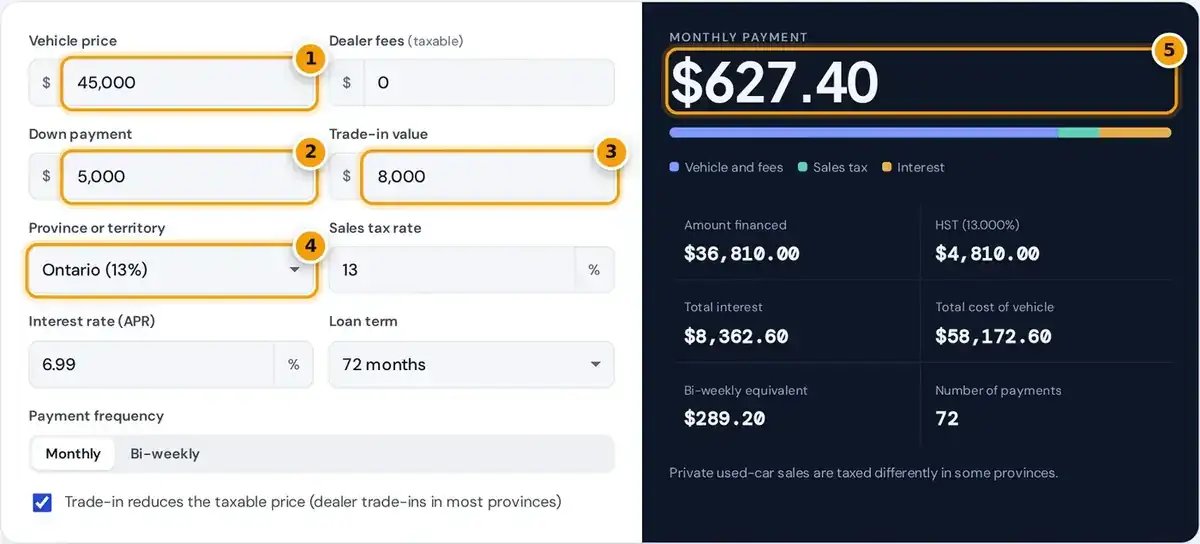
- Enter the vehicle price before tax.
- Add your down payment.
- Enter your trade-in value, which lowers the taxable price in most provinces.
- Choose your province to apply the right sales tax.
- Read your payment, with total interest and the total cost of the vehicle.
Enter the vehicle price, any taxable dealer fees, your down payment and the trade-in value of your current car. Then choose your province so the correct sales tax loads automatically into the tax rate box.
Add the interest rate and loan term from your dealer or lender, and switch between monthly and bi-weekly payments. The result shows the payment, amount financed, sales tax, total interest and the total vehicle cost.
It works the same as a car loan payment calculator, an auto payment calculator or a truck payment calculator, because the math never changes with the vehicle. Open the schedule to see each yearly balance.
How a Car Loan Payment Is Calculated
The calculator first works out the sales tax on the price plus fees, minus the trade-in value wherever your province allows it. It then subtracts the down payment and trade-in to find the amount financed.
Next it applies the standard loan payment formula. The yearly interest rate, or APR, is divided by 12 for monthly payments or 26 for bi-weekly payments, and the number of payments follows the chosen term.
Amount financed = price + fees + tax − down payment − trade-in
Payment = L × i / (1 − (1 + i)−n)
Each payment covers the interest charged since the last one, and the rest reduces the principal. Early payments are mostly interest, while later payments are mostly principal, which the yearly schedule makes easy to see.
Worked Example in Ontario
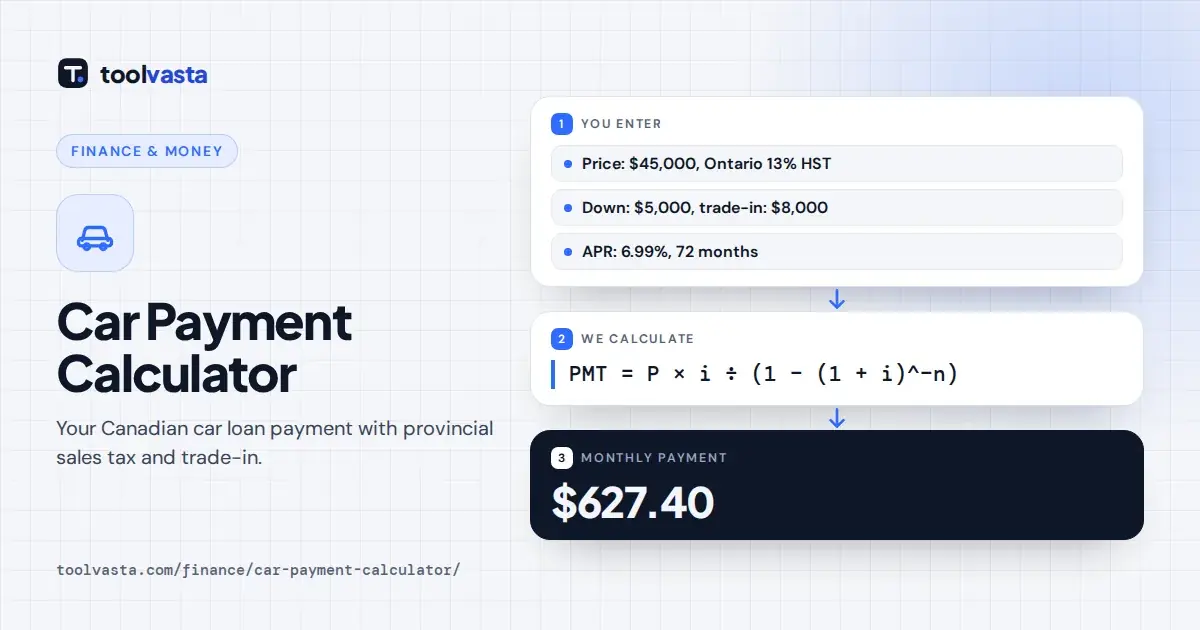
Use the calculator as an Ontario car payment calculator with the default values already filled in. A $45,000 vehicle with an $8,000 trade-in and $5,000 down is taxed on $37,000, the price minus the trade-in.
At 13% HST the tax is $4,810, so the amount financed is $45,000 plus $4,810, minus $5,000 and $8,000, which equals $36,810. That is the balance the lender actually pays out to the dealer directly.
At 6.99% over 72 months the payment is $627.40 a month, and total interest is $8,362.60. Paying bi-weekly over the same 72 months gives 156 payments of $289.20 each, exactly as the calculator above shows.
How the Loan Term Changes Your Payment
Canadian auto loans commonly run from 36 to 96 months. A longer term lowers each payment, but you pay interest for more months, so the total interest rises steadily with every extra year you add.
Using the same $36,810 loan at 6.99%, the table shows the trade-off. Moving from 72 months to 84 months saves about $72 a month but adds almost $1,480 in extra interest over the whole loan.
| Term | Monthly payment | Total interest |
|---|---|---|
| 48 months | $881.29 | $5,491.94 |
| 60 months | $728.71 | $6,912.51 |
| 72 months | $627.40 | $8,362.60 |
| 84 months | $555.38 | $9,842.06 |
Long terms also raise the risk of negative equity, where you owe more than the car is worth. That becomes a problem if you want to trade in early or the car is written off.
Sales Tax on Cars by Province in 2026
Alberta and the three territories charge only the 5% GST. Ontario and the Atlantic provinces charge a single HST, while Saskatchewan adds PST, Manitoba adds RST and Quebec adds 9.975% QST, for a combined 14.975%.
British Columbia charges a higher PST on passenger vehicles as the price rises, from 7% below $55,000 up to 20% from $150,000. For zero-emission vehicles the first luxury tiers start at $75,000 instead of $55,000.
Rates follow the Canada Revenue Agency GST/HST rates and the Government of British Columbia PST rules. You can also type a custom rate for any other case, such as a special exemption or private sale.
| Province or territory | Tax on a dealer purchase |
|---|---|
| Alberta, Northwest Territories, Nunavut, Yukon | 5% GST |
| British Columbia | 5% GST + 7% to 20% PST on passenger vehicles |
| Saskatchewan | 5% GST + 6% PST (11%) |
| Manitoba | 5% GST + 7% RST (12%) |
| Ontario | 13% HST |
| Quebec | 5% GST + 9.975% QST (14.975%) |
| Nova Scotia | 14% HST (since April 1, 2025) |
| New Brunswick, Newfoundland and Labrador, Prince Edward Island | 15% HST |
Monthly or Bi-Weekly Car Payments?
A bi-weekly plan means 26 payments a year instead of 12. Over the same term, interest is charged on a slightly lower balance between payments, so the total interest ends up a little smaller overall.
Many Canadians choose bi-weekly payments because they line up with every pay day. The calculator always shows both figures, so you can compare the bi-weekly amount with the equivalent monthly car payment directly on screen.
Dealers often quote the bi-weekly figure first because it looks much lower on paper. Compare the total interest and the total cost of the vehicle, not just the payment, before you sign any finance agreement.
Interest Rates, Credit Score and 0% Offers
Your rate depends on your credit score, the lender, the vehicle age and current promotions. Borrowers with strong credit get the best rates, while subprime loans for weaker credit can cost far more in interest.
Manufacturers sometimes offer 0% financing on new models, often instead of a cash rebate. Enter 0 as the rate to see that payment, then compare it with taking the rebate and a separate bank loan.
Getting a pre-approval from your bank or a credit union before visiting the dealer gives you a firm rate to compare. It also keeps the price negotiation separate from the financing discussion entirely, which helps.
How to Lower Your Car Payment
Put more money down or negotiate a higher trade-in value, since both reduce the amount financed. In most provinces a dealer trade-in also lowers the sales tax, which cuts the loan amount a second time.
Choose a shorter term if you can afford the higher payment, because it cuts total interest sharply. Shopping for a lower rate saves money on every payment for the whole remaining life of the loan.
Check optional add-ons such as an extended warranty, rust protection or payment insurance. Rolling them into the loan raises the amount financed, and you pay interest on them for the whole loan term as well.
Assumptions and Limits
This result is a planning estimate only. It does not include licensing, registration, tire levies, the federal air-conditioning excise tax, the federal luxury tax on vehicles above $100,000, or any lender or dealer administration fees.
A private sale of a used vehicle can be taxed differently, and some provinces charge only the provincial portion. Untick the trade-in box if your old car is sold privately and does not reduce tax.
Use this vehicle loan calculator to compare offers, then confirm the final numbers on your bill of sale and loan agreement. The lender's final figures decide what you actually pay each month for the car.
Frequently asked questions
How much is a $40,000 car payment per month in Canada?
It depends on tax, rate and term. In Ontario, a $40,000 car with no trade-in or down payment becomes $45,200 with 13% HST. At 6.99% over 72 months the payment is about $770 a month.
Is sales tax included in a car loan in Canada?
Usually yes. Dealers add GST, HST or PST to the price, and you can finance the tax along with the vehicle. The calculator includes the tax in the amount financed and total cost.
Does a trade-in reduce sales tax?
In most provinces a trade-in at a dealer reduces the taxable amount, so you pay tax only on the difference. Selling your old car privately does not give you that tax reduction.
What is a good interest rate for a car loan in Canada?
Rates vary with your credit score, the lender, the vehicle age and promotions. New car manufacturer offers can be very low, while used car and subprime loans cost much more. Compare the total interest figure.
Are bi-weekly car payments better than monthly?
Over the same term they cost about the same, with slightly less interest because the balance falls a little faster. The main advantage is matching payments to a bi-weekly pay schedule.
How long should a car loan be?
Shorter is cheaper. A 48 or 60 month loan costs far less interest than 84 or 96 months. Choose the shortest term whose payment fits your budget, and avoid owing more than the car is worth.