How to Use the Capital Gains Tax Calculator
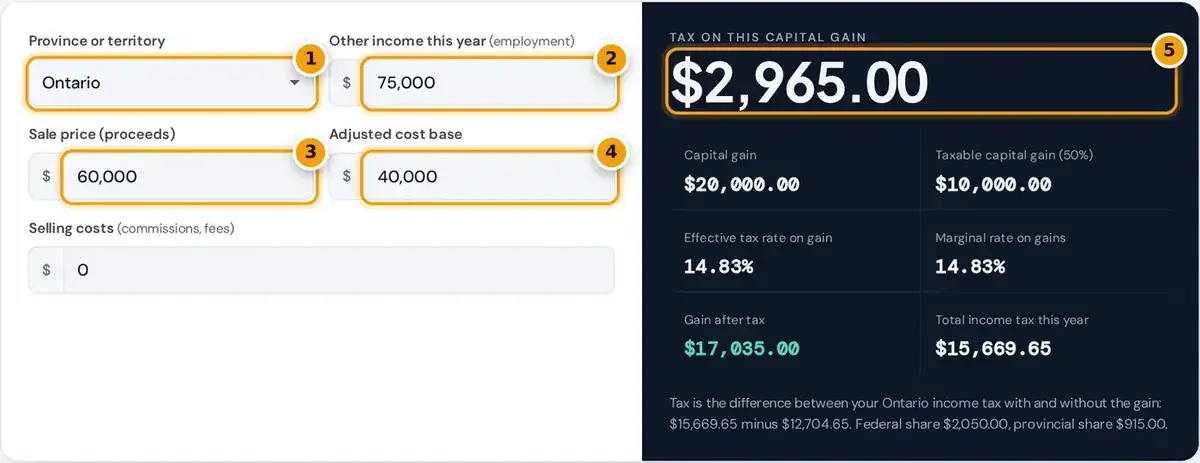
- Choose your province or territory.
- Enter your other income this year so the gain is taxed at your real rate.
- Enter the sale price (proceeds of disposition).
- Enter the adjusted cost base, then any selling costs.
- Read the tax on the gain, the taxable 50% and the gain after tax.
Select your province or territory, then enter your other income for the year, such as your salary. The calculator needs it because the gain is taxed on top of that income, not on its own.
Next, enter the sale price, the adjusted cost base and any selling costs such as commissions or legal fees. The results then show the gain, the taxable half, the tax owed and your effective rate.
It works as a Canada capital gains tax calculator for shares, funds, a cottage or a rental. If the sale produces a loss instead, the note explains how much you can use against other gains.
What a Capital Gain Is in Canada
A capital gain is the profit when you sell or are deemed to sell capital property for more than it originally cost. Common examples include shares, mutual funds, ETFs, crypto, land, cottages and rental buildings.
The selling price is called the proceeds of disposition. The adjusted cost base is what you paid plus purchase costs such as commissions, legal fees and the cost of capital improvements made over the years.
For shares bought at different times, the adjusted cost base is the average cost per share. Keeping good records of every purchase matters, because the CRA can ask you to prove the figure you report.
The 2026 Inclusion Rate Is 50%
Only half of a capital gain is added to your income. That share is the inclusion rate, and the half you report is called the taxable capital gain. The other half is simply never taxed.
In 2024 the federal government proposed raising the rate to two-thirds for individual gains above $250,000 a year, a major change for investors. On March 21, 2025, the increase was cancelled before it took effect.
For 2026 the inclusion rate stays at one-half for individuals, corporations and trusts. Some older calculators still apply two-thirds to large gains, so check which rule a tool uses before you trust its final result.
Capital Gains Tax Formula
There is no separate capital gains tax rate in Canada. The taxable gain is added to your other income and taxed at your marginal tax rate, using all the normal federal and provincial tax brackets.
Taxable capital gain = capital gain × 50%
Tax on gain = tax(other income + taxable gain) − tax(other income)
A large gain can span several brackets. In some provinces it can also trigger a surtax or a health premium, which this calculator includes as it compares your total tax with and without the gain.
Your effective rate is the tax on the gain divided by the full gain. Because only half is taxed, the effective rate is roughly half of your marginal rate on ordinary income in that range.
Worked Example: A $20,000 Gain in Ontario
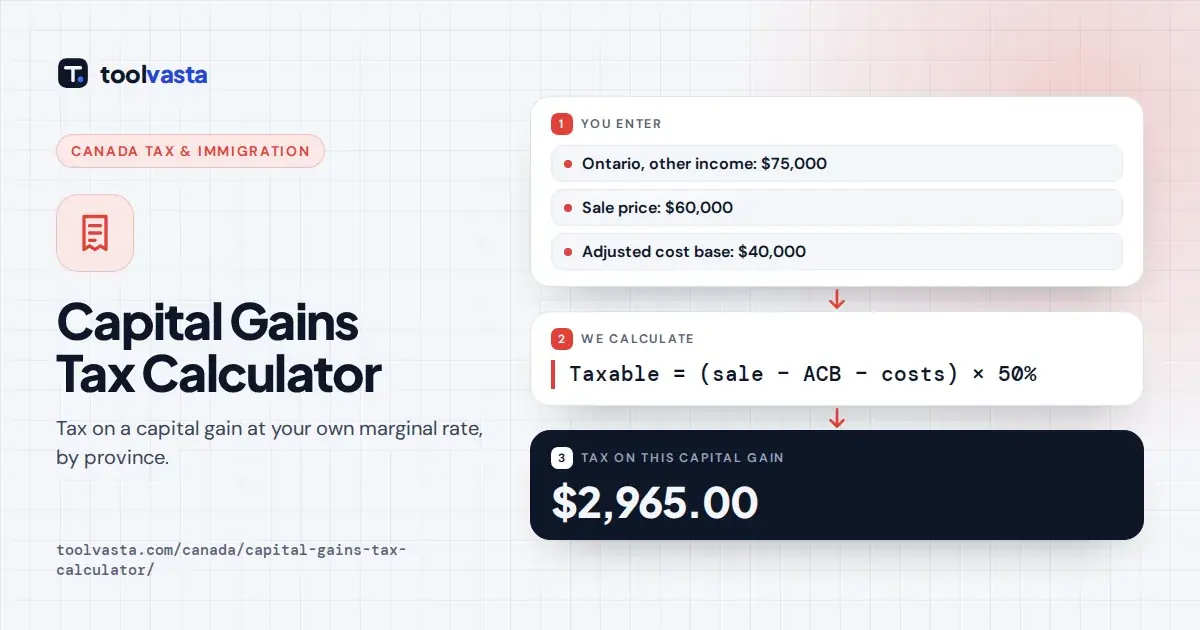
You sell shares for $60,000 that cost $40,000, with no selling costs involved, and your salary is $75,000. The capital gain is therefore $20,000, and the taxable capital gain added to your income is $10,000.
Your 2026 federal and Ontario income tax rises from $12,704.65 to $15,669.65. The difference between those two figures, $2,965, is the tax on the gain, an effective rate of 14.83% on the full $20,000 gain.
With the same salary in British Columbia, the tax on the gain is $2,820 because provincial rates differ. Change the province in the calculator to compare any other province or territory with your own numbers.
Top Capital Gains Tax Rates in 2026
The top rate on capital gains is exactly half the top combined rate on ordinary income. In Ontario that is 26.76%, because the top combined marginal rate on salary and interest is 53.53% in 2026.
British Columbia is almost the same at 26.75%, while Alberta has the clearly lowest top rate of the three at 24%. Top rates only apply to income above the highest bracket, which starts above $250,000.
| Province | Top rate on ordinary income | Top rate on capital gains |
|---|---|---|
| Ontario | 53.53% | 26.76% |
| British Columbia | 53.50% | 26.75% |
| Alberta | 48.00% | 24.00% |
Most people pay far less than this top rate. With a moderate salary, the effective rate is much lower, as the 14.83% in the worked example shows, depending on the province and the gain size.
Exemptions That Can Reduce the Tax
The principal residence exemption usually makes the gain on your home tax-free for every year it was your principal residence. You must still report the sale and the designation on Schedule 3 of your return.
The lifetime capital gains exemption shelters gains on shares of a qualified small business corporation and on qualified farm or fishing property. It rose to $1.25 million in June 2024 and is indexed to inflation.
Gains inside a TFSA, RRSP or FHSA are not taxed as capital gains. Donating publicly listed securities to a registered charity can also remove the tax on the gain, while giving you a donation receipt.
Capital Losses and the Superficial Loss Rule
A capital loss happens when you sell for less than the adjusted cost base. Half of it is an allowable capital loss, which can only offset taxable capital gains, not your salary or other income.
You can apply net capital losses to gains this year, carry back the loss to any of the previous three years, or carry forward the loss indefinitely. The calculator shows the allowable amount for you.
The superficial loss rule denies a loss if you or an affiliated person buy the same property within 30 days before or after the sale. The denied loss is added to the new cost base.
Second Property, Cottage and Rental Sales
A second property like a cottage or rental property is taxed on 50% of the gain, unless you designate it as your principal residence for some years and give up that exemption on your home.
The anti-flipping rule treats a gain on residential property held under 365 days as fully taxable business income, with some exceptions for major life events. Frequent trading of shares can also count as business income.
For a rental property, the depreciation you claimed as capital cost allowance may be taxed as recapture, which is fully taxable as regular income. This calculator shows only the capital gain part of a sale.
Assumptions and Limits
Other income is treated as employment income with only basic personal credits. The calculator does not apply the alternative minimum tax, a capital gains reserve, carried forward losses or any of the exemptions described above.
Quebec tax uses the annual Quebec tax brackets with the basic amount. All figures are for the 2026 tax year and follow the CRA Guide T4037, Capital Gains and current federal and provincial income brackets.
This is an estimate for planning, not tax advice. Your actual tax depends on your full return, credits and deductions, so please confirm large or complex sales with the CRA or a qualified tax professional.
Frequently asked questions
How much tax will I pay on a capital gain in Canada?
Half of the gain is added to your income and taxed at your marginal rate. With a $75,000 salary in Ontario, a $20,000 gain adds about $2,965 of federal and provincial tax in 2026.
Is the capital gains inclusion rate 50% or 66.7% in 2026?
It is 50%. The proposed increase to two-thirds on gains above $250,000 was cancelled on March 21, 2025, before it took effect, so one-half applies to individuals, corporations and trusts.
How do I calculate the adjusted cost base?
Add what you paid for the property to the costs of buying it, such as commissions and legal fees, plus capital improvements. For shares bought at different times, use the average cost per share.
Do I pay capital gains tax on my home?
Usually not. The principal residence exemption covers the gain for each year the home was your principal residence. You must still report the sale and the designation on Schedule 3.
Is there capital gains tax on a second property in Canada?
Yes. A cottage or rental property is taxed on 50% of the gain, unless you designate it as your principal residence for some years instead of your main home.
Can capital losses reduce my capital gains tax?
Yes. Half of a capital loss is an allowable capital loss that offsets taxable capital gains this year, in the previous three years, or in any future year. It cannot reduce salary or other income.