How to Use the Simple Interest Calculator
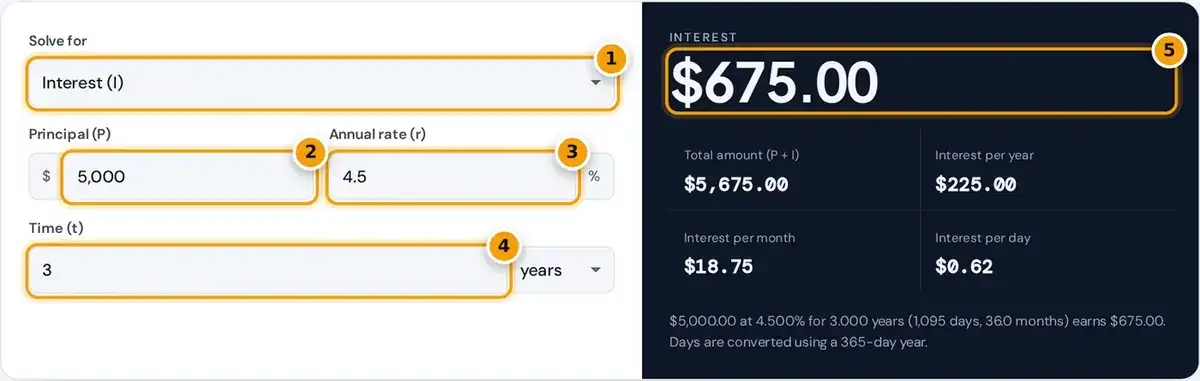
- Choose what to solve for: interest, principal, rate or time.
- Enter the principal.
- Enter the annual interest rate.
- Enter the time and choose days, months or years.
- Read the result, with the total amount and interest per year, month and day.
Pick what to solve for: the interest, the principal, the annual rate or the time. The calculator hides that field and asks for the other three values, then shows the answer instantly as you type.
Enter the time in days, months or years, and always give the rate as an annual percentage. When you solve for time, the unit menu sets whether the answer appears in days, months or years.
The result panel also shows the total amount, meaning principal plus interest, and the interest earned or owed per year, per month and per day. A note under the result restates the calculation in words.
The Simple Interest Formula
Simple interest uses I = Prt. I is the interest, P the principal, r the annual rate as a decimal and t the time in years. To turn 4.5% into a decimal, divide it by 100.
P = I / (r × t) r = I / (P × t) t = I / (P × r)
Total amount A = P + I = P × (1 + r × t)
The total amount, also called the future value, is A = P(1 + rt). It adds the interest to the original principal, so it shows what you receive or repay right at the end of the term.
Rearranging the formula finds any missing variable. Principal is I divided by rt, the rate is I divided by Pt, and time is I divided by Pr. Divide months by 12 and days by 365.
Worked Simple Interest Examples
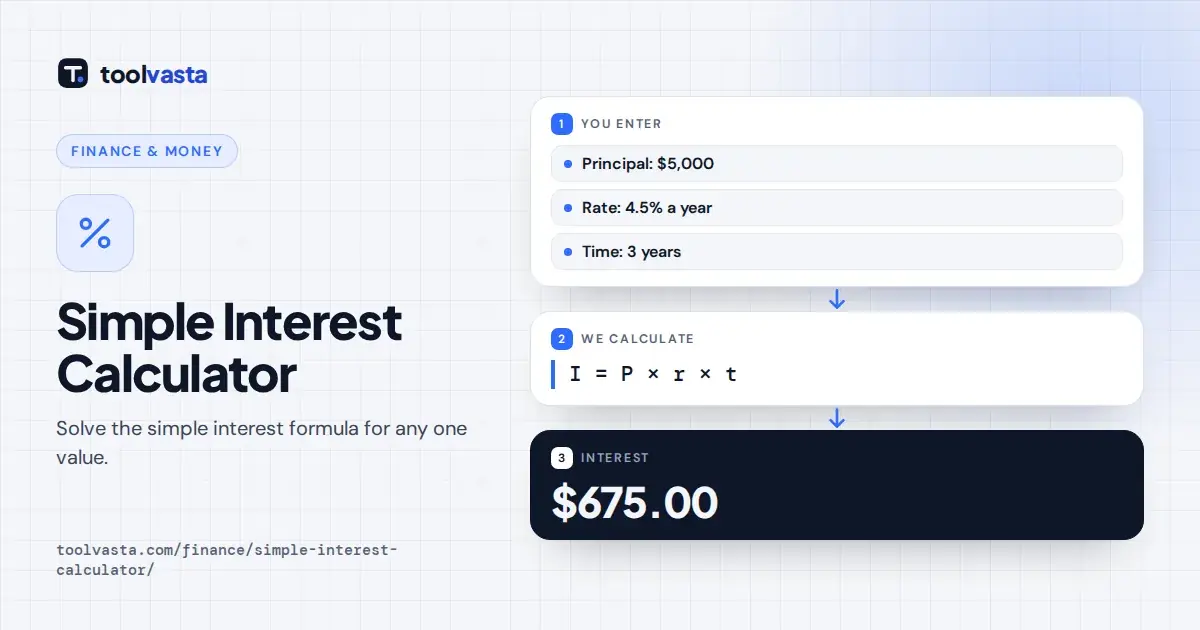
With the default values, $5,000 at 4.5% for 3 years earns 5,000 times 0.045 times 3, which is $675 in interest. The total amount at the end is therefore $5,675, exactly as the calculator shows.
For days, $10,000 at 6% for 90 days earns 10,000 times 0.06 times 90 over 365, which is $147.95. That works out to about $1.64 of interest for each day the money is borrowed out.
For time, $8,000 at 5% needs 1,200 divided by 400, or 3 years, to earn $1,200 in interest. Set the unit menu to months and the calculator shows the same answer as exactly 36 months.
Simple Interest Versus Compound Interest
With simple interest, only the original principal earns interest, so the balance grows by the same dollar amount every year. On a graph that growth is a straight line, which makes the pattern purely linear.
With compound interest, interest is added to the balance and then earns interest itself, often called interest on interest. That growth curves upward and becomes exponential, pulling further ahead as more and more years pass.
Over a single year the two methods give the same result when interest compounds once a year. After 10 years, $5,000 at 4.5% earns $2,250 simple interest but $2,764.85 compounded annually, as the table shows.
| $5,000 at 4.5% | Simple interest | Compounded annually |
|---|---|---|
| 1 year | $225.00 | $225.00 |
| 3 years | $675.00 | $705.83 |
| 10 years | $2,250.00 | $2,764.85 |
Where Simple Interest Is Used
Some GIC and term deposit products pay interest out every year instead of adding it to the balance. Each yearly payment is simple interest on the amount you deposited at the start of the term.
Bonds pay a fixed coupon, which is simple interest on the face value. A promissory note between people or businesses often states simple interest too, because it is easy to calculate and to check later.
Many car loans and personal loans charge simple interest on the remaining balance, and late fees on an overdue invoice are often simple daily interest. Mortgages and credit cards in Canada normally compound interest instead.
Daily Simple Interest
Many lenders calculate daily interest on the outstanding balance using a 365-day year. The daily figure in the result panel is the principal times the rate divided by 365, and it stays constant over time.
Multiply that daily figure by the number of days in a billing period to estimate the interest charged for that period. Interest continues to accrue each day until the whole balance is repaid in full.
Some lenders and markets use a 360-day year instead, which slightly raises the daily figure for any given annual rate. For interest that is added to the balance and grows, use the compound interest calculator.
Solving for the Rate or the Time
To solve for rate, divide the interest by the principal times the time. If $5,000 earns $675 in 3 years, the rate is 675 divided by 15,000, which is 0.045, or 4.5% interest per year.
To solve for time, divide the interest by the principal times the rate. The answer is in years, and the calculator converts it to months or days if you choose another unit from the menu.
A quick check: simple interest makes money double when the rate times the time equals 1. At 5% that takes 20 years, far longer than with compound growth, which reaches double in about 14 years.
Stating Interest Rates in Canada
In Canada, the federal Interest Act says that when a contract states interest per day, per week or per month, it must also clearly state the equivalent yearly rate of interest in the contract itself.
Without a yearly rate, section 4 of the act limits recoverable interest to 5% per annum. That is why loan agreements and invoices usually show an annual rate even when interest is charged each month.
Tax debts owed to the government work quite differently. The CRA prescribed interest rates apply to overdue amounts and are compounded daily, so a simple interest estimate would understate what you actually owe the CRA.
Assumptions and Limits
The calculator assumes a fixed rate for the whole period and never adds interest to the principal. If your rate changes, split the period into parts and calculate each part with its own separate rate.
Days convert with a 365-day year, and results are rounded to the cent. A lender that uses a 360-day year or counts days differently may produce a slightly different figure for exactly the same inputs.
Simple interest favors borrowers because they never pay interest on interest, while compound growth favors savers over long periods. Use the result as an estimate and confirm exact terms with your own lender or bank.
Frequently asked questions
What is the formula for simple interest?
I = Prt, where P is the principal, r the annual rate as a decimal and t the time in years. For example, $5,000 at 4.5% for 3 years earns $675 in simple interest.
How do I calculate simple interest for days?
Divide the number of days by 365 to get the time in years, then use I = Prt. For example, $10,000 at 6% for 90 days earns $147.95, about $1.64 a day.
How do I find the rate in simple interest?
Divide the interest by the principal times the time: r = I / (P × t). Choose Interest rate in the Solve for menu and the calculator does this automatically.
How long does it take to earn a set amount of interest?
Use t = I / (P × r). For example, $8,000 at 5% earns $1,200 in 3 years. Choose Time in the Solve for menu and pick days, months or years for the answer.
Is simple interest better than compound interest?
For savers, compound interest pays more over time. For borrowers, simple interest costs less, because interest is never charged on past interest. Over one year on annual compounding they match.
What is 6% simple interest on $30,000?
It is $1,800 a year, because 30,000 times 0.06 equals 1,800. That is $150 a month or about $4.93 a day on a 365-day year.