How to Use the GST Calculator
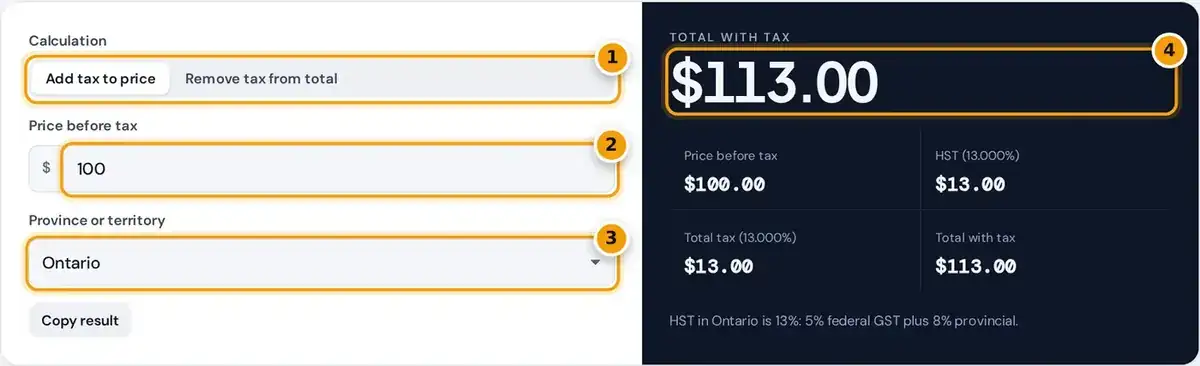
- Choose add tax to a price, or remove tax from a total.
- Enter the amount.
- Choose your province or territory.
- Read the total, with GST, HST, PST or QST shown separately.
Choose Add tax to price to find the total you will pay, or Remove tax from total to find the price before tax from a receipt that already includes tax. Then type in the amount.
Pick the province or territory where the sale takes place, or choose a custom tax rate instead. The result shows each tax separately, so the GST, HST, PST or QST appears on its own line.
A table under the calculator shows the same amount in every province at once. The Copy result button copies a one-line summary, handy for pasting into an expense report, a quote or your bookkeeping notes.
GST, HST, PST and QST Rates by Province
| Province or territory | Taxes | Combined rate |
|---|---|---|
| Alberta, Northwest Territories, Nunavut, Yukon | GST 5% | 5% |
| British Columbia | GST 5% + PST 7% | 12% |
| Manitoba | GST 5% + RST 7% | 12% |
| Saskatchewan | GST 5% + PST 6% | 11% |
| Quebec | GST 5% + QST 9.975% | 14.975% |
| Ontario | HST | 13% |
| Nova Scotia | HST | 14% |
| New Brunswick, Newfoundland and Labrador, Prince Edward Island | HST | 15% |
The federal GST is 5% everywhere in Canada. Alberta and the three territories charge only GST, while British Columbia, Saskatchewan and Manitoba add a separate provincial sales tax, which Manitoba calls retail sales tax (RST).
Five provinces use a single HST combining the 5% federal portion plus a provincial portion. Ontario's 13% HST is 5% federal and 8% provincial, and Nova Scotia cut it to 14% on April 1, 2025.
Quebec charges the 5% GST plus its own QST at 9.975%, for a total combined rate of 14.975%. Rates follow the Canada Revenue Agency GST/HST rate guide and provincial tax authorities, all checked in 2026.
How to Add and Remove GST
Remove tax (reverse GST): price = total / (1 + rate), tax = total − price
To add tax, multiply the price by the rate and add the result. To find reverse GST, divide the tax-included total by 1 plus the rate, so for 5% GST you simply divide by 1.05.
A common mistake is removing tax by subtracting the rate from the total. Taking 13% off $113 gives $98.31, not $100, because the tax was calculated on the smaller pre-tax price, not on the total.
With a separate provincial tax, the formula calculates GST and PST or QST on the price before tax, then adds them together. Each tax is rounded to the cent, the way most receipts show it.
Worked Examples by Province
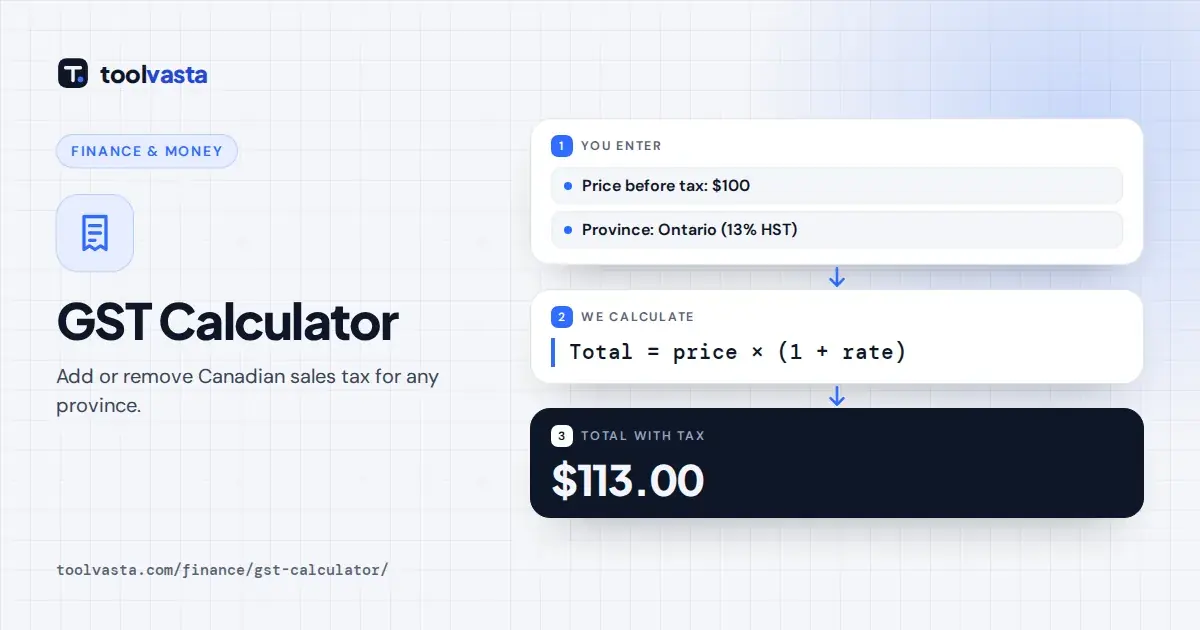
- Ontario: $100 plus 13% HST is $113.00. Removing HST from $113.00 gives $100.00 and $13.00 of HST.
- Quebec: $200 before tax has $10.00 GST (TPS) and $19.95 QST (TVQ), a total of $229.95.
- British Columbia: a $112.00 total includes $5.00 GST and $7.00 PST on a $100.00 price.
- Alberta: $100 plus 5% GST is $105.00.
In Ontario the calculator shows the HST as one line, then notes the 8% provincial share. In Quebec, receipts label the taxes TPS and TVQ, the French names for GST and QST, which appear separately.
Quebec's QST is no longer charged on top of the GST, so both taxes apply to the same pre-tax price. The Revenu Québec rate tables list current and past GST and QST rates by date.
British Columbia and Alberta show how much location matters. The same $100 purchase costs $112.00 in Vancouver and $105.00 in Calgary, a full $7.00 difference that comes entirely from British Columbia's 7% provincial sales tax.
Who Charges GST and HST?
Businesses registered for GST/HST charge it on most taxable supplies. A small supplier with $30,000 or less in taxable sales over four consecutive calendar quarters generally does not have to register, but may register voluntarily.
Some goods and services are zero-rated, such as basic groceries and prescription drugs, so they carry 0% tax. Others are exempt, such as most residential rent and many health and financial services, and carry none.
The difference matters to businesses: sellers of zero-rated goods can still claim credits for tax paid on inputs, while sellers of exempt services cannot. Provincial sales taxes also keep their own separate lists of exemptions.
Using the Calculator for Business
Registered businesses can usually claim input tax credits for the GST or HST they pay on business purchases. Use the remove tax mode to split a tax-included receipt into the price and the claimable tax.
When you prepare a customer invoice, add tax mode shows the exact GST, HST, PST or QST to charge your customer based on their province, since the place of supply generally sets which rate applies.
Keep the copied summaries with your bookkeeping records so the figures match your GST/HST return. Quebec businesses claim QST input tax refunds from Revenu Québec separately from the federal credits they claim through the CRA.
Notes and History
The GST was first introduced in 1991 at 7%. It fell to 6% in 2006 and to 5% in 2008, the rate that still applies today, while HST rates have changed separately in several provinces.
Special rules and rates apply in some cases, such as a higher PST on passenger vehicles in British Columbia, taxes on alcohol, and the point-of-sale rebate on items like children's clothing in some HST provinces.
Confirm the rate for your specific product or service with the CRA or your provincial tax authority. This calculator gives accurate standard rates but cannot know every exemption, rebate or special rule that may apply.
Frequently asked questions
How do I calculate GST backwards?
Divide the tax-included total by 1 plus the tax rate. For 5% GST, a $105 total is $105 / 1.05 = $100 before tax, with $5 of GST. Choose Remove tax from total to do this for any province.
What is the GST rate in Canada in 2026?
The federal GST is 5%. In Ontario, Nova Scotia, New Brunswick, Newfoundland and Labrador and Prince Edward Island, it is combined with the provincial tax as HST at 13% to 15%.
How much is sales tax in Quebec?
Quebec charges 5% GST (TPS) plus 9.975% QST (TVQ), both on the price before tax, for a combined 14.975%. A $100 purchase before tax becomes $114.98 once both taxes are added.
What is the HST in Nova Scotia?
Nova Scotia's HST has been 14% since April 1, 2025. It was 15% before that date. The 14% combines the 5% federal GST with a 9% provincial portion.
Is there PST in Alberta?
No. Alberta, Yukon, the Northwest Territories and Nunavut charge only the 5% federal GST, so a $100 purchase costs $105.00 there, the lowest sales tax anywhere in Canada.
What is the difference between GST, HST and PST?
GST is the 5% federal sales tax. HST combines GST with a provincial portion and is collected as one tax. PST, RST and QST are separate provincial taxes charged alongside GST.