How to Use the After-Tax Income Calculator
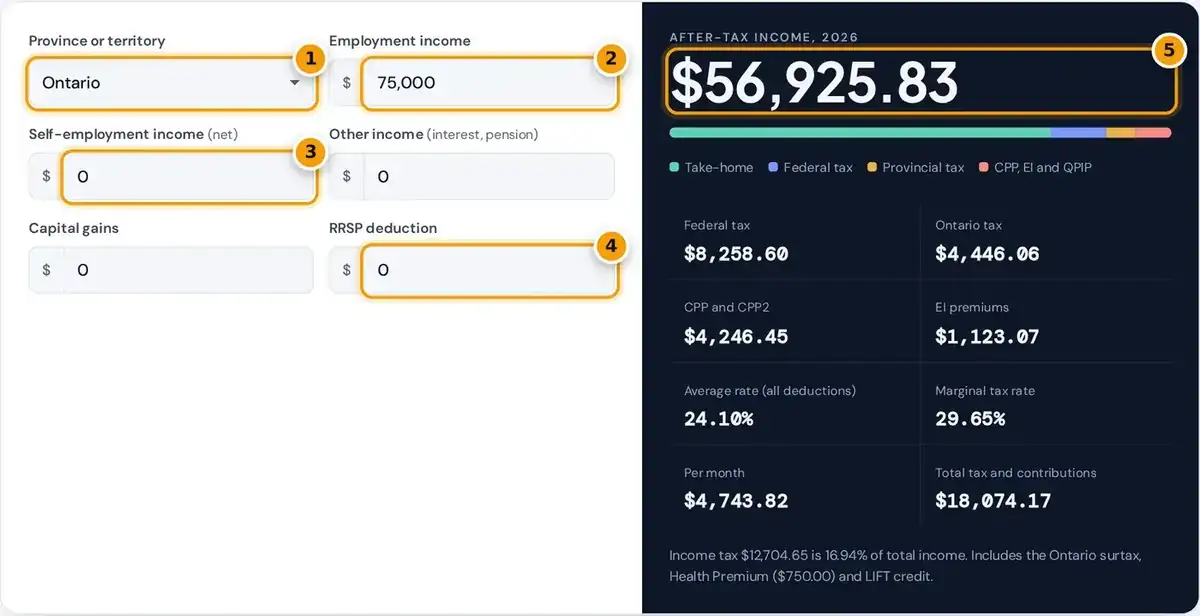
- Choose your province or territory of residence.
- Enter your annual employment income before tax.
- Add any net self-employment income, which also pays both halves of CPP.
- Enter any RRSP deduction to see how much tax it saves.
- Read your after-tax income, then check your marginal rate and monthly take-home.
Choose the province or territory where you lived on December 31, 2026, then enter your total income for the year. Use employment income for a salary, and self-employment income for net business income after expenses.
Add interest or pension income as other income, enter any capital gains, and include an RRSP deduction if you plan one. Every field updates the result instantly, so you can test different scenarios in seconds.
The result shows your after-tax income, federal and provincial tax, CPP or QPP, EI, and both your average and marginal rates. A table below compares the same annual income across all 13 provinces and territories.
How After-Tax Income Is Calculated
Income tax = federal tax + provincial tax
After-tax income = total income − income tax − CPP − EI
Federal tax uses the 2026 tax brackets of 14%, 20.5%, 26%, 29% and 33%. Non-refundable credits include the $16,452 basic personal amount, the $1,501 Canada employment amount, and credits for CPP contributions and EI premiums.
Provincial tax uses each province's 2026 brackets and basic amount. Ontario adds the Ontario surtax, the Health Premium, its tax reduction and the LIFT credit, while British Columbia also applies its own low-income tax reduction.
Quebec uses the Revenu Québec 2026 brackets from 14% to 25.75%, an $18,952 basic amount, QPP and QPIP. The 16.5% federal abatement lowers federal tax there because Quebec runs some programs that are federal elsewhere.
Worked Example: $75,000 Across Provinces
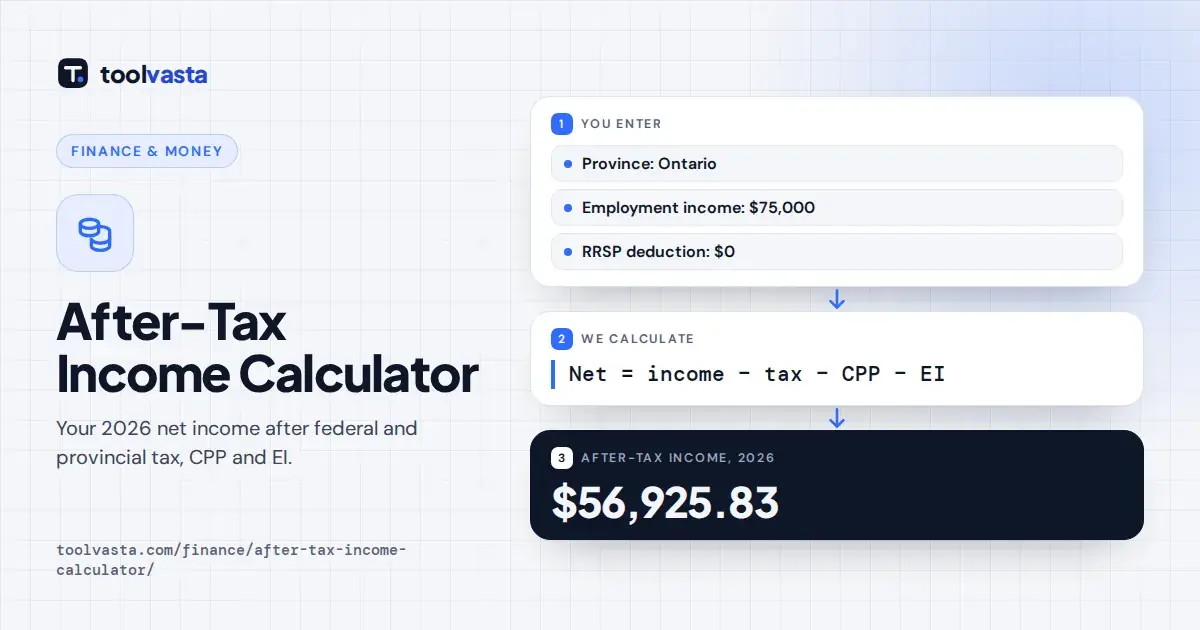
A $75,000 salary in Ontario pays $8,258.60 federal tax, $4,446.06 Ontario tax, $4,246.45 of CPP and CPP2 and $1,123.07 of EI premiums. That leaves $56,925.83 of net income for the year, about $4,743.82 per month.
The same salary leaves $57,361.50 in Alberta and $57,710.56 in British Columbia. In Quebec, higher provincial tax plus QPP and QPIP leave only about $53,964.94, even after the federal abatement is applied to federal tax.
At this income, Nunavut leaves the most take-home pay of any jurisdiction, followed by the Northwest Territories, British Columbia and Yukon. The table updates for any income, so you can check a job offer elsewhere.
Using It as a Self-Employed Tax Calculator
Self-employed people pay income tax at the same rates as employees, but they pay both halves of CPP themselves. That means 11.9% on earnings from $3,500 up to $74,600, plus 8% CPP2 up to $85,000.
The employer portion of those contributions is deductible from income, and the calculator applies that deduction for you. With $80,000 of business income in Ontario, CPP and CPP2 total $8,892.90 and after-tax income is $57,873.53.
Enter net business income, meaning revenue minus eligible expenses. With no tax withheld, the CRA may require quarterly instalments when net tax owing exceeds its threshold this year and one of the two previous years.
2026 Provincial Rates and Basic Amounts
| Province | Lowest rate | Top rate | Basic personal amount |
|---|---|---|---|
| Alberta | 8% | 15% | $22,769 |
| British Columbia | 5.60% | 20.50% | $13,216 |
| Manitoba | 10.8% | 17.4% | $15,780 |
| New Brunswick | 9.4% | 19.5% | $13,664 |
| Newfoundland and Labrador | 8.7% | 21.8% | $13,094 |
| Nova Scotia | 8.79% | 21% | $11,932 |
| Northwest Territories | 5.9% | 14.05% | $18,198 |
| Nunavut | 4% | 11.5% | $19,659 |
| Ontario | 5.05% | 13.16% | $12,989 |
| Prince Edward Island | 9.5% | 20% | $15,000 |
| Quebec | 14% | 25.75% | $18,952 |
| Saskatchewan | 10.5% | 14.5% | $20,381 |
| Yukon | 6.4% | 15% | $16,452 |
Each jurisdiction sets its own lowest rate, top rate and basic personal amount. Nunavut has the lowest starting rate at 4%, while Quebec starts at 14% and reaches 25.75% at the top of its scale.
Alberta offers the largest basic personal amount at $22,769, so a larger slice of income is tax-free there. Nova Scotia has the smallest at $11,932, which raises the tax on lower incomes in that province.
Provincial tax is always added on top of federal tax, so the combined rate is what really matters. The official CRA tax rates and income brackets list every 2026 threshold for federal and provincial calculations.
Average Rate vs Marginal Rate
Your average tax rate is total tax and contributions divided by total income. It is sometimes called your effective rate, and it shows how much of every dollar actually leaves your pocket over the year.
Your marginal tax rate is the income tax on your next $100. It tells you what a raise really adds, and what an RRSP deduction saves, because both happen at the top of your income.
A $75,000 earner in Ontario has an average rate of about 24.1% including CPP and EI, but a marginal rate of 29.65%. The same salary in Quebec faces a higher combined marginal rate of 36.12%.
Using It as a Tax Return Estimate
The calculator estimates the total tax on your 2026 return for simple situations. To turn that into a tax return estimate, compare it with the tax withheld, shown in box 22 of each T4 slip.
If your employer withheld more than the calculated tax, the difference is roughly your refund. If it withheld less, or you had untaxed self-employment income, the gap is roughly the balance owing when you file.
Withholding is based on your pay alone, so second jobs, capital gains and side income often create a balance owing. An RRSP contribution before the deadline is one of the few ways to reduce it.
Assumptions and Limits
The calculator assumes a single person resident in one province for the full year, with only basic personal credits. It does not cover dividends, the alternative minimum tax and QPIP on self-employment income in Quebec.
It also leaves out refundable benefits such as the Canada Workers Benefit and the GST/HST credit, plus provincial low-income reductions outside Ontario and British Columbia. Quebec figures follow the Revenu Québec 2026 rates and amounts.
Every result is an estimate for planning, not tax, legal or financial advice. Your actual tax depends on your full return, credits and deductions, so confirm important numbers with the CRA or a tax professional.
Frequently asked questions
How much is $75,000 after tax in Canada?
It depends on the province. For 2026, a $75,000 salary leaves about $56,926 in Ontario, $57,362 in Alberta, $57,711 in British Columbia and $53,965 in Quebec after income tax, CPP or QPP and EI.
Which province has the lowest income tax?
At most incomes the territories and Alberta leave the most after tax. At $75,000 in 2026, Nunavut leaves the most, followed by the Northwest Territories, British Columbia and Yukon.
How is self-employment income taxed?
It is taxed at the same rates as a salary, but you pay both the employee and employer CPP contributions: 11.9% on earnings up to $74,600, plus 8% CPP2 up to $85,000. Half is deductible.
Does an RRSP contribution lower my tax?
Yes. An RRSP deduction lowers your taxable income, so it saves tax at your marginal rate. Enter the amount in the RRSP field to see how your after-tax income and tax change.
Is this a tax return estimate calculator?
It estimates the tax on your 2026 return for simple situations. Your refund or balance owing also depends on the tax already withheld and on credits this calculator does not include.
What is the difference between gross and net income?
Gross income is your pay before deductions. Net income, or take-home pay, is what remains after federal and provincial income tax, CPP or QPP and EI premiums are taken off.