How to Use the BC PNP Calculator
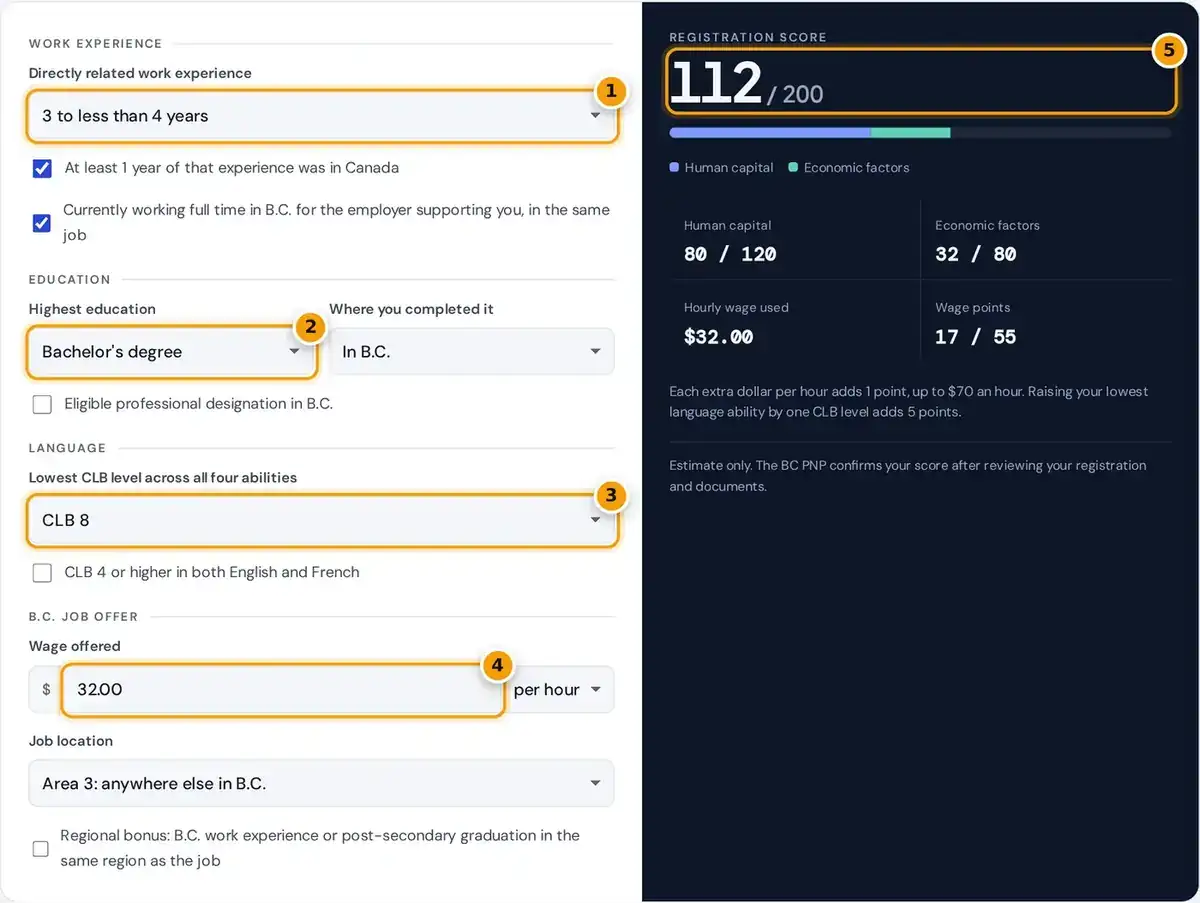
- Choose your years of work experience directly related to the B.C. job offer.
- Pick your highest education and where you completed it.
- Select your lowest CLB level across speaking, listening, reading and writing.
- Enter the wage offered, per hour or per year, then the job location area.
- Read your SIRS score out of 200, split into human capital and economic factors.
Work down the form from top to bottom: work experience, education, language and your B.C. job offer. Each answer updates the registration score out of 200 instantly, and the score breakdown table shows every factor.
Enter your offered hourly wage first. If your offer states an annual salary, switch the wage period to per year and add the hours per week, and the calculator converts it to an hourly figure.
Choose the job location carefully, since the area of employment and the regional bonus can add up to 25 points. The notes under the result show which single change would lift your score the most.
What the SIRS Score Is
The BC Provincial Nominee Program selects most Skills Immigration candidates through the Skills Immigration Registration System, known as SIRS. You create a free registration, and the province gives it a score out of 200 points.
B.C. holds draws and sends an invitation to apply to registrations that meet the cut-off for that round. A nomination from the province is a step toward permanent residence, which the federal government then decides.
It has two halves. Human capital factors cover experience, education and language for up to 120 points, while economic factors cover your wage and job location for up to 80 points. Age is not scored.
| Factor | How points are given | Max |
|---|---|---|
| Work experience | 1 to 20 by years, +10 with 1 year in Canada, +10 if working in B.C. for the employer | 40 |
| Education | 5 (diploma or associate), 15 (bachelor's or post-graduate), 22 (master's), 27 (doctoral); +8 B.C. study or +6 other Canadian study; +5 professional designation | 40 |
| Language | 5 (CLB 4) rising by 5 per level to 30 (CLB 9+); +10 for English and French | 40 |
| Hourly wage | 1 point at $16.00 plus 1 per extra dollar, 55 at $70.00 or more | 55 |
| Area of employment | 0 (Metro Vancouver), 5 (Area 2), 15 (Area 3); +10 regional experience or alumni | 25 |
| Total | 200 |
Human Capital Factors
Directly related work experience earns 1 to 20 points by years in your offered occupation. Canadian experience of at least a year adds 10, and working full time for the employer now adds 10 more.
Education gives 5 for diplomas, 15 for a bachelor's degree, 22 for a master's degree and 27 for a doctoral degree. Post-secondary study in B.C. adds 8, elsewhere in Canada 6, and a designation 5.
Language uses the Canadian Language Benchmark (CLB) and scores your lowest ability across speaking, listening, reading and writing. CLB 4 gives 5 points, rising 5 per level to 30, plus 10 for English and French.
Economic Factors
Score = experience + education + language + wage + area
Wage points reward pay directly. An hourly wage of $16.00 earns 1 point and each extra whole dollar adds 1 more, reaching the 55 point maximum at $70.00 an hour. Leftover cents do not count.
The area of employment adds 0 points in Metro Vancouver, 5 in Area 2 (Squamish, Abbotsford, Agassiz, Mission or Chilliwack) and 15 anywhere else in the province. Rural jobs therefore start with a clear advantage.
A regional bonus of 10 points applies when the job is outside Metro Vancouver and you have work experience in that region or studied there as alumni. The calculator ignores it for Area 1 jobs.
Worked Example
Take the defaults: 3 years of directly related experience (12 points), one of them in Canada (10), and current full time work for the B.C. employer (10). Experience therefore totals 32 of a possible 40.
A bachelor's degree from a B.C. institution earns 15 plus 8, or 23. CLB 8 as the lowest ability adds 25, so human capital reaches 80 of 120 before any job offer factor is counted.
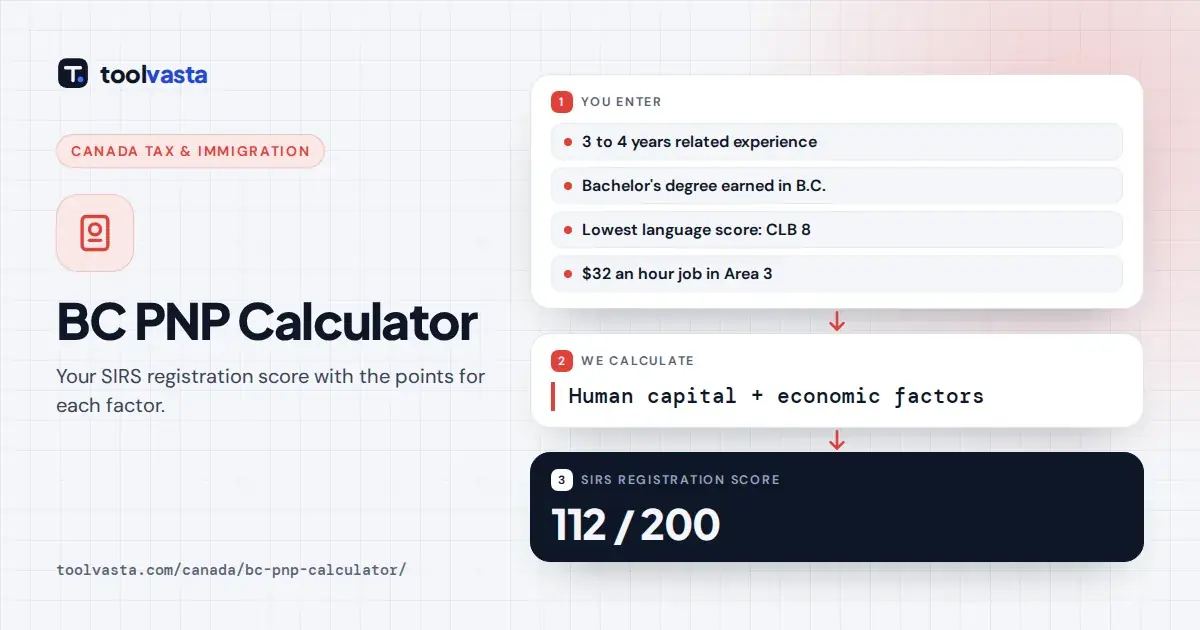
A $32.00 hourly offer in Kelowna scores 17 wage points plus 15 for Area 3, giving economic factors of 32 and a total score of 112. This matches the figure the calculator shows at first.
Draws and Cut-Offs
| Draw category (September 24, 2026) | Minimum score |
|---|---|
| Care: childcare | 99 |
| Care: health | 76 |
| Build: construction | 94 |
| Innovate: high economic impact (points draw) | 131 |
| Temporary rural and remote health | 60 |
The province runs mostly targeted draws by sector, so the minimum score depends on your occupation. The September 24, 2026 round ranged from 60 for rural and remote health to 131 for high economic impact.
Childcare invitations needed 99 points that day and construction needed 94, which clearly shows how far a cut-off can move between categories in a single round. Some high economic impact rounds select by wage instead.
Cut-offs change from draw to draw, so check the latest results on the WelcomeBC invitations to apply page before you register. A score above the last minimum is a good sign, but not a promise.
How to Improve Your Score
Language is often the fastest lever. Raising your lowest ability by one CLB level adds 5 points, so retaking a language test after practice on your weakest skill can move you several points at once.
Pay counts dollar for dollar. A raise from $32.00 to $35.00 an hour adds 3 wage points, and a job outside Metro Vancouver can add up to 25 points through location and the regional bonus.
Experience points grow as you pass yearly thresholds, so a points calculator or score calculator is worth rerunning on your work anniversary. Finishing a credential in B.C. can also add up to 8 education points.
Assumptions and Limits
Points follow the Skills Immigration program guide on WelcomeBC. The tool does not test eligibility rules such as occupation lists, minimum wage levels or income requirements, and the province confirms your score after document review.
A nomination through Express Entry BC adds 600 points to your CRS score, which usually leads to an invitation in a later draw. Base Skills Immigration nominations lead to a separate federal permanent residence application.
This page is an estimate for planning only, not legal or immigration advice. Rules, streams and draw categories change, so confirm every factor with the province, and speak with a licensed consultant for complex cases.
Frequently asked questions
What is a good BC PNP score?
It depends on the draw category. In the September 24, 2026 round, minimum scores ranged from 60 for temporary rural and remote health workers to 131 in the high economic impact points draw.
How are BC PNP wage points calculated?
You get 1 point for an hourly wage of $16.00, plus 1 point for each extra whole dollar, up to 55 points at $70.00 per hour or more. Annual salaries are converted using your weekly hours.
How many points is Metro Vancouver worth?
A job in the Metro Vancouver Regional District gets 0 location points. Jobs in Squamish, Abbotsford, Agassiz, Mission or Chilliwack get 5, and jobs elsewhere in B.C. get 15, plus a possible 10 point regional bonus.
Does BC PNP use my lowest language score?
Yes. SIRS scores language on the lowest CLB level among your four abilities, so one weak ability lowers your language points. Improving that single skill by one level adds 5 points to your registration.
Do I need a job offer for BC PNP?
Yes for the scored Skills Immigration streams covered here. Wage and location points both come from a B.C. job offer, and the offer must meet the conditions in the current program guide.
Does a high BC PNP score guarantee an invitation?
No. A high score improves your chances, but invitations depend on each draw's category, cut-off and the number of candidates in the pool. The province also confirms your score after reviewing your documents.