How to Use the CWB Calculator
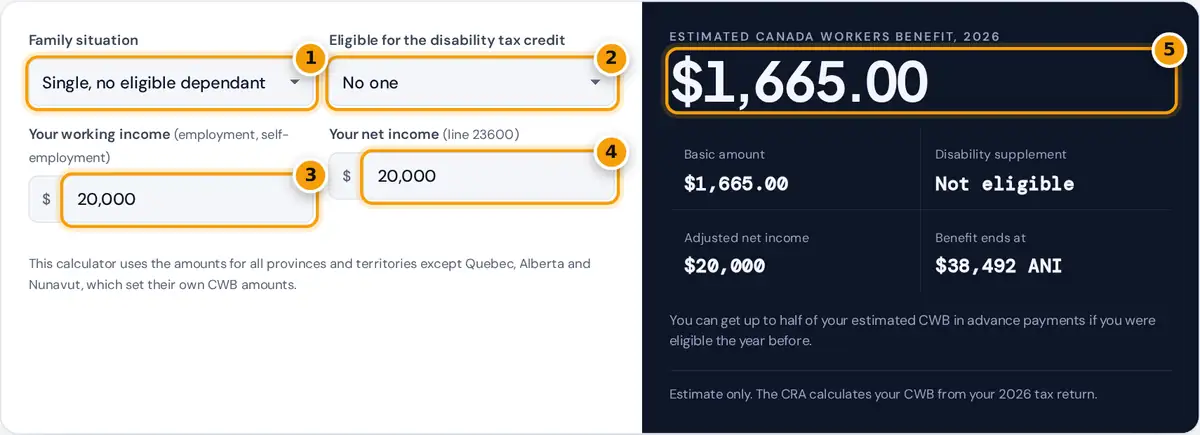
- Choose single, or family if you have a spouse, common-law partner or eligible dependant.
- Say who is eligible for the disability tax credit to add the disability supplement.
- Enter your working income from employment and self-employment.
- Enter your net income from line 23600 of your tax return.
- Read your estimated Canada Workers Benefit, with the basic amount and the income where it ends.
Pick your family situation first. Choose single if you have neither a spouse nor an eligible dependant, or family if you have a spouse or common-law partner, or a child under 19 living with you.
Next, enter your working income, meaning employment income plus net self-employment income, and your net income from line 23600 of your return. Families also enter the spouse's working income and net income in extra fields.
If you or your spouse is approved for the disability tax credit, select who qualifies. This Canada Workers Benefit calculator then shows your basic amount, any disability supplement and a step-by-step table of the calculation.
2026 Canada Workers Benefit Amounts
The CWB is a refundable tax credit for people who work but still earn a low income. Refundable means you receive the full amount even when you owe no income tax, usually within your refund.
| 2026 figure | Single | Family |
|---|---|---|
| Maximum basic amount | $1,665 | $2,869 |
| Reduction threshold (adjusted net income) | $27,392 | $31,251 |
| Basic amount ends at | $38,492 | $50,377 |
| Maximum disability supplement, per eligible person | $860 | $860 |
| Disability supplement reduction starts at | $38,495 | $50,377 |
These 2026 figures come from the annual indexation of benefit amounts, which raised them by 2.0% for the 2026 tax year. The CRA lists each year's values on its indexation adjustment page, alongside other credits.
The maximum basic amount is reached once working income passes about $9,167 for a single person. Above the reduction threshold, every extra dollar of adjusted net income lowers it by 15 cents until nothing remains.
How the CWB Is Calculated
The benefit has a phase-in and a phase-out. During the phase-in, you earn 27% of every dollar of working income above $3,000, up to the maximum. Below $3,000 of working income, you receive no benefit.
Disability supplement = min($860, 27% × (working income − $1,150)) − 15% × (adjusted net income − supplement threshold)
The phase-out then subtracts 15% of adjusted net income above the threshold. For families, both partners' working income is added together, and the reduction uses adjusted family net income rather than either person's income alone.
Families also get a secondary earner exemption. The lower earning spouse can exclude up to $16,714 of working income from adjusted family net income, which is the 2025 figure of $16,386 indexed upward by 2.0%.
Worked Examples for Singles and Families
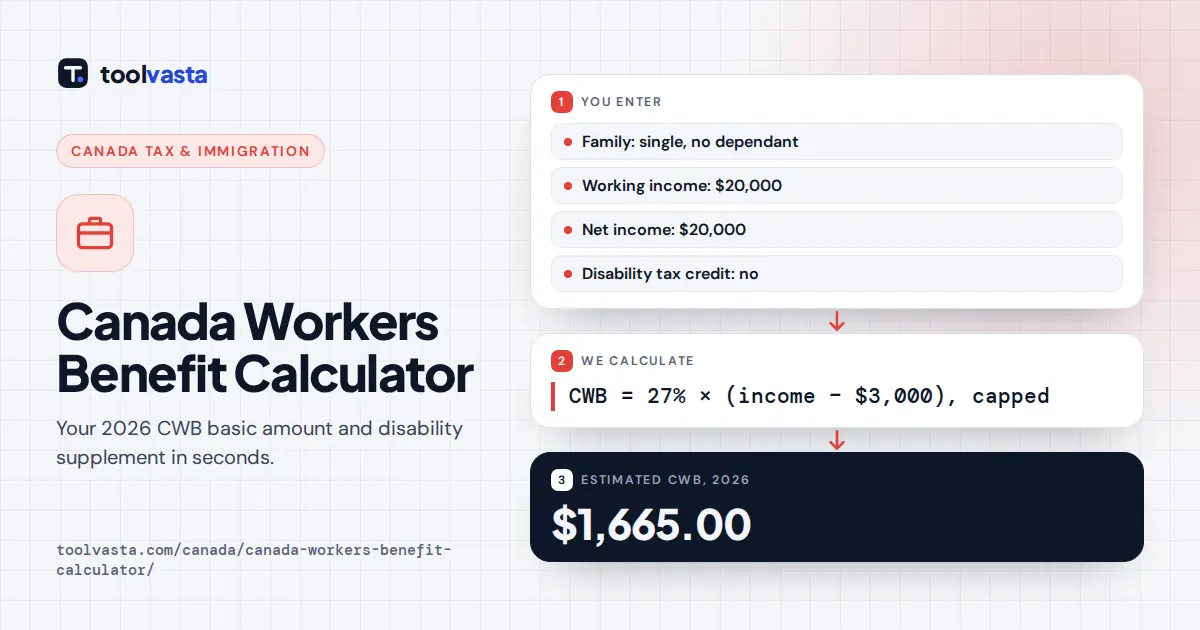
A single worker with $20,000 of working and net income gets the full basic amount. Here 27% of $17,000 is $4,590, above the $1,665 cap, and income sits below $27,392, so no income reduction applies.
At $30,000 of income, the reduction is 15% of $2,608, which is $391.20. That leaves a basic amount of $1,273.80. If the same person qualifies for the disability supplement, the total CWB rises to $2,133.80.
A family where one spouse earns $35,000 and the other $10,000 can exclude the whole $10,000 as secondary earner income. The reduction is 15% of $3,749, or $562.35, giving a total family CWB of $2,306.65.
The CWB Disability Supplement
The disability supplement is paid on top of the basic amount to anyone in the household officially approved for the disability tax credit. Approval comes from an accepted Form T2201, the Disability Tax Credit Certificate.
The supplement phases in at 27% of working income above $1,150 and tops out at $860 per eligible person. It starts shrinking only at a higher income than the basic amount, so it lasts longer.
When both spouses qualify, each gets a supplement, so the family can receive up to $1,720. In that case each supplement is reduced at 7.5% rather than 15%, which the calculator applies automatically for you.
Who Can Get the Canada Workers Benefit
You must be a resident of Canada for the whole year, have working income above $3,000 and have adjusted net income below the level where the benefit ends. The CRA checks this when you file.
- You were 19 or older on December 31, or lived with a spouse or common-law partner or your child.
- You were not a full-time student for more than 13 weeks, unless you had an eligible dependant.
- You were not in prison for 90 days or more in the year.
Age matters only if you have no family. A person under 19 living with a spouse or child can still qualify, while a single full-time student usually cannot claim the benefit at all that year.
Residents of Quebec, Alberta and Nunavut have different amounts and thresholds under agreements with Ottawa. This calculator uses the amounts for the other provinces and territories, so check the CRA tables if you live there.
Claiming the CWB and Advance Payments
You claim the CWB on Schedule 6 and enter the result on line 45300 of your tax return. It replaced the Working Income Tax Benefit in 2019, and only one spouse claims the family amount.
Eligible workers can get up to half of their expected benefit as advance payments. The CRA pays them automatically in July, October and January to people who qualified the previous year, based on that return.
Advance payments are a prepayment, not extra money. When you file later, the CRA subtracts what you already received from your final CWB, and you must repay any amount you were not entitled to receive.
Limits of This Estimate
The calculator assumes your net income and adjusted net income are the same, apart from the secondary earner exemption. It does not adjust for items such as income that is exempt under the Indian Act.
It also ignores advance payments already received, the separate Quebec, Alberta and Nunavut rules and the choice of which spouse claims. These details can noticeably change what you actually receive when your return is assessed.
Treat the result as an estimate for budgeting and planning, not as tax advice. The CRA works out your actual benefit from your tax return, and the official CWB page explains every rule in detail.
Frequently asked questions
How much is the Canada Workers Benefit for 2026?
The maximum basic amount is $1,665 for single individuals and $2,869 for families. Anyone approved for the disability tax credit can add a disability supplement of up to $860 per eligible person.
What is the income limit for the CWB in 2026?
For a single person, the basic amount starts to shrink at $27,392 of adjusted net income and ends at about $38,492. For families it starts at $31,251 and ends at about $50,377.
Do I need to apply for the Canada Workers Benefit?
There is no separate application. You claim the benefit on Schedule 6 when you file your tax return, and the CRA can also check your eligibility when it assesses your return.
What counts as working income for the CWB?
Working income is employment income, including tips and taxable benefits, plus net income from self-employment. Pension income, Employment Insurance benefits and investment income do not count toward the $3,000 minimum.
Can students get the Canada Workers Benefit?
Not if you were a full-time student for more than 13 weeks in the year, unless you had an eligible dependant at the end of the year. Part-time students can qualify normally.
Is the CWB paid in advance?
Yes. If you qualified the previous year, the CRA automatically pays up to half of your expected benefit in three advance payments, and the rest is settled when you file your return.