How to Use the Dividend Tax Calculator
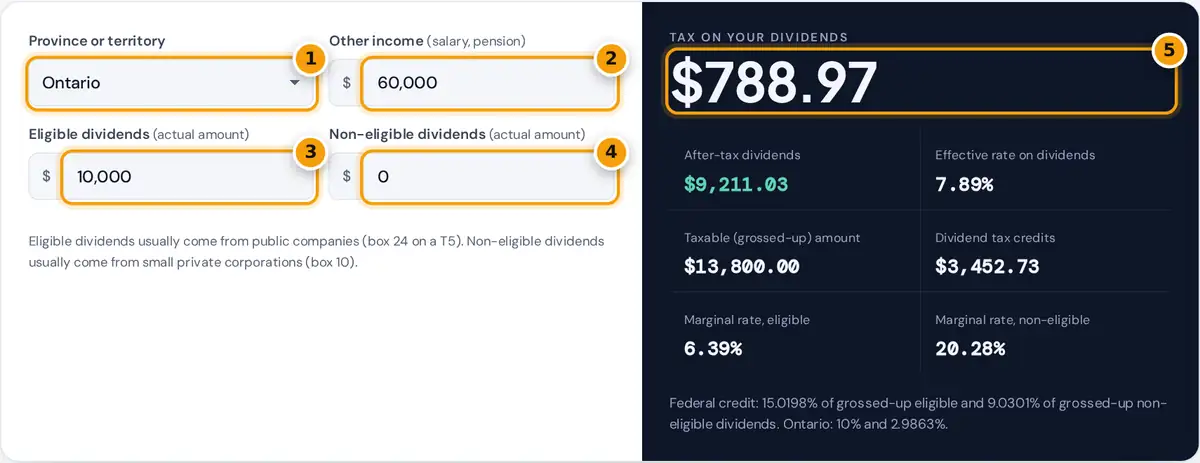
- Choose your province or territory so the right provincial dividend tax credit is used.
- Enter your other income for the year, such as salary or pension, to set your tax bracket.
- Enter eligible dividends from box 24 of your T5, usually from public companies.
- Enter any non-eligible dividends (box 10), usually paid by small private corporations.
- Read the tax on your dividends, then check the gross-up, credits and marginal rates below.
Start by choosing your province or territory, because each one sets its own separate dividend tax credit rate. Then enter your other income for 2026, such as salary, pension or self-employment earnings, before any deductions.
Next, type the actual eligible dividends and non-eligible dividends you received, not grossed-up figures. The dividend tax calculator adds the gross-up itself, applies every credit and updates the result the moment you change a number.
The result shows the extra tax caused by your dividends, your after-tax dividends and the effective rate on them. It also shows your marginal tax rate on the next $100 of each dividend type held.
How Dividends Are Taxed in Canada
A dividend comes from company profit that already faced corporate tax. To avoid double taxation, Canada uses a two-step system: you add a gross-up to the dividend, then claim credits that offset that corporate tax.
Federal credit = 15.0198% (eligible) or 9.0301% (non-eligible) × grossed-up dividend
Provincial credit = provincial rate × grossed-up dividend
Tax on dividends = tax with dividends − tax without dividends
The gross-up raises the dividend to roughly the pre-tax profit behind it, and that taxable amount is taxed normally. The federal dividend tax credit and the provincial credit are then subtracted from the tax owing.
Both credits are non-refundable. They can reduce your tax to zero but never create a refund on their own. The calculator compares your tax with and without the dividends, so the difference is the cost.
Eligible vs Non-Eligible Dividends
Eligible dividends usually come from public corporations and companies whose profit was taxed at the general corporate rate. Because more corporate tax was paid, they get a 38% gross-up and the larger dividend tax credit.
Non-eligible dividends usually come from a Canadian-controlled private corporation whose income was taxed at the lower small business rate. They get a 15% gross-up and a smaller credit, so personal tax on them is higher.
Your T5 slip tells you exactly which type you received. Box 24 shows the actual amount of eligible dividends and box 10 shows the actual amount of other than eligible dividends. Enter both figures above.
Worked Example: $10,000 of Dividends in Ontario
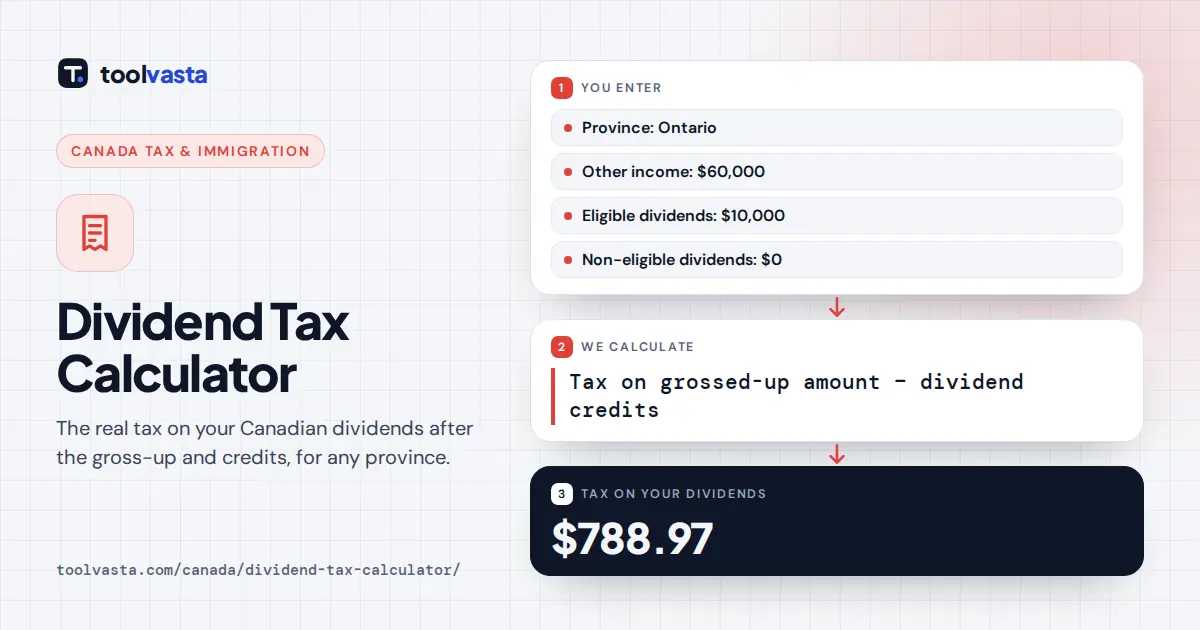
Take a resident of Ontario with a $60,000 salary who receives $10,000 of eligible dividends. The gross-up adds $3,800, so $13,800 joins taxable income. Without the dividends, total income tax is $8,320.50 for the year.
The federal credit is 15.0198% of $13,800, or $2,072.73, and the Ontario credit is 10% of it, or $1,380. Income tax then rises to $9,109.46, so the dividends cost $788.97, an effective rate of 7.89%.
| Same $10,000 received as | Extra tax | Effective rate | You keep |
|---|---|---|---|
| Eligible dividends | $788.97 | 7.89% | $9,211.03 |
| Non-eligible dividends | $2,027.86 | 20.28% | $7,972.14 |
| Extra salary or interest income | $2,813.42 | 28.13% | $7,186.58 |
The table compares the same $10,000 received three ways by this taxpayer. Interest income is taxed exactly like salary for income tax purposes, which is why dividends from Canadian companies are so popular with investors.
2026 Dividend Tax Credit Rates by Province
Every province and territory adds its own credit to the federal one, as a percentage of the grossed-up dividend. That is why the combined rate on the same dividend can differ by several points nationally.
| Province or territory | Eligible | Non-eligible |
|---|---|---|
| Federal | 15.0198% | 9.0301% |
| Alberta | 8.12% | 2.18% |
| British Columbia | 12% | 1.96% |
| Manitoba | 8% | 0.7835% |
| New Brunswick | 14% | 2.75% |
| Newfoundland and Labrador | 6.3% | 3.2% |
| Northwest Territories | 11.5% | 6% |
| Nova Scotia | 8.85% | 1.5% |
| Nunavut | 5.51% | 2.61% |
| Ontario | 10% | 2.9863% |
| Prince Edward Island | 10.5% | 1.3% |
| Quebec | 11.7% | 3.42% |
| Saskatchewan | 11% | 2.519% |
| Yukon | 12.02% | 0.67% |
For 2026, British Columbia offers the largest provincial credit on eligible dividends at 12%, while Newfoundland and Labrador offers the smallest at 6.3%. Ontario publishes its own rates on its official dividend tax credit page.
Non-eligible rates are much lower everywhere, from 0.67% in Yukon to 6% in the Northwest Territories. Quebec applies its own credit on a separate provincial return, so the calculator treats Quebec results as an estimate.
When Dividend Tax Is Zero or Negative
At a low income, the two credits can exceed the tax on the grossed-up amount. The calculator then shows negative tax, which means the dividend credits also reduce the tax on your salary or pension.
Because the credits are non-refundable, this only helps if you owe some tax. With no other income, the basic personal amount and the credits can make a large amount of eligible dividends close to tax-free.
For example, $30,000 of eligible dividends with no other income produces no tax in Alberta. In Ontario the same case owes $450, which comes from the Ontario Health Premium rather than from income tax itself.
Accounts, Foreign Dividends and Clawbacks
The gross-up and credit only apply in a non-registered account. Dividends earned in a TFSA are never taxed, and dividends inside an RRSP are taxed as ordinary income when withdrawn, without any dividend tax credit.
Foreign dividends, including US dividends, get no gross-up or credit and are taxed like interest. The US usually keeps a 15% withholding tax under the treaty, which you may claim as a foreign tax credit.
The grossed-up amount counts toward your net income, not the cash received. A higher net income can raise the OAS clawback and reduce income-tested benefits such as the Canada Child Benefit and the GST/HST credit.
Assumptions and Limits
The calculator treats your other income as employment income and applies the basic personal credits, CPP and EI credits for that income. It uses the same 2026 tax engine as our Ontario and payroll calculators.
It does not model the alternative minimum tax, the OAS recovery tax, capital gains, pension credits or deductions like RRSP contributions. The gross-up and federal credit rates match the CRA guide to the T5 slip.
Every figure is an estimate for planning, not tax or investment advice. Final tax depends on your full return, so confirm large decisions with the CRA, Revenu Québec or a qualified tax professional before acting.
Frequently asked questions
How much tax do I pay on dividends in Canada?
It depends on your province, your other income and the dividend type. With a $60,000 salary in Ontario, $10,000 of eligible dividends adds about $789 of tax in 2026, while non-eligible dividends add about $2,028.
What is the dividend gross-up for 2026?
Eligible dividends are grossed up by 38% and non-eligible dividends by 15%. You report the grossed-up amount as taxable income, then claim federal and provincial dividend tax credits based on that same amount.
What is the federal dividend tax credit rate?
The federal dividend tax credit is 15.0198% of grossed-up eligible dividends and 9.0301% of grossed-up non-eligible dividends. Your province or territory adds its own credit on top of the federal amount.
Why are eligible dividends taxed less than non-eligible dividends?
Eligible dividends are paid from profit taxed at the general corporate rate, so they receive a larger gross-up and credit. Non-eligible dividends come from profit taxed at the lower small business rate, so the credit is smaller.
Are dividends in a TFSA or RRSP taxed?
Dividends earned inside a TFSA are tax-free, even when withdrawn. Dividends inside an RRSP are not taxed when received, but withdrawals are taxed as ordinary income and the dividend tax credit does not apply.
Do dividends affect OAS or other benefits?
Yes. Your net income includes the grossed-up dividend, not the cash amount, so dividends can increase the OAS recovery tax and reduce income-tested benefits such as the Canada Child Benefit and GST/HST credit.