How to Use the Maternity Leave Calculator
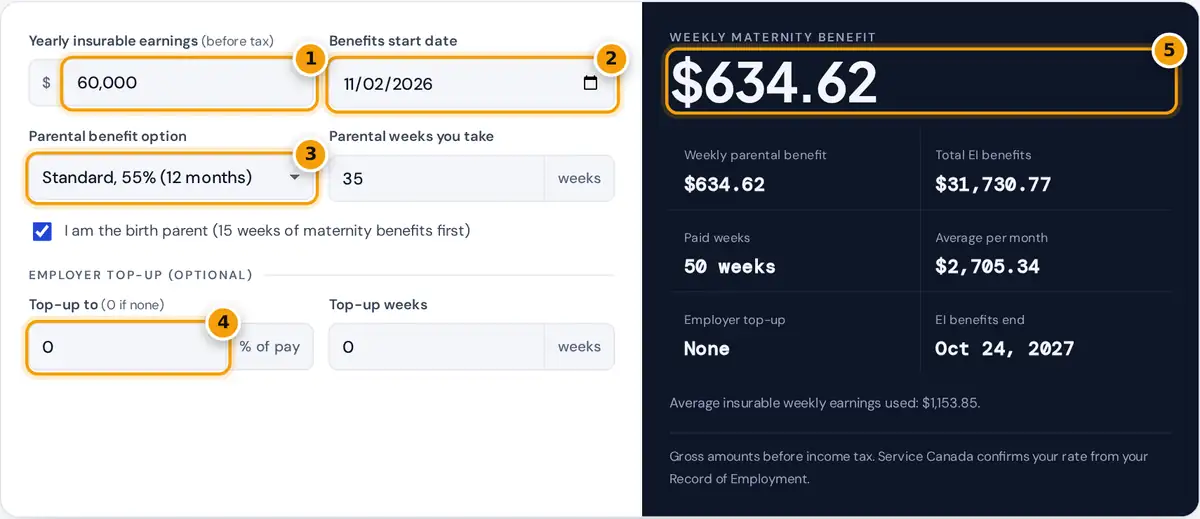
- Enter your yearly insurable earnings before tax, as shown on your pay stubs or Record of Employment.
- Pick the date your EI benefits start, usually the week your leave begins.
- Choose standard (55% over 12 months) or extended (33% over 18 months) parental benefits.
- Add an employer top-up percentage and weeks if your contract includes one, or leave 0.
- Read your weekly maternity benefit, then check parental pay, total EI and the end date.
Enter your yearly insurable earnings, which for most employees is their gross salary or wages before tax. Then pick your benefits start date, the first day of the unpaid waiting week, so dates line up.
Choose standard or extended parental benefits and type the parental weeks you plan to take. Keep the birth parent box ticked to add 15 maternity weeks first; untick it for a non-birth or adoptive parent.
If your employer tops up EI, add the percentage of pay and the number of weeks it lasts. The maternity leave calculator then shows weekly pay, total benefits, a monthly average and your end date.
2026 EI Maternity and Parental Benefit Rates
| Benefit | Rate | Maximum per week (2026) | Weeks |
|---|---|---|---|
| Maternity (birth parent) | 55% | $729 | Up to 15 |
| Standard parental | 55% | $729 | Up to 35 per parent, 40 when shared |
| Extended parental | 33% | $437 | Up to 61 per parent, 69 when shared |
EI maternity benefits and standard parental benefits both replace 55% of your average weekly insurable earnings. Extended parental benefits replace 33%, which is why the weekly amount drops so sharply when you stretch the leave.
Every rate has a ceiling. In 2026 the maximum insurable earnings figure is $68,900 a year, or about $1,325 a week, so the weekly maximum works out to $729 at 55% and $437 at 33%.
Anyone earning above $68,900 receives the same capped amount, so a $90,000 salary and a $150,000 salary both get exactly $729 a week. Lower earners receive their full percentage because they sit below the cap.
How EI Maternity Pay Is Calculated
Maternity or standard parental = 55% × weekly earnings, up to $729
Extended parental = 33% × weekly earnings, up to $437
Total = 15 × maternity rate + parental weeks × parental rate
The calculator divides your capped yearly insurable earnings by 52 to get average weekly earnings, then applies the benefit rate. It adds the maternity weeks and parental weeks together to produce the total before tax.
Service Canada works a little differently. It averages your best weeks of earnings from the 52 weeks before your claim, and the number of best weeks used depends on the unemployment rate in your region.
For a steady salary both methods give nearly the same answer. If hours changed, you had unpaid time off or you earned overtime, your official benefit rate can be higher or lower than this figure.
Worked Example: A $60,000 Salary
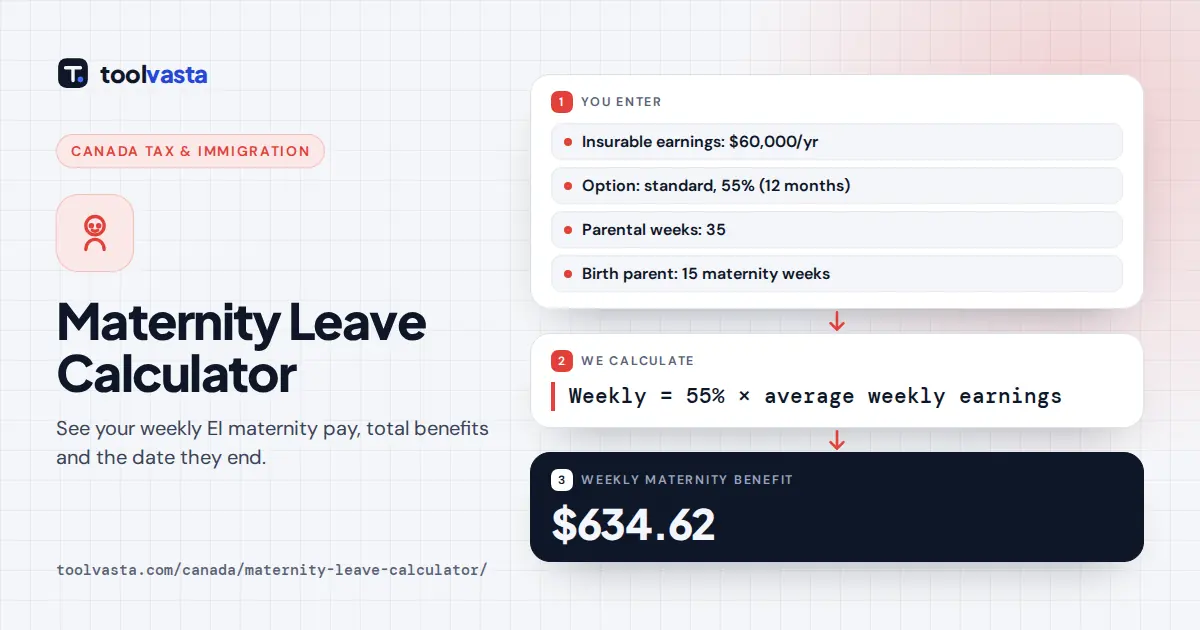
Take a $60,000 salary with EI benefits starting on November 2, 2026. Average weekly earnings are $60,000 divided by 52, which equals $1,153.85, and 55% of that gives a weekly benefit of $634.62 before tax.
Fifteen maternity weeks pay $9,519.23 and 35 standard parental weeks pay $22,211.54. Total benefits come to $31,730.77 over 50 paid weeks, ending October 24, 2027 with the waiting week. That is roughly $2,705 per month.
Switch to extended parental and the parental rate falls to $380.77 a week for 61 weeks. The total rises to $32,746.15, but it is spread over 76 paid weeks, so each month gets noticeably less.
Standard or Extended Parental Benefits
Standard parental benefits suit families who plan a return to work about 12 months after the birth. You receive the higher 55% rate, so household cash flow stays closer to normal during the year off.
Extended parental benefits stretch leave to 18 months at a lower weekly rate of 33%. The total paid is only slightly higher, so the choice is really about time at home versus money each week.
You pick the option when you apply, and it cannot change once parental benefits have been paid. Both parents must choose the same option, even if only one of them claims most of the weeks.
Sharing Parental Leave Between Parents
Two parents can share parental benefits, and the pool grows: standard rises from 35 to 40 weeks, and extended benefits rise from 61 to 69 weeks, giving families 5 extra weeks or 8 extra weeks.
One parent can never take over 35 standard or 61 extended weeks alone. The bonus weeks exist only if the second parent claims them, so they are often called use it or lose it weeks.
Parents can be off at the same time or one after the other. To model a share parental plan, run the calculator once for each parent, unticking the birth parent box for the partner's claim.
Who Qualifies for EI Maternity Benefits
You generally need 600 insured hours of work in the 52 weeks before your claim, or since your last claim. Regular weekly earnings must also have dropped by more than 40% because of the leave.
Your employer issues a Record of Employment, and you apply online through Service Canada soon after your last day of work. Maternity benefits can start as early as 12 weeks before the expected due date.
A self-employed parent can qualify only after opting in to the EI special benefits program and meeting a minimum earnings threshold. Self-employed rules differ, so this calculator is designed mainly for salaried and hourly employees.
Waiting Week, Taxes and Employer Top-Up
Before benefits begin you serve one unpaid waiting week, which you serve only once when maternity and parental benefits run together. The calculator adds that week to the schedule, which pushes your end date out.
EI benefits count as taxable income. Service Canada withholds tax at source and sends a T4E slip for your return. Low-income families with net income of $25,921 or less may also receive the family supplement.
Some employers pay a top-up through a supplemental unemployment benefit plan. For example, a $90,000 salary topped up to 93% of pay for 17 weeks adds $14,970.46 on top of the $729 weekly EI benefit.
Job-Protected Leave and Quebec
EI pays you, but job-protected leave comes from provincial or federal labour law. The Ontario Employment Standards Act guide allows up to 17 weeks of pregnancy leave plus up to 61 weeks of parental leave.
Other provinces set similar lengths, and federally regulated workplaces follow the Canada Labour Code. During protected leave your seniority keeps building, and your employer must offer the same or a comparable job when you return.
Quebec is different. Residents claim through the Quebec Parental Insurance Plan, known as QPIP, which has its own rates, weeks and maximums. Because of that, this EI calculator should not be used for Quebec claims.
Limits of This Estimate
This page gives an estimate for planning only. Service Canada sets your actual rate from your Record of Employment and your best weeks, so check the official Service Canada benefit amount page before you budget.
Amounts are gross figures before income tax and before any family supplement. The calculator assumes one continuous claim with no earnings while on claim, because working during benefits can reduce the weekly amount you receive.
Twins or triplets do not double the claim: the number of weeks and the weekly rate stay the same for a multiple birth. Rates and maximums shown are the 2026 figures and change every January.
Frequently asked questions
How much is maternity leave pay in Canada in 2026?
EI maternity benefits pay 55% of your average weekly insurable earnings, up to $729 a week in 2026. On a $60,000 salary that works out to about $634.62 a week before income tax is deducted.
How many weeks of maternity leave do I get in Canada?
The birth parent can receive up to 15 weeks of EI maternity benefits, followed by up to 35 weeks of standard or 61 weeks of extended parental benefits. One unpaid waiting week comes first.
Is 18 month maternity leave worth it?
Extended parental benefits pay 33% instead of 55%, so each week pays much less. The total is only slightly higher than standard benefits, so the decision mainly depends on how long you want to stay home.
What is the maximum EI maternity benefit for 2026?
The maximum is $729 a week for maternity and standard parental benefits and $437 a week for extended parental benefits. Both caps come from 2026 maximum insurable earnings of $68,900 a year.
Are maternity benefits taxable in Canada?
Yes. EI maternity and parental benefits are taxable income. Service Canada deducts tax from each payment, and you receive a T4E slip to report the benefits on your income tax return.
Does this calculator work for Quebec?
No. Quebec residents receive maternity, paternity and parental benefits from the Quebec Parental Insurance Plan, which uses different rates, weeks and maximum insurable earnings than the federal EI program.