How to Use the TFSA Calculator
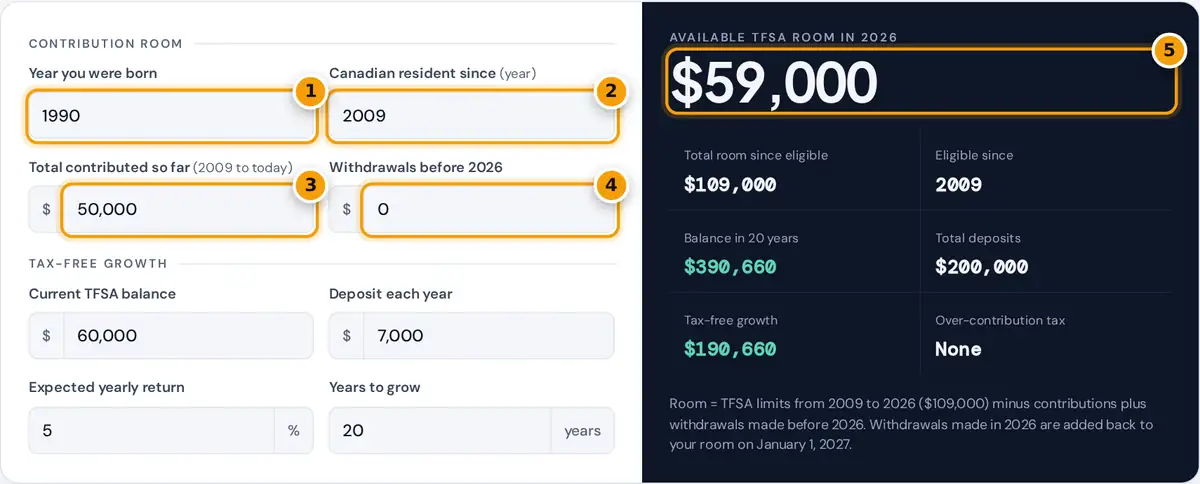
- Enter the year you were born. Room starts the year you turn 18.
- Enter the year you became a Canadian resident, or 2009 if you were here all along.
- Enter everything you have deposited into your TFSAs since 2009.
- Add withdrawals made before 2026. They are added back to your room.
- Read your available 2026 room, then check the growth projection below it.
The top section works out your TFSA contribution room for 2026. Enter your birth year, the year you became a resident of Canada, the total you have ever contributed and any withdrawals made before 2026.
Leave the residency year at 2009 if you lived in Canada before TFSAs began. The result shows your cumulative room, the year you first became eligible and how much you can still deposit this year.
The bottom section is a growth projection. Enter your current balance, a yearly deposit, an expected rate of return and the number of years, and the table below shows deposits and tax-free growth over time.
How TFSA Contribution Room Is Calculated
You start earning TFSA room in the year you turn 18, as long as you are a Canadian resident with a valid social insurance number. Unused room carries forward to later years with no expiry.
Future balance = balance × (1 + r)n + deposit × ((1 + r)n − 1) ÷ r
Each year adds the new annual dollar limit to your room. Contributions use it up, and withdrawals are added back on January 1 of the following year, not on the day you take money out.
Investment growth never changes your room, so a balance that grows far beyond your deposits is perfectly fine. The official CRA guide to calculating TFSA room walks through these same steps in much more detail.
Worked Example: Room and Growth
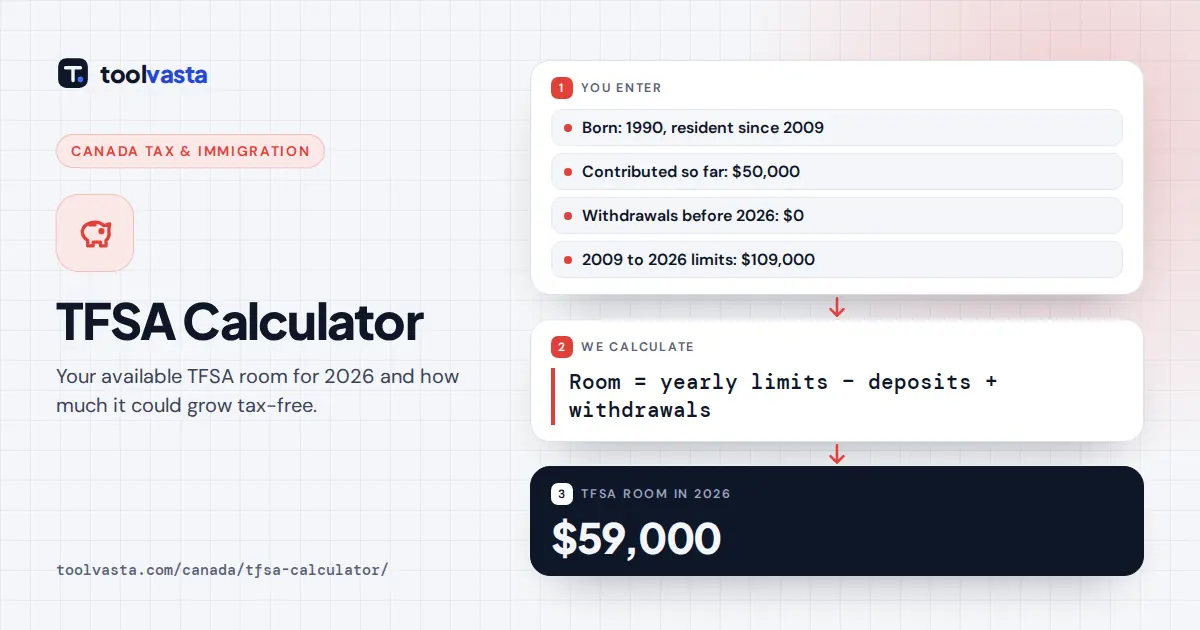
You were born in 1990 and have lived in Canada since before 2009, so you have been eligible ever since TFSAs first began. Your cumulative room is $109,000, the maximum possible for anyone in 2026.
You have contributed $50,000 and never withdrawn, so you can still contribute $59,000 in 2026. If your $60,000 balance earns 5% a year and you add $7,000 each year, it grows to an estimated $390,660.
That projection covers a period of 20 years. You deposited $200,000 in total, so $190,660 is tax-free growth. Someone born in 2005 turned 18 in 2023 and already has $27,500 of cumulative room in 2026.
TFSA Dollar Limits by Year
The annual TFSA limit is indexed to inflation and rounded to the nearest $500. It started at $5,000 in 2009, jumped to $10,000 for 2015 only, and has stayed at $7,000 every year since 2024.
| Year | Annual limit | Cumulative since 2009 |
|---|---|---|
| 2026 | $7,000 | $109,000 |
| 2025 | $7,000 | $102,000 |
| 2024 | $7,000 | $95,000 |
| 2023 | $6,500 | $88,000 |
| 2019 to 2022 | $6,000 a year | $81,500 by 2022 |
| 2016 to 2018 | $5,500 a year | $57,500 by 2018 |
| 2015 | $10,000 | $41,000 |
| 2013 to 2014 | $5,500 a year | $31,000 by 2014 |
| 2009 to 2012 | $5,000 a year | $20,000 by 2012 |
Your own maximum depends on when you became eligible. A newcomer born in 1980 who became a resident in 2016 adds only the limits from 2016 onward, which gives $68,000 of total room by 2026.
Someone who has never contributed can deposit their full cumulative room at once, with no separate yearly cap. The CRA table of registered plan limits publishes each new TFSA dollar limit when it is announced.
Over-Contributions and Withdrawals
If you put in more than your room, the CRA charges a tax of 1% per month on the highest excess amount in each month. There is no grace amount, so any excess costs money.
The calculator shows this penalty when your room turns negative. For example, $120,000 of contributions against $109,000 of room leaves an $11,000 excess, which costs $110 a month until you withdraw it from the account.
Withdrawing and re-depositing in the same year is the most common way people over-contribute by accident. Withdrawn room only returns on January 1 of the next year, so wait before you put the money back.
TFSA vs RRSP
A TFSA gives no tax deduction when you contribute, but interest, dividends and capital gains grow tax-free and withdrawals are never taxed. An RRSP gives a deduction now and taxes the money later when withdrawn.
A TFSA suits flexible goals such as an emergency fund, a home or a car, because you can withdraw at any time. An RRSP is built for retirement and usually suits higher earners the most.
Many Canadians use both accounts side by side. If you expect a lower tax bracket in retirement, the RRSP deduction is worth more, while a TFSA keeps withdrawals from affecting income-tested benefits later in life.
Assumptions and Limits
The growth projection uses a steady yearly return and deposits made at the end of each year. Real returns vary from year to year and are never guaranteed, especially for portfolios of stocks and ETFs.
A TFSA can hold savings, GICs, bonds, mutual funds, ETFs and stocks. Foreign dividends may carry withholding tax that cannot be recovered, so the real return can be slightly lower than the rate you enter.
The room calculation assumes you were a resident in every year since you became eligible. It does not handle transfers between TFSAs, which do not use room. Always check CRA My Account before you contribute.
Frequently asked questions
What is the TFSA limit for 2026?
The TFSA dollar limit for 2026 is $7,000, the same as in 2024 and 2025. Someone eligible since 2009 who has never contributed has $109,000 of cumulative room in 2026.
How do I calculate my TFSA contribution room?
Add the annual limits for every year since you turned 18 and lived in Canada, subtract all contributions, then add back withdrawals made before this year. The calculator does this from your birth year and residency year.
When does TFSA room from a withdrawal come back?
The amount you withdraw is added back to your contribution room on January 1 of the following year. Re-depositing it in the same calendar year uses new room and can cause an over-contribution.
What happens if I over-contribute to my TFSA?
You pay a tax of 1% of the highest excess amount for each month it stays in the account. Withdraw the excess as soon as you notice it to stop the monthly penalty from growing.
Is TFSA interest taxable?
No. Interest, dividends and capital gains earned inside a TFSA are not taxed, and withdrawals are tax-free. The only exception is foreign withholding tax on dividends from some foreign stocks.
Should I use a TFSA or an RRSP?
Use an RRSP if you want a tax deduction now and expect a lower tax rate in retirement. Use a TFSA for flexible goals and tax-free withdrawals. Many Canadians contribute to both accounts.