How to Use the Coast FIRE Calculator
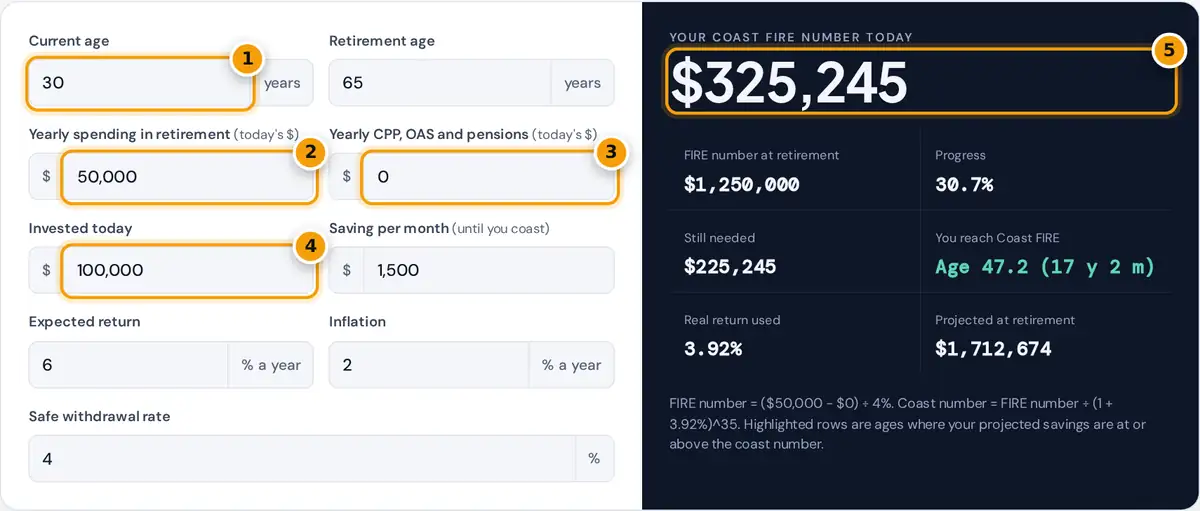
- Enter your current age, then your target retirement age in the next box.
- Enter your yearly retirement spending in today's dollars.
- Add the yearly CPP, OAS and pension income you expect, which lowers the savings you need.
- Enter what you have invested today and, below, your monthly savings, return and inflation.
- Read your Coast FIRE number, then check your progress and the age you reach Coast FIRE.
Enter your current age, your target retirement age and the yearly spending you expect in retirement, all in today's dollars. The Coast FIRE calculator uses these three inputs to set the size of your goal.
Next, add any CPP, OAS or workplace pension you expect, so savings only cover the rest. Then enter what you have invested today, your monthly contributions, the expected return, inflation and your safe withdrawal rate.
The result shows your Coast FIRE number, your progress and the age when you reach it. A table below lists the coast number for each age next to your projected savings, with matching rows highlighted.
What Coast FIRE Means
FIRE stands for financial independence, retire early. Full FIRE means you have enough invested to live on it now. Coast FIRE is an earlier milestone that many savers can reach in their thirties or forties.
At Coast FIRE, you could stop investing and compound growth alone would carry your portfolio to your full FIRE number by retirement age. Your paycheque then only needs to cover what you spend each year.
That freedom can mean part-time work, a job you enjoy or a career break. It does not mean you stop working. It means your retirement savings are on track without any extra contributions from you.
The Coast FIRE Formula
The calculation has three steps. Convert your nominal return into a real return after inflation. Then find the FIRE number you need at retirement. Finally, discount that target back to today at the real return.
FIRE number = (yearly spending − pensions) ÷ withdrawal rate
Coast FIRE number = FIRE number ÷ (1 + real return)years to retirement
Using a real return keeps every figure in today's dollars, so you can compare the result with your current balance. A 6% return with 2% inflation gives a real return of 3.92%, not exactly 4%.
The withdrawal rate turns spending into a goal: at 4%, every $1,000 of yearly spending needs $25,000 invested. A lower rate, such as 3.5%, raises the target but gives your plan a wider safety margin.
Worked Example: Coasting From Age 30
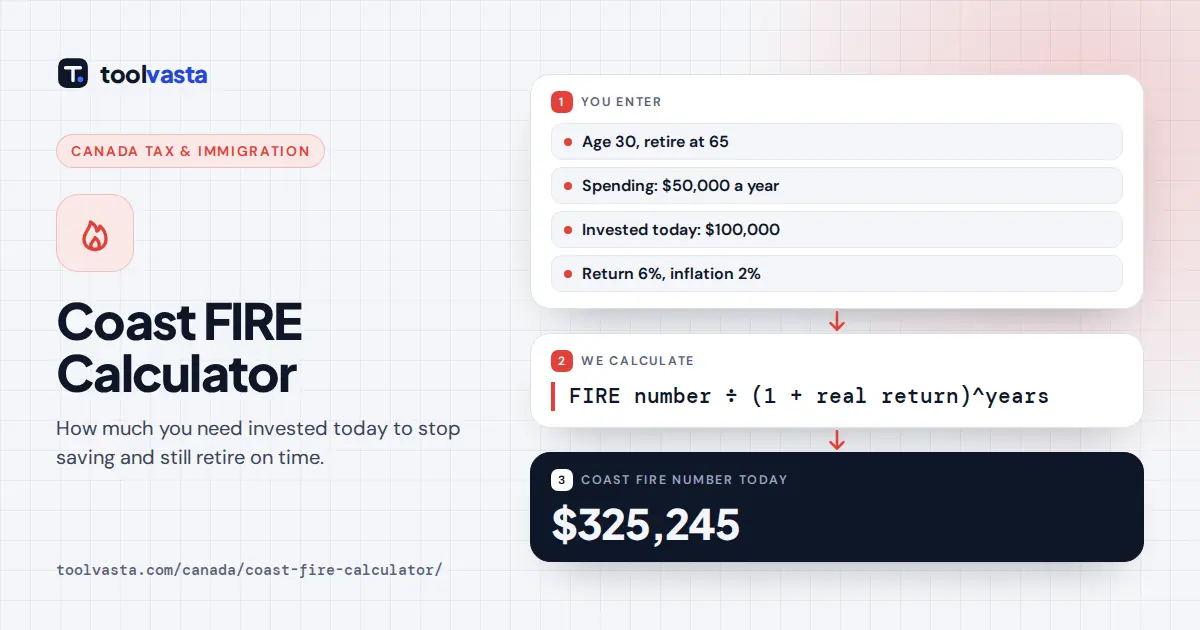
Say you are 30 and want to retire at 65 on $50,000 a year, before pensions. With a 4% withdrawal rate, your FIRE number is $50,000 divided by 0.04, which equals $1,250,000 in today's dollars.
At a 3.92% real return over 35 years, one dollar grows to roughly 3.84 dollars, so your Coast FIRE number today is $325,245. With $100,000 invested, your progress is already 30.7% of the way there.
Saving $1,500 a month, you reach Coast FIRE at about age 47.2, then stop saving for retirement. Expecting $15,000 a year from CPP and OAS cuts the coast number to $227,672, reached near age 38.3.
Coast FIRE Number by Age
The coast number by age table shows why starting younger really matters. A longer time horizon gives compound growth more years to work, so the amount you need today falls sharply the earlier you start.
| Current age | Years to 65 | Coast FIRE number |
|---|---|---|
| 25 | 40 | $268,338 |
| 30 | 35 | $325,245 |
| 35 | 30 | $394,221 |
| 40 | 25 | $477,824 |
| 45 | 20 | $579,157 |
| 50 | 15 | $701,980 |
| 55 | 10 | $850,850 |
These figures assume a $1,250,000 goal at 65, a 6% return and 2% inflation, the calculator's default inputs. Change any input above and the table under the calculator recalculates every age for your own situation.
A rough doubling rule helps here. At about 3.92% real, money doubles roughly every 18 years, so a 25-year-old needs well under a quarter of the full target while a 55-year-old needs most of it.
CPP, OAS, TFSA and RRSP in a Canadian Plan
Government benefits can lower your savings target. In 2026, the maximum CPP retirement pension at 65 is $1,507.65 a month, while the average new pension is only $858.34, according to the Canada.ca CPP payment amounts.
OAS adds more income from 65, but higher incomes face a clawback. CPP can start between 60 and 70, so if you retire earlier, your savings must bridge the years before those government benefits begin.
Investing in a TFSA keeps growth tax-free, and an RRSP defers tax until you withdraw. Because RRSP withdrawals are taxable withdrawals, your spending figure should include the income tax you expect to pay on them.
Coast FIRE vs Barista, Lean and Fat FIRE
Full FIRE means your portfolio pays for retirement now. Lean FIRE aims for a small budget and early exit, while Fat FIRE targets a larger budget and needs a much bigger portfolio to fund it.
Barista FIRE is a form of semi-retirement. You already draw on investments and use part-time work, often with benefits, to cover the rest. Coast FIRE is different because you leave your investments untouched until retirement.
Many people treat Coast FIRE as a checkpoint on the way to full FIRE. Reaching it early removes pressure, and any savings you add after that simply move your full retirement date closer than planned.
Assumptions and Risks
The 4% rule comes from the Trinity Study of 30-year retirements. Longer retirements, high investment fees or a poor first decade of returns can make it too generous, so early retirees use 3% to 3.5%.
Sequence of returns risk matters most while you coast. A market crash soon after you stop saving can push your timeline back. A diversified portfolio, a small buffer and occasional contributions all reduce that risk.
Returns are never guaranteed, so review every year and adjust. This calculator gives a planning estimate, not financial advice. For tax or pension decisions, consider speaking with a fee-only financial planner before you stop saving.
Frequently asked questions
What is a Coast FIRE number?
It is the amount you need invested today so that, with no more contributions, compound growth alone reaches your full FIRE number by your retirement age. In the default example it is $325,245.
How do I calculate Coast FIRE?
Divide your yearly retirement spending, minus pensions, by your withdrawal rate to get your FIRE number. Then divide that by one plus the real return, raised to the number of years until retirement.
Should I include CPP and OAS in my FIRE number?
Yes, if you expect them. Subtract the yearly amount from your spending before dividing by the withdrawal rate. Remember that CPP starts at 60 at the earliest and OAS at 65.
What return should I use for Coast FIRE?
Many people use a long-term nominal return of 5% to 7% for a diversified portfolio, with 2% to 3% inflation. A lower expected return gives a safer, higher target.
What is the difference between Coast FIRE and Barista FIRE?
Coast FIRE means your investments grow untouched until retirement while work covers today's costs. Barista FIRE means you already draw on investments and use part-time work to cover the rest.
What happens after you reach Coast FIRE?
You can stop contributing, cut your hours or switch careers, as long as income covers current spending. Many people keep saving a little anyway, which builds a buffer and brings full FIRE closer.